
SYLLABUS
GS-2: India and its neighborhood- relations; Bilateral, regional and global groupings and agreements involving India and/or affecting India’s interests.
GS-3: Security Challenges and their Management in Border Areas – Linkages of Organized Crime with Terrorism.
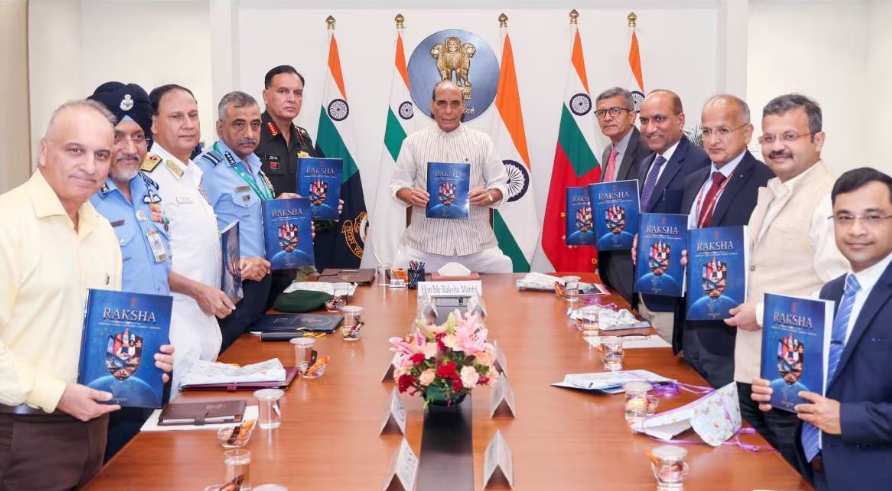
Context: India has unveiled ‘RAKSHA’, a 10-year strategic roadmap for global defence partnerships, aimed at aligning national security objectives with proactive global cooperation and long-term stability.
More on the News
• RAKSHA marks a shift towards proactive strategic engagement, reflecting the growing importance of defence diplomacy in India’s external relations.
• The government describes defence diplomacy as a core pillar of foreign policy, with RAKSHA providing a clear and actionable vision for the next decade.
India’s Evolving Defence Diplomacy
• From military exchanges to strategic partnerships: India’s defence diplomacy has expanded beyond traditional military-to-military engagements to sustained bilateral and multilateral security partnerships.
• From buyer to defence partner: Growing indigenous capabilities have enabled India to increasingly engage as a defence producer and exporter, alongside cooperation in defence technology and industry.
• From bilateral engagement to networked cooperation: Joint exercises, training, capacity building and information-sharing have become important instruments for strengthening security cooperation with partner countries.
• Defence diplomacy as strategic statecraft: Defence cooperation increasingly serves wider objectives of national security, strategic autonomy and diversification of international partnerships.
• Growing maritime dimension: India’s role in the Indian Ocean has expanded the maritime component of defence diplomacy, including regional security cooperation and its responsibilities as a Net Security Provider and First Responder.
About RAKSHA: India’s 10-Year Defence Diplomacy Roadmap
• RAKSHA provides a comprehensive and actionable framework for India’s global defence partnerships over the next decade.
• Its four pillars bring together strategic engagement, partner capacity enhancement, indigenous defence exports and India’s regional maritime-security role.
- Strategic Partnerships: Seeks to deepen bilateral and multilateral security cooperation, strengthening India’s long-term defence relationships with partner countries.
- Capacity Building: Focuses on enhancing the capabilities of friendly nations through joint military exercises, training programmes and sharing of best practices, thereby strengthening defence cooperation.
- Indigenous Exports: Promotes Make-in-India defence platforms with the objective of establishing India as a reliable global defence-manufacturing hub, linking indigenous defence capabilities with international partnerships.
- Maritime Security: Seeks to strengthen India’s role as a Net Security Provider and First Responder in the Indian Ocean Region, reinforcing its contribution to regional maritime security.
• Thus, RAKSHA integrates four complementary dimensions of defence diplomacy—partnership-building, capacity enhancement, defence-industrial outreach and maritime security—within a long-term strategic framework.
Strategic Significance of RAKSHA
• Institutionalising defence diplomacy: A 10-year framework can provide greater continuity and strategic direction to India’s expanding defence partnerships.
• Linking defence production with diplomacy: The explicit focus on indigenous exports gives India’s growing defence-manufacturing capabilities a greater role in international engagement.
• Strengthening regional security: The maritime-security pillar reinforces India’s contribution to security and stability in the Indian Ocean Region.
• Enhancing India’s global role: RAKSHA seeks to position India as an anchor of peace, stability and a rules-based order while pursuing mutually beneficial global partnerships.
Challenges in Translating RAKSHA into Outcomes
• Balancing diverse partnerships: India must deepen defence cooperation with different partners while preserving its strategic autonomy and avoiding excessive dependence on any single relationship.
• Converting exports into durable partnerships: The ambition of becoming a reliable defence-manufacturing hub will require Indian platforms to demonstrate sustained competitiveness, reliability and global acceptability.
• Matching maritime responsibilities with capabilities: A larger role as a Net Security Provider and First Responder requires adequate operational capabilities and sustained engagement across the IOR.
• Ensuring institutional coordination: Implementing a multidimensional defence-diplomacy framework requires effective coordination between the Ministry of Defence, Ministry of External Affairs, Armed Forces and defence industry.
Way Forward
• Pursue differentiated partnerships: Align defence cooperation with the strategic interests and requirements of individual partner countries while retaining strategic autonomy.
• Build credible defence-export ecosystems: Complement indigenous platforms with the institutional and support capabilities required to establish India as a dependable long-term defence partner.
• Strengthen maritime cooperation: Expand regional capacity building, exercises and cooperative mechanisms to translate India’s Net Security Provider and First Responder role into sustained regional capability.
• Adopt a whole-of-government approach: Ensure closer alignment of diplomatic objectives, military capabilities and defence-industrial capacity for effective implementation of RAKSHA.