
SYLLABUS
GS-2: India and its Neighborhood- Relations; Bilateral, regional and global groupings and agreements involving India and/or affecting India’s interests.
Context: The 1996 Ganga Water Sharing Treaty between India and Bangladesh, governing lean-season sharing of Ganga waters at Farakka, is set to expire on 12 December 2026 amid Bihar’s demand against its renewal in the existing form.
More on the News
• Bihar has urged the Centre to address its concerns before deciding the future of the treaty, particularly regarding water availability, flooding, siltation and developmental requirements.
• The Centre has assured Bihar that its concerns will be considered during the treaty-renewal process, bringing the State’s concerns into the Union-level negotiations with Bangladesh.
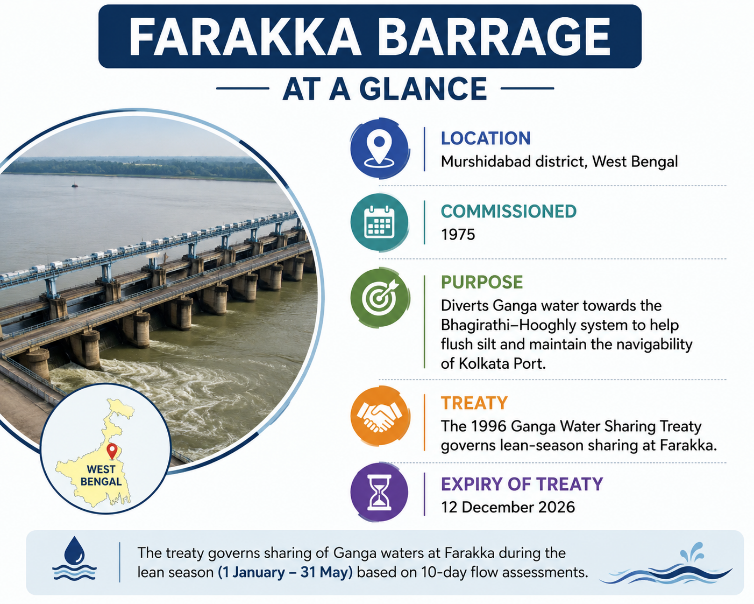
• The treaty, signed on 12 December 1996 for 30 years, provides for sharing Ganga waters at Farakka during the lean period from January 1 to May 31, based on successive 10-day flow measurements.
• The issue has acquired urgency as India and Bangladesh must decide whether to renew, modify or replace the existing framework before its expiry, while avoiding uncertainty in bilateral water cooperation.
Understanding the Ganga Water Sharing Treaty, 1996
• Background and Purpose
- Farakka Barrage: Commissioned in 1975 in West Bengal, it diverts Ganga water towards the Bhagirathi-Hooghly system to help flush silt and maintain the navigability of Kolkata Port.
- Bilateral Framework: The 1996 treaty established a long-term, formula-based framework for sharing Ganga waters between India and Bangladesh, replacing earlier short-term arrangements.
• Water-Sharing Mechanism
- Lean-Season Sharing: Ganga waters are shared at Farakka from January 1 to May 31 according to a flow-based formula, with allocations determined for successive 10-day periods.
- Low-Flow Situation: In situations of exceptionally low availability, the treaty provides for immediate consultations between the two governments to arrive at an agreed arrangement.
• Monitoring Mechanism
- Joint Committee: Implementation is monitored by a Joint Committee comprising representatives of India and Bangladesh, including joint observation of flows at designated sites.
• Expiry and Review
- 30-Year Term: Signed on 12 December 1996, the treaty expires on 12 December 2026, providing an opportunity to reassess the framework in light of changing hydrological and developmental conditions.
Why Does Bihar Want the Treaty Scrapped/Redrafted?
• Flooding and Siltation: Bihar argues that the Farakka system has contributed to sedimentation, altered river dynamics and flooding/erosion; however, the precise causal relationship remains contested.
• Lean-Season Water Needs: Bihar seeks greater consideration of its irrigation, drinking-water, agricultural and industrial requirements during periods of low river flow.
• Changing Future Requirements: The State wants any successor framework to consider changing water demand and projected requirements up to 2050, rather than relying on conditions prevailing in 1996.
• Limited State Role: Bihar was not a signatory to the bilateral treaty and has therefore sought greater consideration of its concerns in India’s negotiating position.
• Need for Fresh Assessment: Bihar seeks a reassessment based on updated hydrological and sedimentation data, alongside contemporary developmental and environmental requirements.
The Centre’s Dilemma: Bihar’s Interests vs India–Bangladesh Relations
• Federal–Diplomatic Tension: The treaty is negotiated by the Union Government with Bangladesh, while its consequences affect riparian States such as Bihar, creating a domestic–diplomatic balancing challenge.
• Bihar’s Water Concerns: Bihar seeks greater consideration of its irrigation, drinking-water, agricultural and flood-management needs; importantly, it has no separate allocation under the bilateral treaty.
• Bangladesh’s Water Interests: Bangladesh has a strong interest in predictable lean-season Ganga flows, making major changes to the existing arrangement diplomatically sensitive.
• Need for a Successor Framework: Allowing the treaty to lapse without an alternative could create uncertainty, while renegotiation offers an opportunity to incorporate updated hydrology, climate variability and the concerns of affected Indian States.
Way Forward
• Renegotiate, Don’t Simply Renew: Use the expiry as an opportunity to reassess lean-season flows and the water-sharing formula using updated hydrological evidence.
• Institutionalised State Consultation: Incorporate the concerns of Bihar and West Bengal into India’s negotiating preparations, as recommended by the Parliamentary Standing Committee.
• Adopt Basin-Level Management: Complement water allocation with coordinated management of sediment, floods, river morphology, irrigation and ecological needs across the Ganga basin.
• Integrate Climate and Future Demand: Account for changing hydrology, climate variability and long-term water requirements while designing the successor arrangement.
• Ensure Continuity Through Dialogue: Begin negotiations early to avoid a gap in the water-sharing framework after December 2026 while balancing Bihar’s concerns with Bangladesh’s dry-season requirements.