
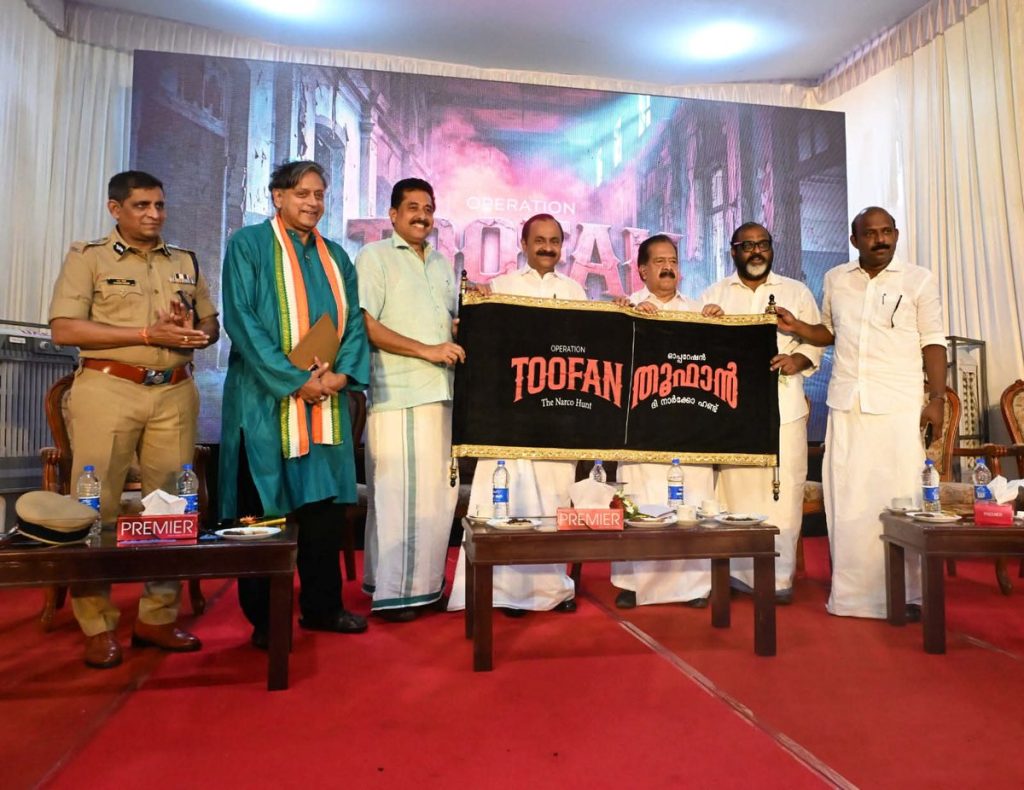
Context: The Narco Hunt is Kerala’s statewide anti-narcotics campaign, launched on 2 June 2026. It combines enforcement against drug-trafficking networks with citizen mobilisation and rehabilitation support, involving the Police, Excise, Education and Health Departments.
Performance So Far
- Within 76 days of its launch, the operation registered 10,213 cases, arrested 9,941 persons and seized narcotics valued at more than ₹100 crore, according to the State Home Minister. The seizures include MDMA, cannabis (ganja) and other synthetic drugs.
- The Minister also reported preliminary indications of a 30% reduction in overall crimes and a 40% decline in road accidents since the crackdown began.
Three-Pillar Strategy
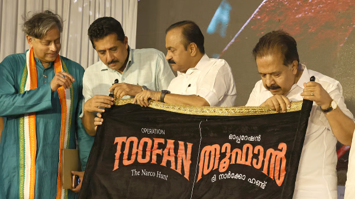
- Toofan Strike – Enforcement:
- Raids and intelligence-led action
- Arrests and seizures
- Disruption of dealers, distributors and trafficking networks
- Toofan Warriors – Social Mobilisation:
- Awareness among students and parents
- Engagement of community groups and public figures
- Public participation against substance abuse
- Toofan Care – Rehabilitation:
- Treatment and counselling
- Support for recovery
- Reintegration of people with substance dependence into society
- Around 40 private hospitals and de-addiction centres have reportedly been linked to the rehabilitation effort, with more than 150 persons admitted for treatment at the time of the Minister’s statement.
- Operation Toofan frames drug control as both an internal-security challenge and a public-health and social-protection responsibility.
Black Representation in U.S. Governorships
Context: Across roughly 250 years of U.S. history, only three Black Americans have been elected governor of a state: L. Douglas Wilder of Virginia, Deval Patrick of Massachusetts and Wes Moore of Maryland. All three were Democrats and men.
The Three Elected Governors
- L. Douglas Wilder of Virginia was the first Black American popularly elected as a U.S. state governor. He took office in 1990.
- Deval Patrick of Massachusetts became the second Black elected governor in U.S. history. He served as governor from 2007 to 2015.
- Wes Moore of Maryland became the state’s first Black governor and the third Black American elected governor in U.S. history. He assumed office in 2023.
- This count concerns those elected to governorships. A few Black political leaders, including P.B.S. Pinchback of Louisiana in 1872 and David Paterson of New York in 2008, served as governors after succeeding from the lieutenant-governorship but were not elected directly to that office.
Kosi–Mechi Link Project
Context: Bihar Chief Minister Samrat Choudhary inspected the under-construction Kosi–Mechi Intra-State River Link Project at Chainpur village, Chhatapur block, Supaul district, on 19 August 2026. He directed officials and the construction agency to ensure timely, high-quality completion of the project, which is scheduled for completion by March 2029.
Project Overview
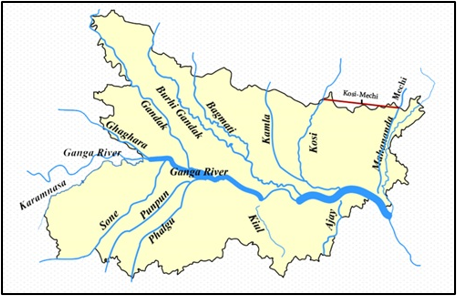
- The project seeks to divert surplus water from the Kosi river to the Mahananda basin through the Mechi river, by remodelling and extending the existing Eastern Kosi Main Canal (EKMC).
- The Cabinet Committee on Economic Affairs approved its inclusion under Pradhan Mantri Krishi Sinchayee Yojana–Accelerated Irrigation Benefits Programme (PMKSY-AIBP) on 28 March 2025.
Key Engineering Works
- Increase the carrying capacity of the Eastern Kosi Main Canal from 15,000 cusecs to 20,000 cusecs.
- Extend and remodel the canal system up to the Mechi river.
- Construct four branch canals, six distributaries and associated canal infrastructure.
- Release around 950 cusecs of water into the Mechi river at the terminal end.
Significance
- Assured irrigation: It can expand reliable irrigation in Seemanchal, helping farmers shift toward higher-value crops, horticulture and multiple cropping.
- Flood-water utilisation: It seeks to use surplus monsoon flows of the flood-prone Kosi productively rather than allowing them to remain unutilised.
- Drought mitigation: Better canal-based irrigation could reduce dependence on erratic rainfall and groundwater in water-stressed parts of north-eastern Bihar.
Buxar–Bhagalpur Greenfield Expressway
Context: The Bihar Cabinet, chaired by Chief Minister Samrat Choudhary, has given in-principle approval for a 336-km, six-lane, fully access-controlled greenfield expressway between Buxar and Bhagalpur. Approved on 19 August 2026, the project will be developed through the Public–Private Partnership (PPP) route by the Bihar State Road Development Corporation Ltd. (BSRDCL).
Project Features
- Corridor: Buxar–Bhagalpur
- Length: 336 km
- Configuration: Six-lane, greenfield, fully access-controlled expressway
- Delivery model: PPP under DBFOT (Design, Build, Finance, Operate and Transfer)–Toll
- Implementing agency: Bihar State Road Development Corporation Ltd. (BSRDCL)
- Approval status: In-principle approval by the Bihar Cabinet
- A greenfield expressway is built on a new alignment, rather than by widening an existing road. A fully access-controlled expressway permits entry and exit only through specified points, improving speed, safety and traffic flow.
Districts Covered
- The proposed corridor is expected to benefit 13 districts of Bihar: Buxar, Bhojpur, Arwal, Jehanabad, Gaya, Nalanda, Sheikhpura, Munger, Lakhisarai, Nawada, Jamui, Banka and Bhagalpur.
Significance
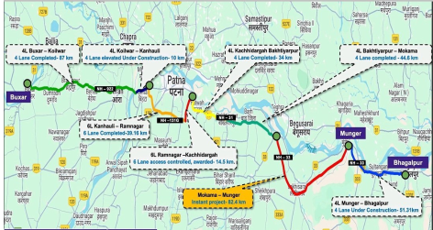
- East–west connectivity: It will create a high-speed corridor from western Bihar to the Bhagalpur–Banka region in eastern Bihar.
- Reduced travel time: A journey currently reported to take about 10–12 hours could be reduced to about 4–5 hours, subject to final alignment and operational conditions.
- Industrial and logistics gains: Faster movement can support agriculture, food processing, warehousing, manufacturing and freight connectivity.
- Regional integration: The corridor can connect relatively less-developed districts with larger markets and economic centres.