
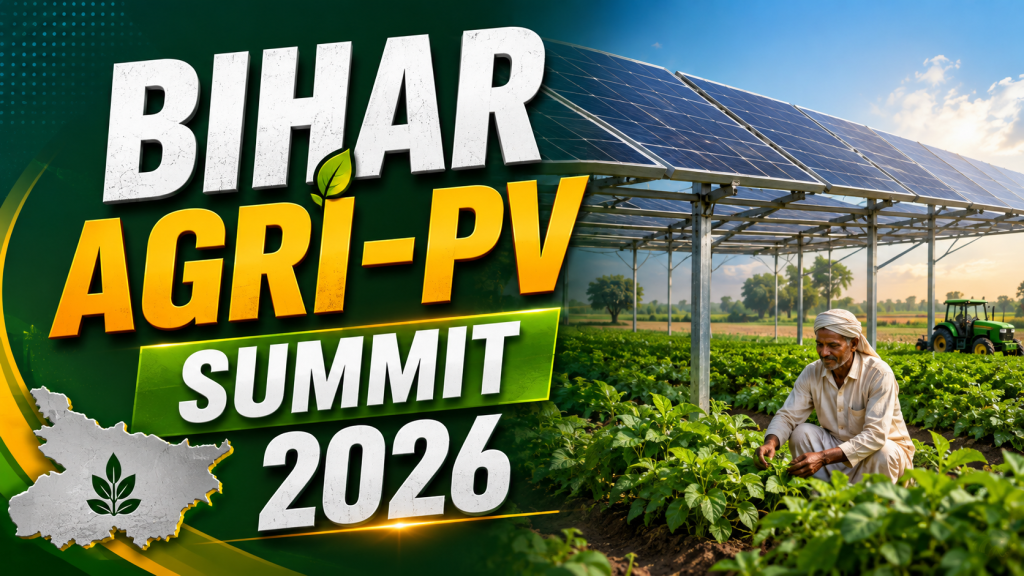
Context: The Bihar Agri-PV Summit 2026 was held in Patna on 18 August 2026. The summit brought together government officials, renewable-energy experts, agricultural stakeholders, private-sector representatives and financial institutions to explore agrivoltaic farming as a farmer-centric clean-energy model for Bihar.
About Agri-PV
● Agrivoltaics, or Agri-Photovoltaics (Agri-PV), is the co-location of solar panels and agricultural activity on the same land.
● Solar modules are mounted at an appropriate height and spacing. Crops can be cultivated beneath, around or between panels.
● The design must balance sunlight available to crops, ease of farm operations, irrigation access and electricity generation.
● Suitable crops may include shade-tolerant vegetables, fodder, spices, flowers and certain horticultural crops; crop suitability is location- and design-specific.
● Bihar is predominantly agrarian, but has limited land available for exclusive solar parks. Hence, Agri-PV can reduce the land-use conflict between food production and renewable-energy expansion.
● Bihar’s Renewable Energy Policy, 2025 includes agrivoltaics among the renewable-energy technologies within its scope. It envisages cumulative renewable-energy capacity of 23,968 MW and energy storage of 6,100 MWh by FY 2029–30.
Potential Benefits
● Farmers’ income: Lease rent, electricity sales or revenue sharing, while continuing crop production.
● Land efficiency: Produces food and electricity from the same land area.
● Climate resilience: Partial shade can reduce heat stress and evapotranspiration for suitable crops.
● Irrigation: Solar power can operate agricultural pumps and support efficient irrigation.
● Energy transition: Promotes decentralised, locally generated renewable electricity.
Policy Linkages — PM-KUSUM
● PM-KUSUM can support the adoption of Agri-PV/solarisation in agriculture.
● The scheme targets 34,800 MW of solar capacity.
● It covers:
- Decentralised grid-connected renewable power plants.
- Standalone solar agricultural pumps.
- Solarisation of grid-connected agricultural pumps.
Bihar Approves 14 Sugar-Mill Projects
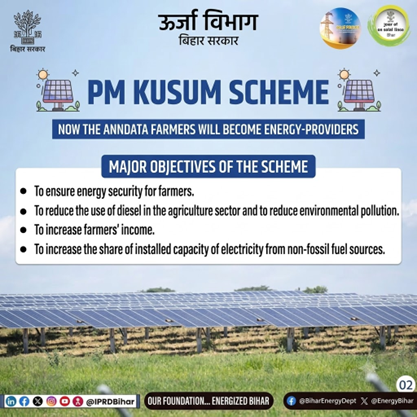
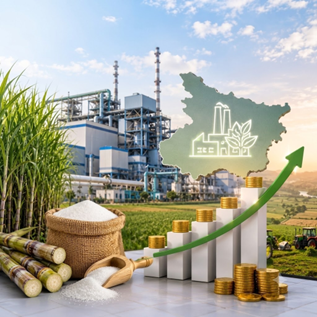
Context: The Bihar government has approved investment proposals worth ₹3,605.92 crore for establishing 14 new sugar-industry projects across the State.
Key Details
● The approved projects are expected to generate an estimated 16,500 direct and indirect jobs.
● It has received clearance either from the State Cabinet or the State Investment Promotion Board (SIPB).
● Investments are proposed across districts including Madhubani, East Champaran, Muzaffarpur, Saran, Gopalganj, West Champaran, Supaul and Rohtas.
● Typical projects combine:
- A sugar mill with crushing capacity measured in TCD—tonnes of cane per day;
- An ethanol distillery, measured in KLPD—kilolitres per day;
- A cogeneration plant producing electricity from bagasse; and
- In selected cases, CBG facilities using sugar-industry waste.
Policy Context
● The investments align with the Bihar Sugar Industry Investment Promotion Policy, 2026. The policy provides incentives for integrated sugar complexes and supports distilleries, ethanol units, cogeneration projects and CBG plants. It also aims to revive closed mills and establish 25 new sugar mills under Saat Nischay-3.
● Key incentives include up to 40 acres of government land on lease at a token Re. 1 for 30 years, reimbursement of registration and stamp duty on land purchase, reimbursement of State GST on sugar production for five years, and financial support for new mills and capacity expansion.
H1N1 Cases Rising
Context: Several States are reporting a rise in H1N1, or swine-flu, cases amid a broader increase in influenza-like illness, viral fever and respiratory infections.
About H1N1
● H1N1 is a subtype of influenza A virus. It spreads mainly through respiratory droplets and close contact, and may cause:
- Sudden fever or chills
- Cough and sore throat
- Runny or blocked nose
- Headache, body ache and fatigue
- Occasionally vomiting or diarrhoea
● Routine H1N1 testing is not necessary for every person with fever and cough. Under India’s clinical guidance, treatment and testing are prioritised based on symptom severity and risk factors.
● People at higher risk of severe illness or complications include:
- Children below five years, especially below two years
- Adults aged 65 years or above
- Pregnant women and women up to two weeks after delivery
- People with asthma or chronic heart, lung, kidney, liver or neurological disease
- Persons with diabetes, blood disorders or severe obesity
- Immunocompromised persons, including those on long-term steroids or post-transplant treatment.
● High-risk persons and those with severe symptoms should contact a doctor early. Antiviral treatment such as oseltamivir should be prescribed by a clinician; NCDC guidance recommends it for Category B and C cases, and it works best when started early where indicated.

India’s Sixth Defence Indigenisation List
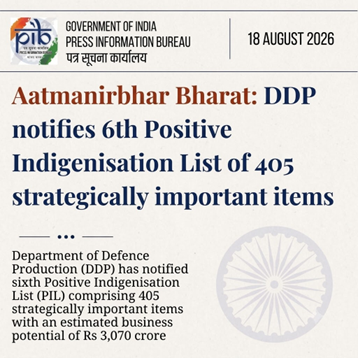
Context: On 18 August 2026, the Department of Defence Production (DDP), Ministry of Defence, notified the sixth Positive Indigenisation List (PIL) comprising 405 strategically important defence items, with an estimated business potential of ₹3,070 crore.
What Does the List Cover?
● The list includes:
- 389 items linked to Defence Public Sector Undertakings (DPSUs).
- 16 items related to the Indian Coast Guard.
- Line Replaceable Units (LRUs), subsystems, subassemblies, spares, components and raw materials.
● It spans a wide range of platforms and systems:
- Air Platforms: Advanced Light Helicopter (ALH), Light Utility Helicopter (LUH), Su-30MKI, Light Combat Aircraft (LCA) and AL-31FP engine.
- Land Platforms: T-72, T-90 and BMP-II armoured platforms.
- Naval Systems: Warships and associated components.
- Missiles: Konkurs-M, Invar and Medium Range Surface-to-Air Missile (MRSAM) systems.
- Defence Electronics: Radars, sonars, fire-control systems and satellite-communication systems.
- Munitions: High-Explosive Anti-Tank (HEAT) ammunition and other critical equipment.
● The detailed list is available on the SRIJAN Defence Portal, and every item carries an indicative deadline for indigenisation.
About Positive Indigenisation List
● A PIL identifies defence equipment, systems, components or materials that will be progressively developed and manufactured within India. After the stipulated timeline, the concerned item is to be procured from domestic industry rather than imported.
● The Ministry of Defence introduced PILs in 2021 under the Aatmanirbhar Bharat initiative to reduce import dependence, create assured demand for Indian firms and develop domestic defence supply chains.
● By May 2026, five DPSU PILs covering 5,012 items had been notified. In the preceding five years, more than 15,700 defence items—including 3,204 PIL items—were indigenised through the SRIJAN Portal, with DPSUs placing domestic orders worth ₹9,782 crore.