
SYLLABUS
GS-3: Science and Technology- developments and their applications and effects in everyday life.
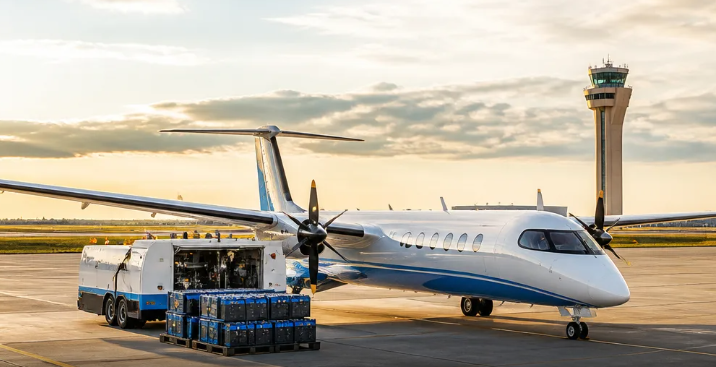
Context: The world’s largest battery-electric aircraft, Heart Aerospace’s X1, has completed its maiden flight, demonstrating the potential of fully electric propulsion at the scale of a commercial aircraft.
About Heart Aerospace’s Battery-Powered X1
- Heart Aerospace’s X1 demonstrator aircraft completed its first flight, from Plattsburgh International Airport in upstate New York.
- The 27-minute piloted flight reached an altitude of 1,100 feet (335 metres) and was powered entirely by batteries.
- With a 106-foot (32-metre) wingspan, 76-foot (23-metre) length and take-off weight exceeding 25,000 pounds (11.3 tonnes), the X1 is the largest battery-electric aircraft ever flown.
- Its all-electric propulsion system delivered more than 1 megawatt of power during the flight.
- The X1 is a full-scale demonstrator representative of Heart’s ES-30 production aircraft, designed to validate key technologies, aerodynamics and flight performance.
- The ES-30 is a conventional fixed-wing, 30-seat hybrid-electric regional airliner, targeted to enter service by 2031.
India’s Electric Aviation Landscape
- India has initiated the development of Electric Hansa (E-Hansa), a next-generation two-seater electric trainer aircraft.
- It is being indigenously developed by CSIR–National Aerospace Laboratories (NAL), Bengaluru.
- The E-Hansa is part of the larger HANSA-3 (NG) trainer aircraft programme, designed to be a cost-effective and indigenous option for pilot training in India.
- The aircraft marks a key step toward India’s green aviation goals and the use of green or clean energy in running aircraft.
- The development is also linked with the broader push for technology commercialisation, public-private partnerships and indigenous research.
Significance of Electric Aviation Sector
- Cleaner aviation: Electric aircraft are being developed to enable efficient, low-noise and zero-emissions air travel, helping reduce the environmental footprint of conventional aviation.
- Lower operating costs: Electric propulsion has the potential to reduce energy and maintenance costs, while Heart expects the ES-30 to reduce operating costs by more than 40% compared with legacy regional aircraft.
- Reduced fuel dependence: Electric propulsion can potentially reduce airlines’ dependence on conventional aviation fuel and exposure to global oil-price volatility.
- Regional connectivity: Battery-electric and hybrid-electric aircraft are particularly relevant for short-haul and regional aviation, where current battery limitations are less restrictive.
- Technological advancement: Electric aviation is driving development in batteries, electric motors, power electronics, charging systems and aircraft design.
Challenges/Hurdles
- Low battery energy density: Battery energy density remains the biggest limitation, restricting the size and range of fully electric aircraft.
- Battery weight: Unlike conventional aircraft fuel, batteries remain at roughly the same weight throughout the flight, creating a major weight penalty.
- Limited range: Fully battery-electric aircraft are currently most suitable for short-haul missions, while longer routes require hybrid or other propulsion systems.
- Charging infrastructure: Electric aircraft require high-power charging infrastructure at airports, with options including plug-in charging, battery swapping and mobile charging.
- Safety and thermal management: Battery safety, thermal management, high-voltage systems and electrical insulation require significant technological development and stringent aviation safety standards.
Way Forward
- Advance battery technology: Develop batteries with higher specific energy, lower weight, longer cycle life and improved safety to overcome the present range limitations.
- Promote hybrid-electric aircraft: Hybrid-electric aircraft may offer a more realistic near-term pathway by combining batteries with a combustion engine to extend range.
- Develop charging infrastructure: Airports need to develop high-power charging infrastructure and suitable electricity systems to support electric aircraft.
- Improve propulsion technologies: Advances in electric motors, power electronics, distributed electric propulsion and aerodynamic integration can improve aircraft efficiency and reduce required battery capacity.
- Follow a phased approach: Battery-electric aircraft can serve short-haul missions, hybrid-electric aircraft can serve somewhat longer regional routes, while advanced battery or hydrogen fuel-cell technologies may support longer-range flights in the future.