

SYLLABUS
GS-3: Achievements of Indians in science & technology; indigenization of technology and developing new technology; Awareness in the fields of Space.
Context: Bengaluru-based space-tech startup Astrobase Space Technologies, unveiled EVEREST, India’s first privately developed 800 kN Full-Flow Staged Combustion (FFSC) LOX-Methane rocket engine.
More on the News
- The unveiling makes India the fourth nation after Russia, the United States and China to develop FFSC engine technology, while Astrobase claims to be the fourth commercial company globally to develop a high-thrust FFSC engine.
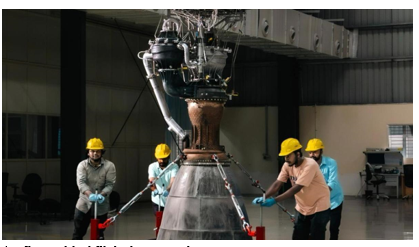
- EVEREST is yet to undergo its full-engine hot-fire test, with the campaign planned to begin in the coming months, while the company is targeting the first orbital flight in December 2028.
- The development of the engine started in 2024, its subsystems have so far been tested, and fully integrated testing including the engine hot-fire campaign is planned at its test facility Anantapur in Andhra Pradesh.
- The company plans to manufacture and test around 20 engines before its first orbital flight and has been selected under the Indian National Space Promotion and Authorization Centre’s (IN-SPACe) Technology Adoption Fund (TAF) for the development of this FFSC rocket engine.
About the FFSC Rocket Engine
- Full-Flow Staged Combustion (FFSC) is one of the most advanced and technically demanding liquid rocket engine architectures.
- In an FFSC engine, both the fuel and the oxidiser are fully gasified through separate pre-burners before entering the main combustion chamber.
- Unlike conventional rocket engines, where only a portion of the propellants is used to drive the turbopumps, an FFSC engine routes both the fuel and the oxidiser through separate pre-burners before they enter the main combustion chamber.
- The gases generated are not left to the atmosphere but put back into the rocket combustion chamber ensuring that the propellant is utilised and not wasted.
- This allows the turbopumps to operate more efficiently while ensuring that all of the propellants ultimately contribute to generating thrust.
- It is designed for reusable medium-lift launch vehicles, supporting precision control, faster turnaround and improved launch economics.
- Key Features
- Propellants: Liquid Oxygen (LOX) and methane.
- Thrust: 800 kN.
- Specific Impulse: 340 seconds.
- Throttle Range: 50%–110%.
- Indigenous Development: More than 70% of the engine is indigenously developed and manufactured in India.
- Manufacturing: Astrobase currently has a capacity to build 6–8 engines per annum, which will be scaled up to up to 50 engines annually.
- First Flight: The first orbital flight is targeted for December 2028.
Significance of FFSC Rocket Engine
- Advanced Indigenous Propulsion: FFSC engines are highly challenging and efficient, with Astrobase claiming to be the fourth commercial company globally to develop a high-thrust FFSC engine, after SpaceX’s Raptor.
- Reusable Launch Vehicles: FFSC offers high efficiency, precise throttle control and reusability, while LOX-Methane enables cleaner combustion and faster turnaround.
- Higher Launch Capability: EVEREST enables up to 30-tonne reusable launch capability to Low Earth Orbit (LEO) for commercial and strategic missions.
- Launch Infrastructure: Astrobase is building an integrated launch chain and targets 100 tonnes annual capacity in Phase 1 and over 1,000 tonnes in Phase 2.
- Space Economy: Indigenous propulsion and scalable launch infrastructure can strengthen India’s global space-economy position and reduce dependence on foreign technologies.