
SYLLABUS
GS-2: Issues relating to development and management of Social Sector/Services relating to Human Resources; Welfare schemes for vulnerable sections of the population by the Centre and States.
Context: NITI Aayog has released the report titled “Reimagining Care: Strategies for Empowering Caregivers in Viksit Bharat@2047”, presenting a comprehensive roadmap for building an organised, professional, accessible and future-ready caregiving ecosystem in India.
Key Findings of the Report
Need for Strengthening the Caregiving Ecosystem:
- Caregiving is emerging as a priority sector for India’s transition towards Viksit Bharat@2047, critical for both social well-being and economic development.
- The report positions caregivers at the centre of the care ecosystem, recognising caregiving as a skilled, dignified and valued profession.
- It emphasises quality of care, professional recognition, workforce welfare, institutional support, and enabling families and communities to access reliable and affordable care.
- India’s growing elderly population, changing family structures, rising disability prevalence and increasing long-term care needs require a more organised, professional and coordinated system of care.
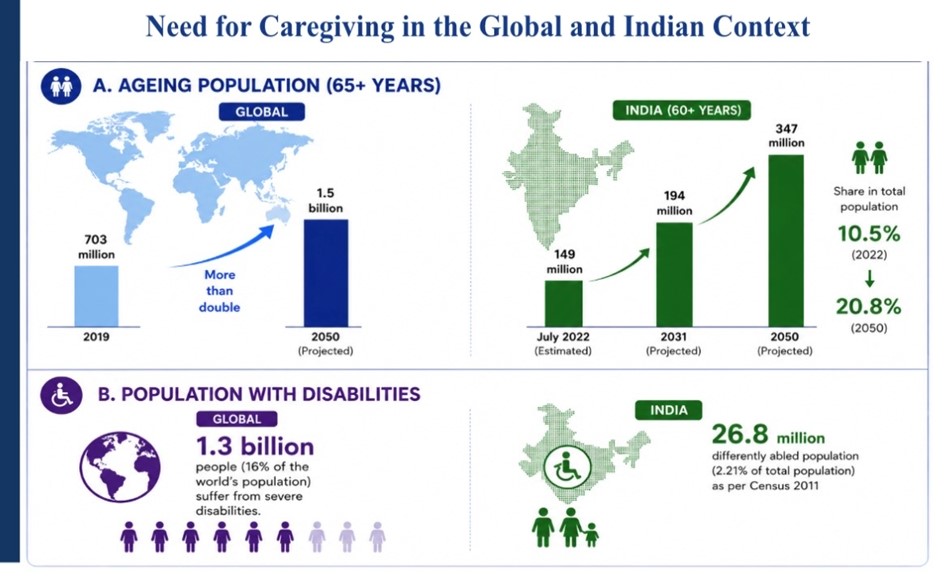
- According to the India Ageing Report 2023:
- Elderly population (60 years and above) was 149 million (10.5% of the population) in 2022.
- It is projected to increase to 194 million by 2031 and 347 million (20.8% of the population) by 2050.
- As per Census 2011, India has 26.8 million Persons with Disabilities (PwDs), further increasing demand for caregiving services.
- Around 10% of India’s population are family caregivers, according to the International Alliance of Carer Organisations.
Opportunities in the Care Economy:
- India is uniquely positioned to capitalise on its demographic dividend and expand its care network and skilled workforce.
- The report highlights the potential to:
- Meet growing domestic care needs.
- Create skilled employment opportunities.
- Increase women’s economic participation.
- Position India as a global hub for skilled caregiving professionals.
- WHO estimates a global shortage of nearly 11 million health workers by 2030, highlighting growing international demand for trained caregivers.
- India’s care services market was valued at USD 29.62 billion in 2023 and is expanding at a 13.76% CAGR, representing a high-potential engine for formal job creation, enhanced female labour force participation and sustainable economic growth.
- Women spend 299 minutes per day on unpaid domestic and caregiving services compared to 97 minutes by men, highlighting the need for recognition and formalisation of care work.
Recommendations
- Policy & Institutional Framework: Establish a National Policy on Caregiving and a National Caregiver Council (NCC) for institutional leadership and coordination.
- Workforce Development: Develop a National Caregiving Qualification Framework to standardise education, training, accreditation and certification.
- Create a dedicated caregiver cadre with professional recognition, structured career progression and specialised training.
- Caregiver Support: Expand social security and welfare measures for caregivers.
- Strengthen family and community-based caregiving and Recognition of Prior Learning (RPL) for informal caregivers.
- Technology & Service Delivery: Create a National Caregiver Registry and digital platform for workforce planning and service delivery.
- Promote technology-enabled caregiving services and a National Digital Caregiving Portal connecting caregivers with care seekers.
- Global Collaboration: Encourage innovation and cross-learning across States.
- Strengthen international partnerships and overseas placement mechanisms to prepare a globally competitive caregiving workforce.