

SYLLABUS
GS-2: Indian Constitution—Amendments, Significant Provisions and Basic Structure; Structure, Organization and Functioning of the Judiciary; Appointment to various Constitutional Posts, Powers, Functions and Responsibilities of various Constitutional Bodies.
Context: The Lok Sabha has passed the Supreme Court (Number of Judges) Amendment Bill, 2026, increasing the sanctioned strength of the Supreme Court from 34 to 38 judges, including the Chief Justice of India.
More on the News
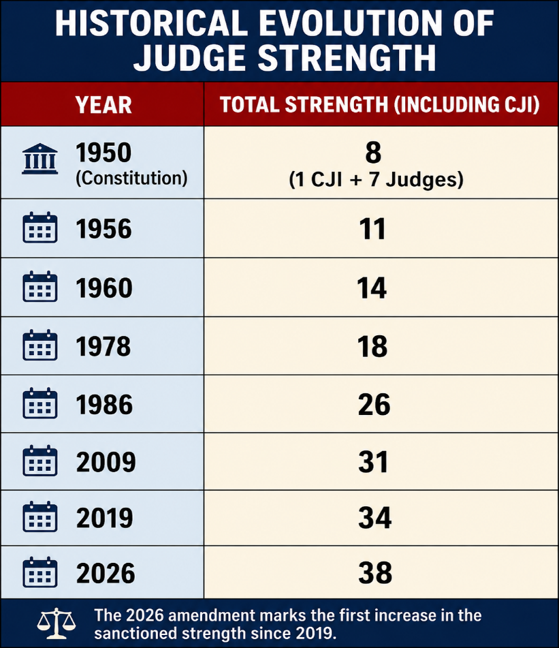
- The Bill replaces the Supreme Court (Number of Judges) Amendment Ordinance, 2026, promulgated by the President in May 2026, after the Union Cabinet approved the proposal on 5 May 2026.
- It amends the Supreme Court (Number of Judges) Act, 1956 by increasing the number of judges from 33 to 37 (excluding the Chief Justice of India), thereby raising the total sanctioned strength to 38 judges.
- The Government stated that the increase in judicial strength is aimed at addressing the growing backlog of cases, improving docket management, and enabling faster disposal of matters, particularly Constitution Bench cases.
Constitutional and Legal Framework
- Article 124 of the Constitution establishes the Supreme Court of India.
- Article 124(1) provides that the Supreme Court shall consist of the Chief Justice of India and such number of other judges as Parliament may prescribe by law.
- Therefore, no Constitutional Amendment is required to alter the strength of Supreme Court judges; Parliament can do so through an ordinary law passed by a simple majority.
- Parliament enacted the Supreme Court (Number of Judges) Act, 1956 to prescribe the maximum sanctioned strength of the Supreme Court.
- The Supreme Court (Number of Judges) Amendment Bill, 2026 amends Section 2 of the Act by substituting “33″ with “37“, thereby increasing the number of judges excluding the Chief Justice of India.
Rationale Behind the Increase
- Rising Pendency of Cases: 92,101 cases were pending before the Supreme Court. The Court has experienced a persistent gap between the institution of new cases and their disposal.
- Growing Litigation: During 2025, the Supreme Court received 75,410 fresh cases but disposed of only 65,615 cases, resulting in a continued increase in pending matters.
- Improving Docket Management: A larger judicial strength is expected to improve the Court’s ability to manage its growing docket, particularly long-pending matters.
- Constitution Bench Requirements: Many constitutional and nationally significant cases require Benches of five or more judges. Increasing the number of judges would facilitate the constitution of more Constitution Benches without affecting regular judicial work.
- Strengthening Judicial Capacity: The Government considers increasing the sanctioned strength as one of the most immediate and practical measures to enhance judicial efficiency and ensure timely justice.
Significance / Implications of the Move
- Reduction in Case Backlog: Additional judges are expected to accelerate the disposal of pending cases and reduce delays in the justice delivery system.
- Timely Access to Justice: Faster adjudication will strengthen citizens’ access to speedy justice, an essential component of the rule of law.
- More Effective Constitution Benches: The enhanced strength will enable the Supreme Court to constitute more Constitution Benches while maintaining the disposal of routine cases.
- Improved Judicial Efficiency: Greater judicial capacity is likely to improve overall docket management and reduce the gap between new filings and case disposal.
- Strengthening the Justice Delivery System: The amendment reinforces institutional capacity without requiring constitutional changes and supports a more responsive and efficient judiciary.