
SYLLABUS
GS-3: Conservation, environmental pollution and degradation, environmental impact assessment.
Context: India ranked 176th out of 177 countries in the recently released Environmental Performance Index (EPI) 2026, remaining among the world’s lowest-performing nations on environmental sustainability.
Global Key Findings of the Index
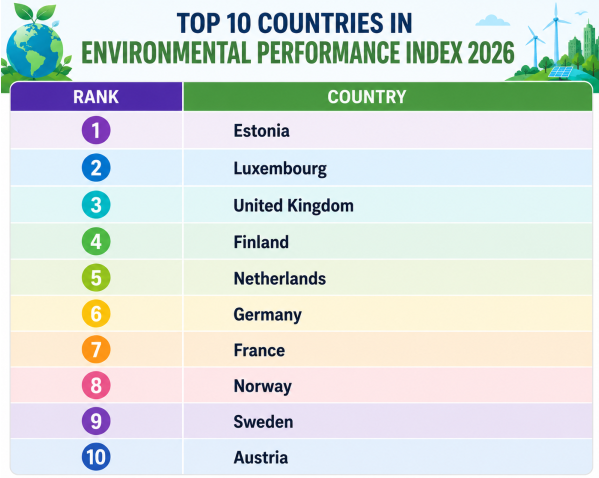
• Estonia topped the Environmental Performance Index 2026 with a score of 74.79, followed by Luxembourg (2nd), the United Kingdom (3rd), Finland (4th), and the Netherlands (5th).
• Germany, France, Norway, Sweden, and Austria completed the top 10 rankings.
• Five European countries occupied the top five positions, highlighting strong environmental governance and sustainability performance.
• Laos ranked 177th with an overall score of 21.78.
• The report found that EPI scores are strongly correlated with national income (correlation coefficient: 0.69), although countries with similar income levels often display significant differences in environmental performance, indicating that policy choices remain important.
• The Index highlights global sustainability challenges related to air quality, biodiversity conservation, climate change, sustainable forestry, water quality, and greenhouse gas reduction, while identifying policy leaders and laggards.
India’s Key Findings of the Index
• Overall Performance: India ranked 176th out of 177 countries, making it the second-lowest performer globally, with an overall EPI score of 22.46, compared to the regional average of 31.81.
- In South Asia, India ranked 7th among 8 countries.
• Sector-wise Performance: India performed poorly in Environmental Health, particularly air quality, and in Biodiversity, ranking 174th in both categories.
- The country recorded a tree cover loss score of -3.92 in Key Biodiversity Areas.
- India performed comparatively better in Climate Change (130th) and Waste Management as well as Sanitation (141st each).
- Climate Change is one of the most improved sectors with a 13.98-point rise over the last ten years.
• Factors Behind India’s Low Ranking: The report stated that India’s per-capita emissions remain relatively low but are growing rapidly.
- India faces an acute development-versus-pollution tension.
- Hundreds of millions of people are gaining access to modern energy services, but this has been accompanied by severe urban air pollution and rising greenhouse gas emissions.
- India’s performance has declined in air quality, fishery, tree cover, and pesticide pollution over the last decade.
- In air quality, India slipped 0.15 points during the last decade, despite spending ₹16,423 crore under the National Clean Air Programme (NCAP).
• Ranking Trend & Government’s Response: India’s ranking declined from 141st (2016) to 177th (2018), 168th (2020), 180th (2022), and 176th in both 2024 and 2026.
- In 2022, when India ranked 180th out of 180 countries, the Ministry of Environment, Forest and Climate Change (MoEFCC) rejected the rankings, stating that the Index has many indicators based on unfounded assumptions and that some indicators are extrapolated and based on surmises and unscientific methods.
- Responding to these allegations, the Yale researchers stated that the EPI ranks countries based on current environmental performance, not policy intentions, and that India’s low score reflects poor performance across air quality, water quality, agriculture, fisheries, and other environmental issues.
About the Environmental Performance Index (EPI) 2026
• The EPI is a biennial, data-driven global benchmark developed by the Yale Center for Environmental Law & Policy, the Center for International Earth Science Information Network (CIESIN), Columbia University, and the Yale Center for Geospatial Solutions, with support from the McCall MacBain Foundation.
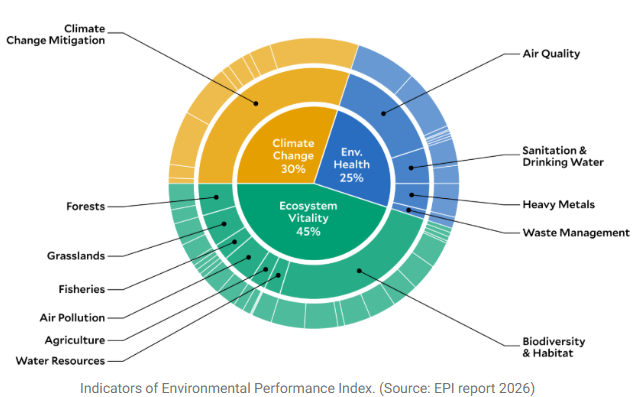
• The 2026 EPI evaluates 177 countries using 47 indicators across 12 issue categories under three policy objectives—Environmental Health, Ecosystem Vitality, and Climate Change.
• The indicators assess national performance across air and water quality, biodiversity, sustainable forestry, fisheries, waste management, sanitation, pesticide pollution, tree cover, and greenhouse gas emissions.
• The Index provides policymakers with an objective scorecard to track sustainability progress, identify ecological vulnerabilities, refine environmental policies, and measure progress towards the United Nations Sustainable Development Goals (SDGs) and the Paris Climate Agreement.