
SYLLABUS
GS-3: Awareness in the fields of Space; Achievements of Indians in science & technology; indigenization of technology and developing new technology.
Context: India’s private SpaceTech ecosystem has entered a new growth phase, with funding reaching a record $200 million in 2025, driven by regulatory reforms, successful private orbital launches, and rising global investor confidence.
Key Findings of the Tracxn Report
- According to Tracxn’s “Space Tech in India” report, India’s private SpaceTech ecosystem has raised about $871 million across 241 funding rounds (as of July 2026).
- The ecosystem currently comprises 285 companies, of which 274 are active, while 72 startups have received institutional equity funding.
- Funding increased from $43 million in 2021 to a record $200 million in 2025; startups have already raised $113 million across 24 rounds in 2026 (YTD).
- Seed-stage funding rose sharply from $7 million (2022) to $62 million (2025), while late-stage funding emerged for the first time, reaching $17 million in 2025 and $53 million in 2026 (YTD).
- The top 10 funded companies have collectively raised over $548 million, accounting for more than 60% of total funding.
- Skyroot Aerospace became India’s first SpaceTech unicorn, raising $150 million, followed by Pixxel ($96 million), AgniKul Cosmos ($76 million), Digantara ($67 million) and Bellatrix Aerospace ($34 million).
- Bengaluru leads the ecosystem with $495 million (57% of total funding) across 106 funding rounds, followed by Hyderabad ($205 million) and Chennai ($80 million).
India’s SpaceTech Ecosystem
- Rapid Expansion of Private Space Sector: Following the 2020 space sector reforms, private startups are now active across launch vehicles, satellite platforms, propulsion systems, earth observation, communications, downstream analytics and space situational awareness, reflecting diversification across the entire space value chain.
- The number of space startups has grown from 1 in 2014 to over 400 (February 2026).
- Major Commercial Milestone: On 18 July 2026, Skyroot Aerospace’s Vikram-1 became India’s first privately developed orbital-class rocket to successfully place payloads into a 450-km Low Earth Orbit.
- Making India the third country after the United States and China to achieve a privately developed orbital launch capability.
- Growing Commercial Space Economy: India’s space economy is currently valued at around $8 billion (about 2–3% of the global space economy) and is targeted to grow to $40–45 billion with an 8% global market share by 2030.
- Growth is being driven by NewSpace India Limited (NSIL), IN-SPACe, and ISRO’s technology transfer framework, which have accelerated commercialisation, technology transfer, private participation, and access to advanced technologies, testing facilities, and mission expertise.
- Emerging Investment Trends: Funding is increasingly flowing towards startups with demonstrated technological execution, while investment remains concentrated among a few high-performing companies, indicating a maturing ecosystem and likely industry consolidation.
Government Initiatives Driving Growth
- Space Sector Reforms (2020): Opened the entire space value chain to private participation, enabling startups to access launch infrastructure, satellite development and downstream applications.
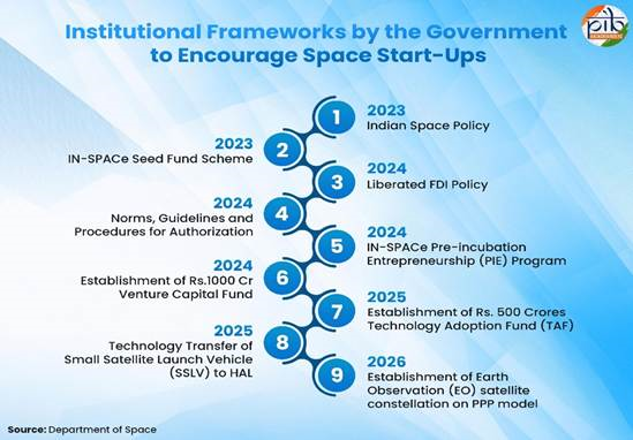
- Indian Space Policy, 2023: Defined the institutional roles of ISRO, IN-SPACe and NSIL, while promoting commercialisation, technology transfer and greater industry participation.
- Indian National Space Promotion and Authorisation Centre (IN-SPACe): Functions as the single-window regulator and promoter for private space activities, has facilitated 71 ISRO technology transfers to industry and startups.
- Itintroduced the Norms, Guidelines and Procedures (NGP), 2024 to simplify authorisation and improve investor confidence.
- Technology Adoption Fund (TAF): Supports startups in commercialising early-stage space technologies by upgrading technologies from TRL-3/4 to TRL-7/8 or higher, while promoting innovation, import substitution, indigenous capability and Aatmanirbhar Bharat.
- Foreign Direct Investment (FDI) Liberalisation (2024): Permits up to 100% FDI in selected space activities, including 74% under the automatic route for satellite manufacturing and operations, 49% for launch vehicles and spaceports, and 100% for manufacturing satellite components and subsystems.
- Financial and Startup Support: The Government has established a ₹1,000 crore Venture Capital Fund, a ₹500 crore Technology Adoption Fund, and the IN-SPACe Seed Fund Scheme and Pre-incubation Entrepreneurship Programme to strengthen private investment and support early-stage startups.
- Karnataka’s Centre of Excellence for Space Technology: Karnataka launched India’s first State-led Centre of Excellence for Space Technology (CoE SpaceTech Foundation) in Bengaluru through the Karnataka Innovation and Technology Society in collaboration with SIA-India.