
SYLLABUS
GS-3: Infrastructure: Energy, Ports, Roads, Airports, Railways, etc.; Changes in Industrial Policy and their Effects on Industrial Growth.
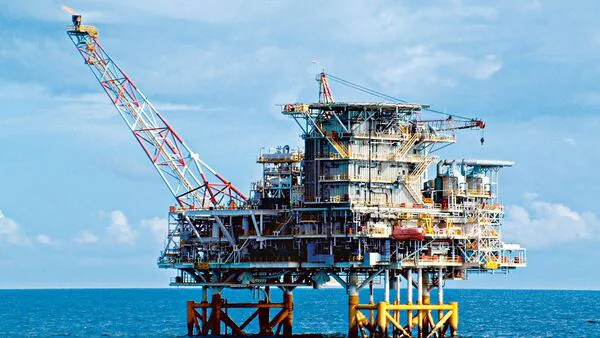
Context: The Oil and Natural Gas Corporation (ONGC) has commenced spudding of the first appraisal well (MN-DWN18-1-HD) in the Mahanadi Offshore Basin under Mission Samudra Manthan, marking a major milestone in India’s deepwater hydrocarbon exploration programme.
More on the News
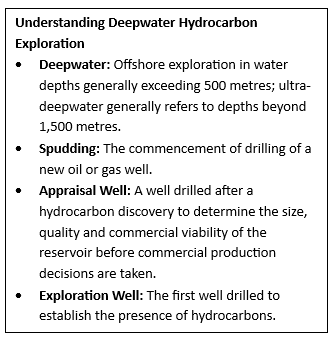
- The appraisal well is being drilled in the MN-DWN-2018/1 block, off the Odisha coast, to assess the size, quality and commercial viability of hydrocarbon discoveries in one of India’s most prospective offshore basins.
- It is the first of four planned deepwater appraisal wells that will systematically evaluate the hydrocarbon potential of the Mahanadi Offshore Basin using advanced deepwater drilling technologies.
- The initiative represents a major step in India’s broader strategy to enhance domestic oil and gas production, reduce import dependence and advance the vision of energy self-reliance (Atmanirbharta).
Understanding India’s Hydrocarbon Exploration Framework
- Mission Samudra Manthan
- About: Mission Samudra Manthan is India’s national initiative to accelerate exploration of deepwater and ultra-deepwater hydrocarbon resources in frontier offshore sedimentary basins.
- Objectives: It aims to enhance reserve accretion, increase domestic oil and gas production, unlock offshore hydrocarbon potential and strengthen India’s long-term energy security.
- Strategic Focus: The Mission promotes advanced deepwater exploration and appraisal of offshore discoveries, supported by recent policy reforms and wider access to offshore exploration blocks.
- Evolution of India’s Exploration Policy
- New Exploration Licensing Policy (NELP), 1997: Introduced competitive bidding to encourage private and foreign participation in hydrocarbon exploration.
- Hydrocarbon Exploration and Licensing Policy (HELP), 2016: Replaced NELP to simplify the licensing regime, improve transparency and promote exploration of frontier and difficult hydrocarbon areas.
- Key Features of HELP
- Uniform Licensing: A single licence permits exploration and production of all conventional and unconventional hydrocarbons.
- Revenue Sharing Model: Replaced the cost-recovery mechanism to simplify fiscal administration and reduce disputes.
- Marketing & Pricing Freedom: Provides greater operational flexibility, particularly for production from difficult fields.
- Open Acreage Licensing Programme (OALP): Allows companies to identify exploration blocks throughout the year, supported by the National Data Repository (NDR) containing geoscientific data.
Significance of Deepwater Hydrocarbon Exploration
- Enhances Energy Security: Increased domestic production of oil and natural gas can reduce India’s dependence on imported hydrocarbons and improve long-term energy resilience.
- Unlocks Frontier Hydrocarbon Resources: Deepwater exploration can unlock commercially viable reserves in frontier offshore basins, expanding India’s domestic hydrocarbon resource base.
- Strengthens Technological Capability: It promotes the adoption of advanced offshore drilling, seismic imaging and reservoir evaluation technologies while strengthening indigenous exploration capabilities.
- Supports Economic Growth and the Offshore Economy: Greater domestic production can reduce the import bill, attract investment, generate employment and promote sustainable development of India’s offshore energy sector.
Challenges/Limitations
- High Capital Costs: Deepwater exploration requires substantial investment in specialised drilling rigs, subsea infrastructure and advanced technologies, making projects financially intensive.
- Geological Uncertainty and Commercial Viability: Hydrocarbon discoveries may not always translate into commercially viable reserves, exposing exploration projects to significant geological and financial risks.
- Technological Complexity: Deepwater operations demand sophisticated engineering, specialised equipment and advanced technical expertise, with continued dependence on global technology in several areas.
- Environmental Concerns: Offshore drilling poses risks such as oil spills, marine ecosystem disturbance and operational accidents, necessitating stringent environmental safeguards and monitoring.
Way Forward
- Accelerate Deepwater Exploration: Fast-track exploration and appraisal of frontier offshore basins under Mission Samudra Manthan to translate discoveries into commercially producible reserves.
- Strengthen the Exploration Ecosystem: Expand high-quality geoscientific surveys, improve seismic data acquisition and leverage the National Data Repository (NDR) to reduce exploration risks and attract investment.
- Enhance Technology and Private Participation: Promote indigenous deepwater drilling capabilities while encouraging greater participation of private and global energy companies through effective implementation of HELP and OALP.
- Balance Energy Security with Environmental Sustainability: Adopt international best practices in offshore safety, environmental impact assessment and emergency response to ensure responsible development of deepwater hydrocarbon resources.