
SYLLABUS
GS-2: Bilateral, Regional and Global Groupings and Agreements involving India and/or affecting India’s interests; Important International Institutions, agencies and fora – their Structure, Mandate.
Context: During India’s Eighth Trade Policy Review (TPR) at the World Trade Organization (WTO), India reiterated its opposition to incorporating plurilateral agreements into the WTO framework without consensus, leading to differences with several members over the future direction of WTO reforms.
Key Highlights of the Issue
- Concerns Raised by WTO Members
- Several WTO members, including the European Union (EU), Canada, the United Kingdom (UK), Cambodia, Gambia and Costa Rica, urged India to adopt a more constructive approach towards plurilateral initiatives, arguing that they could help revitalise the WTO’s negotiating function and address emerging trade issues.
- Members expressed concern that India’s opposition could impede ongoing WTO reform efforts.
- India’s Position
- India maintained that plurilateral agreements should not bypass the WTO’s consensus-based decision-making process or alter the rights and obligations of non-participating members.
- It argued that incorporating such agreements into the WTO legal framework without the consensus of all members would undermine the multilateral trading system.
- India also questioned the legal basis of the WTO Director-General acting as the depositary for interim arrangements under the proposed Agreement on Electronic Commerce (ECA).
Understanding Plurilateral Agreements
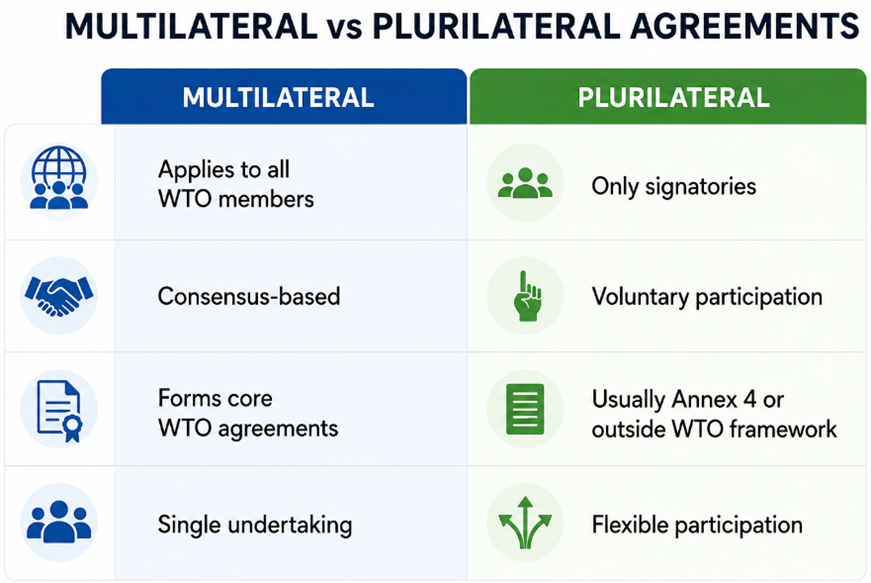
- Meaning: Plurilateral agreements are negotiated among a group of willing WTO members, with the resulting rights and obligations generally applying only to participating members.
- Joint Statement Initiatives (JSIs): Many recent plurilateral negotiations are conducted through JSIs, under which like-minded WTO members negotiate agreements outside the traditional multilateral negotiating framework.
- Legal Status in the WTO: Unlike multilateral agreements, plurilateral agreements are not binding on all WTO members. Only those accepted by consensus can be incorporated into Annex 4 of the Marrakesh Agreement, thereby becoming part of the WTO legal framework.
- Types:
- Open Plurilateral Agreements: Allow other WTO members to join at a later stage.
- Closed Plurilateral Agreements: Participation is limited to the original signatories.
- Objective: They enable willing members to advance negotiations in areas where consensus among all WTO members is difficult to achieve.
- Examples:
- Existing: Agreement on Government Procurement (GPA), Information Technology Agreement (ITA).
- Under negotiation: Investment Facilitation for Development (IFD) and Agreement on Electronic Commerce (ECA).
Why are Plurilateral Agreements Becoming Important?
- Breaking Negotiation Deadlocks: They enable willing members to make progress when multilateral negotiations remain stalled under the WTO’s consensus-based decision-making process.
- Addressing Emerging Trade Issues: They facilitate rule-making in areas such as digital trade, investment facilitation, environmental sustainability and services that are inadequately covered under existing WTO agreements.
- Flexible Participation: Countries can voluntarily participate based on their interests and level of preparedness without requiring the involvement of all WTO members.
- Modernising the Global Trading System: They help update global trade rules in response to technological advancements and evolving business models.
- Building Wider Consensus: Successful plurilateral initiatives may eventually serve as building blocks for broader multilateral agreements.
India’s Concerns over Plurilateral Agreements
- Dilution of Multilateralism: India argues that plurilateral agreements weaken the WTO’s consensus-based decision-making and the principle of equal participation by all members.
- Weakening the Development Dimension: Limited participation may marginalise developing and least-developed countries and dilute the principle of Special and Differential Treatment (S&DT).
- Procedural and Legal Concerns: India maintains that plurilateral agreements should not be incorporated into the WTO legal framework without consensus, as required under the Marrakesh Agreement.
- Expansion of WTO’s Negotiating Mandate: India contends that issues such as investment facilitation and electronic commerce have not been multilaterally agreed upon for negotiations by all WTO members.
- Fragmentation of Multilateral Trading System: India argues that the proliferation of plurilateral agreements could create multiple layers of trade obligations among WTO members, leading to fragmented trade rules, overlapping commitments and weakening the principle of a uniform, rules-based multilateral trading system.