

SYLLABUS
GS-3: Conservation, Environmental Pollution and Degradation, Environmental Impact Assessment.
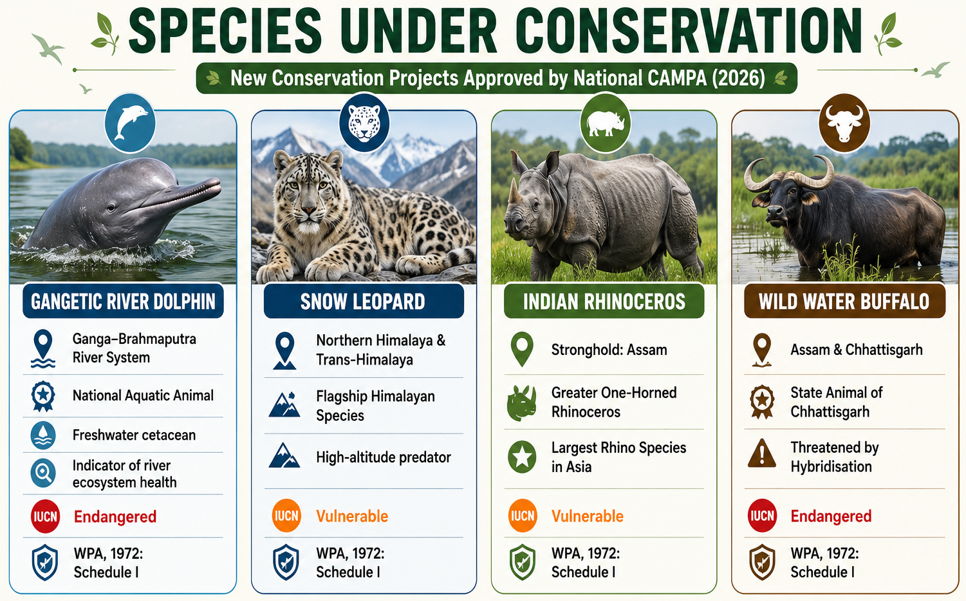
Context: Recently, the 7th Meeting of the Governing Body of National CAMPA, chaired by Union Environment Minister Bhupender Yadav in Coimbatore, approved four new national-level conservation projects for the Gangetic River Dolphin, Snow Leopard, Indian Rhinoceros, and Wild Water Buffalo.
More on the News
- The Governing Body also approved the ‘Aastha Van Sanrakshan Yojana’ with an initial outlay of ₹3,000 crore (2026–31) for conservation and restoration of nearly 15,000 sacred groves across the country.
- It approved the extension of MISHTI (Mangrove Initiative for Shoreline Habitats & Tangible Incomes) up to 2029 with additional financial support for mangrove restoration and conservation.
- The meeting reviewed the progress of the Nagar Van Yojana, which promotes urban forests and green spaces in cities.
- It also approved continued support for Sangai (Manipur Brow-antlered Deer) conservation and reviewed the establishment of a CAMPA GIS Monitoring Laboratory for technology-enabled monitoring of conservation projects.
Key Conservation Projects Approved by National CAMPA
- Project Dolphin
- Preparation of a Conservation and Recovery Action Plan for the Gangetic River Dolphin, including population assessment, habitat mapping, and river-health monitoring.
- Focus on threat mitigation, protection of critical riverine habitats, and strengthening long-term conservation of freshwater ecosystems.
- Project Snow Leopard (Phase-II)
- Strengthens conservation of snow leopard populations and fragile Himalayan ecosystems through scientific monitoring and habitat protection.
- Includes the second nationwide population estimation of Snow Leopards and promotes community-based conservation initiatives.
- Indian Rhinoceros Conservation Project
- Focuses on habitat improvement, corridor development, and strengthening anti-poaching measures for the Greater One-Horned Rhinoceros.
- Emphasizes genetic diversity conservation, disease surveillance, and long-term population security.
- Wild Water Buffalo Conservation Project
- Adopts India’s first pan-India conservation approach for the Wild Water Buffalo across its range states.
- Focuses on habitat restoration, population recovery, genetic purity, and mitigation of hybridisation threats from domestic buffaloes.
Significance of the Approved Projects
- Strengthening Species-Specific Conservation: The projects expand India’s species-focused conservation framework beyond traditional flagship programmes and provide dedicated attention to threatened wildlife species.
- Promoting Landscape-Based Conservation: The initiatives cover diverse ecosystems, including riverine habitats, Himalayan landscapes, floodplains, wetlands, and grasslands, encouraging holistic ecosystem management.
- Advancing Science-Based Wildlife Management: The projects emphasize population estimation, GIS-based monitoring, habitat connectivity, genetic conservation, and evidence-based wildlife management practices.
- Supporting Biodiversity Commitments: The initiatives contribute to India’s national biodiversity goals and commitments under global biodiversity conservation frameworks.
About CAMPA (Compensatory Afforestation Fund Management and Planning Authority)
- Statutory Basis: CAMPA functions under the Compensatory Afforestation Fund (CAF) Act, 2016, enacted to manage funds collected for diversion of forest land for non-forest purposes.
- Objective: To compensate for ecological losses arising from forest diversion and strengthen long-term conservation, restoration, and sustainable management of forests and wildlife resources.
- Administrative Ministry: It functions under the Ministry of Environment, Forest and Climate Change (MoEFCC) through National CAMPA and State CAMPA mechanisms.
- Source of Funds: Funds are generated through Compensatory Afforestation charges, Net Present Value (NPV) payments, and other levies imposed on agencies diverting forest land.
- Fund Distribution: Under the CAF framework, 90% of funds are transferred to State CAMPA accounts, while 10% are retained by National CAMPA.
- Major Areas of Utilisation: Funds are used for compensatory afforestation, assisted natural regeneration, wildlife conservation, habitat improvement, forest fire prevention, catchment area treatment, and ecological restoration.