
SYLLABUS
GS-3: Issues of Buffer Stocks and Food Security; Infrastructure: Energy.
Context: The recently released OECD–FAO Agricultural Outlook 2026–2035 projects sustained growth in global agriculture through productivity gains, while highlighting risks from climate change, income volatility and geopolitical disruptions.
More on the News
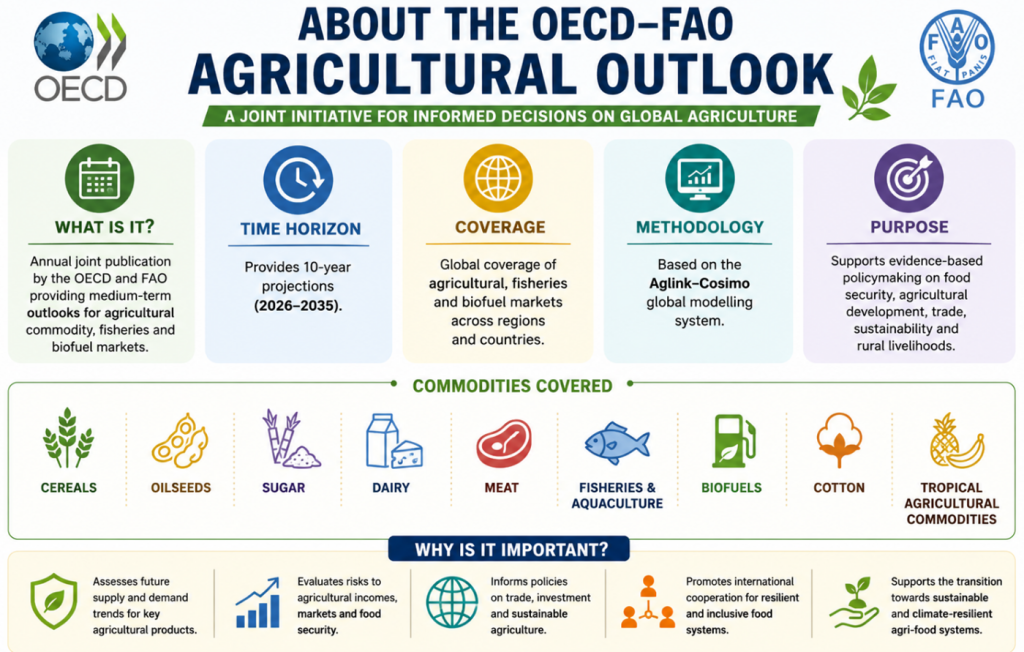
- The 22nd edition of the OECD–FAO Agricultural Outlook provides a ten-year assessment of global agricultural commodity, fisheries and biofuel markets from 2026 to 2035.
- The report places special emphasis on Agricultural Labour Productivity and Income Variability, highlighting the need for resilient and inclusive agricultural growth.
- Global agricultural and fish production is projected to increase by around 13% by 2035, while the global population is expected to reach 8.8 billion.
- The Outlook also analyses the potential impact of the 2026 Middle East conflict, warning that higher energy and fertiliser prices could adversely affect agricultural production and food security, particularly in low-income countries.
Key Findings of the OECD–FAO Agricultural Outlook 2026–2035
- Agricultural Production to Grow Through Productivity Gains
- Global agricultural and fish production is projected to increase by about 13% by 2035, driven primarily by productivity improvements.
- However, some expansion of crop area and livestock numbers will still be necessary to meet rising demand.
- Most production growth is expected to come from Asia, Latin America and Sub-Saharan Africa.
- Agricultural Incomes Likely to Improve, but Risks Persist
- Average agricultural income per worker is projected to rise by about 9% by 2035.
- However, agricultural incomes remain vulnerable to climate shocks, market volatility and rising input costs, particularly in low-income countries.
- There remains a 25% probability that incomes could fall significantly below baseline projections.
- Biofuels and Energy Transition to Shape Agricultural Demand
- Global biofuel demand is expected to continue expanding, led by emerging economies.
- Maize, sugarcane and vegetable oils will remain the principal feedstocks, keeping food crops at the centre of biofuel production (First-generation biofuels).
- The report highlights growing concerns over the food-versus-fuel debate and the slow commercial adoption of advanced biofuels and Sustainable Aviation Fuel (SAF).
- Evolving Global Food Systems
- Rising incomes and urbanisation are expected to increase demand for livestock products, dairy and aquatic foods.
- Southeast Asia is projected to account for around 39% of global food consumption growth by 2035.
Challenges and Risks Highlighted by the Report
- Income Volatility and Farmer Vulnerability: Despite projected income growth, farmers—especially in low-income countries—remain highly vulnerable to climate shocks, market fluctuations and input-cost volatility.
- Climate Change and Environmental Sustainability: Direct agricultural emissions are projected to rise by 6.5% by 2035, highlighting the challenge of increasing production while reducing environmental impacts.
- Geopolitical and Input-Cost Risks: Geopolitical disruptions can raise energy and fertiliser prices, increasing production costs and reducing agricultural output, particularly in vulnerable economies.
- Food Security Concerns: Supply-chain disruptions, price volatility and unequal access to resources continue to threaten global food security, especially for low-income populations.
Recommendations
- Promote Productivity-Led Agricultural Growth: Increase investments in agricultural research, innovation, digital technologies and improved farming practices to sustainably raise productivity.
- Strengthen Farmer Resilience: Expand climate-risk insurance, social protection measures and risk-management tools to reduce the impact of income volatility on farmers.
- Advance Sustainable Agriculture: Encourage climate-smart agriculture, efficient resource use and low-emission technologies to decouple production growth from environmental degradation.
- Balance Food and Fuel Objectives: Design biofuel policies that support energy-transition goals while minimizing pressure on food systems, land resources and commodity prices.
Sources :
Down to Earth
Oecd