
SYLLABUS
GS-3: Public Distribution System – Objectives, Functioning, Limitations, Revamping; Issues of Buffer Stocks and Food Security.
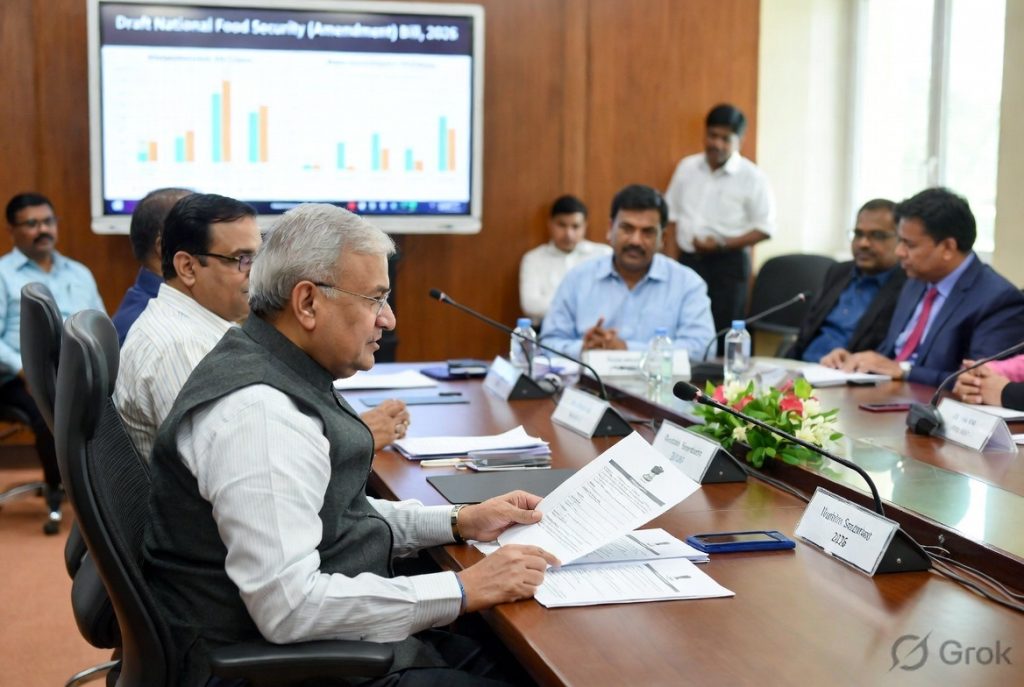
Context: The Department of Food and Public Distribution has released the Draft National Food Security (Amendment) Bill, 2026 for public consultation, proposing a major reform in foodgrain entitlements for beneficiaries under the Antyodaya Anna Yojana (AAY).
More on the News
- The draft amendment focuses exclusively on the Antyodaya Anna Yojana (AAY) category, which covers the poorest and most vulnerable households under the National Food Security Act (NFSA), 2013.
- It seeks to address intra-category inequities in AAY by shifting from a fixed household-based foodgrain allocation to a person-based entitlement system, with the objective of ensuring more rational and equitable distribution aligned with household size and nutritional requirements.
- The amendment has triggered a wider debate on food security, nutritional adequacy, beneficiary coverage and the future direction of India’s food subsidy regime.
About the National Food Security Act (NFSA), 2013
- Enacted in 2013, NFSA provides a legal right to food security by ensuring access to subsidised foodgrains through the Targeted Public Distribution System (TPDS).
- The Act covers up to 75% of the rural population and 50% of the urban population, corresponding to about 81.35 crore beneficiaries based on the 2011 Census.
- Beneficiaries are classified into:
- Antyodaya Anna Yojana (AAY): Poorest households; currently entitled to 35 kg of foodgrains per household per month.
- Priority Households (PHH): Entitled to 5 kg of foodgrains per person per month.
- The Act follows a life-cycle approach to food and nutrition security, providing nutritional support to pregnant women, lactating mothers and children (6 months–14 years) through Anganwadi services and school meal programmes, along with a maternity benefit of at least ₹6,000.
Key Provisions of the Draft NFSA (Amendment) Bill, 2026
- Person-Based Entitlement for AAY Beneficiaries: The draft proposes a new provision in Section 3 of the NFSA 2013 to propose an entitlement of 7 kg of foodgrains per person per month for AAY beneficiaries instead of the current household-based allocation.
- Retention of Household Ceiling: While shifting to a per-person entitlement, the amendment retains a maximum cap of 35 kg of foodgrains per household per month.
- No Change for Priority Households: The entitlement for Priority Households (PHH) remains unchanged at 5 kg per person per month. The amendment is confined to the AAY category.
- Continuity of Existing NFSA Framework: The draft does not alter NFSA coverage, beneficiary identification mechanisms or the broader public distribution architecture.
Significance of the Amendment
- Addressing Intra-Category Inequities: Under the existing AAY framework, every household receives 35 kg of foodgrains per month irrespective of family size, leading to unequal per-capita entitlements. The proposed shift to a person-based allocation seeks to make foodgrain distribution more equitable.
- Strengthening Food Security for Vulnerable Families: Larger AAY households often receive lower per-person foodgrain support than beneficiaries under the Priority Household (PHH) category. The revised entitlement structure seeks to enhance food security for the poorest and most vulnerable families.
- Rationalising Welfare Delivery: The amendment represents a shift from a uniform household entitlement to a demographic-sensitive approach, improving the targeting and efficiency of food subsidy distribution.
- Reinforcing the Objectives of NFSA: By addressing allocation disparities within the Antyodaya Anna Yojana, the proposal seeks to strengthen the rights-based food security framework envisioned under the National Food Security Act, 2013.
Concerns and Criticisms
- Limited Benefits for Larger Families: Although the amendment proposes 7 kg per person, the retention of the 35 kg household cap means larger AAY families may still not receive their full entitlement.
- Outdated NFSA Coverage: Activists associated with the Right to Food Campaign argue that NFSA coverage continues to be based on the 2011 Census, leaving millions of eligible persons outside the food security net.
- Exclusion of Other Beneficiaries: The reform is confined to AAY households and does not address concerns relating to Priority Households (PHH), which constitute the majority of NFSA beneficiaries.
- Concerns of States: Kerala and some other southern states have argued that the amendment should be accompanied by a revision of NFSA coverage limits and greater flexibility to address state-specific demographic and nutritional requirements.
Way Forward
- Rationalise AAY Entitlements: Review the 35 kg household ceiling to ensure that larger AAY families receive foodgrain support commensurate with their size and needs.
- Expand and Update NFSA Coverage: Revise beneficiary coverage using the latest population estimates to address exclusion errors and ensure that all eligible households are brought under the food security net.
- Move from Food Security to Nutrition Security: Complement cereal-based support with greater access to pulses, millets, edible oils and other nutrient-rich foods to address malnutrition and dietary deficiencies.
- Strengthen Cooperative Federalism and PDS Reforms: Incorporate feedback from States and stakeholders while improving beneficiary identification, portability, grievance redressal and last-mile delivery under the Public Distribution System (PDS).