SYLLABUS
GS-3: Indian Economy and issues relating to planning, mobilization of resources, growth, development and employment.
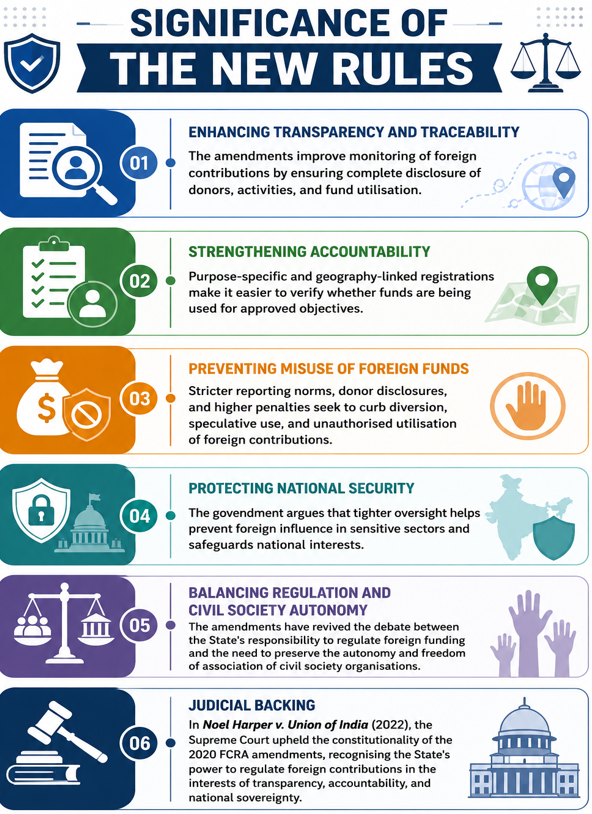
Context: The Union Government notified the Foreign Contribution (Regulation) Amendment Rules, 2026, to strengthen transparency, accountability, and traceability in the receipt and utilisation of foreign contributions by NGOs and associations.
About FCRA (Foreign Contribution Regulation Act, 2010)
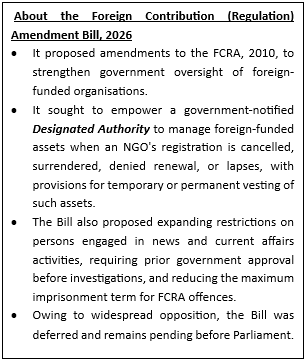
• The FCRA regulates foreign donations to ensure that foreign contributions do not adversely affect India’s sovereignty, integrity, security, public interest, or democratic institutions.
• It applies to all associations, NGOs, trusts, societies, and organisations seeking to receive foreign contributions for social, educational, religious, economic, and cultural purposes.
• Registration and Validity: Organisations must obtain FCRA registration or prior permission from the Ministry of Home Affairs (MHA), with registration remaining valid for five years and subject to renewal.
• Restrictions under FCRA: Members of legislatures, political parties, government servants, judges, election candidates, and media persons are prohibited from receiving foreign contributions.
• The Foreign Contribution (Regulation) Amendment Act, 2020, prohibited the transfer of foreign funds to other NGOs and reduced the administrative expenditure cap from 50% to 20%.
Key Provisions of FCRA Amendment Rules, 2026
• Government-Approved Activity List: NGOs must now select their objectives from a government-prescribed Schedule containing 105 approved activities under five categories—social, economic, educational, cultural, and religious.
• Restriction on Approved Activities: Foreign contributions can be utilised only for activities specifically approved in the registration certificate.
• State/UT-Specific Approval: Associations must specify the States and Union Territories where they intend to operate, making geography a part of the licence itself.
• Expansion Requires Approval: Any expansion beyond approved States/UTs or activities requires fresh government approval.
• Social media and Digital Disclosure: Organisations must disclose their websites, social media accounts, publications, and detailed activity reports.
• Annual Reporting: Annual returns must include financial statements, activity reports, and details of programme implementation.
• Ultimate Donor Disclosure: Entities receiving funds through donor-advised funds or intermediary funding mechanisms must disclose the ultimate source of contributions.
• Broader Coverage: The term now includes directors, trustees, partners, Karta of a Hindu Undivided Family (HUF), office bearers, governing body members, and any person exercising managerial control.
• Restriction on Foreign Nationals: Associations having foreign nationals (other than Persons of Indian Origin) as key functionaries will ordinarily not be granted registration or prior permission.
• Condition for Renewal: Organisations seeking renewal are expected to have spent at least ₹10 lakh of foreign contribution on approved activities during the previous two financial years.
• Exclusion of Proselytisation: Religious education, preservation of traditions, theological studies, and faith-based activities remain permissible, but several categories must be conducted excluding proselytisation.
• Constitutional Basis: The provision aligns with the Supreme Court judgment in Rev. Stainislaus v. State of Madhya Pradesh (1977), which held that the right to propagate religion does not include the right to convert another person.
• Administrative Expense Violation: Spending beyond the statutory 20% administrative expenditure cap attracts a penalty of ₹1 lakh or 5% of the excess amount, whichever is higher.
• Speculative Investments: Investment of foreign contributions in speculative activities attracts a penalty of ₹1 lakh or 30% of the amount invested, whichever is higher.
• Diversion or Misuse of Funds: Using foreign contributions for unauthorised purposes or in unauthorised States/UTs attracts a penalty of ₹1 lakh or 30% of the amount involved, whichever is higher.