

SYLLABUS
GS-3: Indian Economy and issues relating to Planning, Mobilization of Resources, Growth, Development and Employment.
Context: Recently, the Quarterly Bulletin on Unincorporated Sector Enterprises (QBUSE) for January–March 2026 was released by the National Statistics Office (NSO), Ministry of Statistics and Programme Implementation (MoSPI).
More on the News
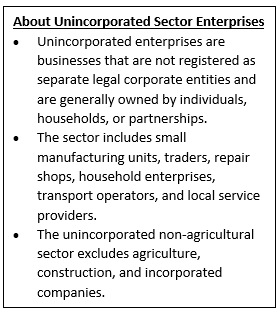
- QBUSE is the quarterly edition of the Annual Survey of Unincorporated Sector Enterprises (ASUSE) and provides high-frequency estimates for India’s unincorporated non-agricultural sector covering manufacturing, trade, and other services (excluding construction).
- The bulletin aims to strengthen the availability of timely labour-market and enterprise-level indicators for the informal sector, complementing surveys such as the Periodic Labour Force Survey (PLFS).
- The survey captures economic and operational characteristics of unincorporated enterprises, including establishments, employment, digital adoption, ownership patterns, and formal registration trends.
Key Findings of QBUSE (January–March 2026)
- Expansion in Establishments
- The unincorporated non-agricultural sector recorded a year-on-year growth of 16.69% in the number of establishments, with the estimated number of establishments rising to 9.16 crore during January–March 2026 from 7.85 crore in the corresponding quarter of the previous year.
- The rural sector emerged as the primary driver of growth, registering a notable increase of 20.46%, while the urban sector recorded a growth of 12.59% during the same period.
- Employment Growth
- Employment in the unincorporated non-agricultural sector reached 15.17 crore during January–March 2026, crossing the 15-crore mark for the first time. The sector recorded a year-on-year employment growth of 15.51% over the corresponding quarter of the previous year.
- The services sector witnessed particularly strong growth, with the number of establishments increasing by 24.82% and employment rising by 31.13% over the corresponding quarter of the previous year.
- Changing Workforce Composition
- Working owners accounted for the largest share of the workforce in the unincorporated sector during January–March 2026, constituting 60.97% of total workers compared to 58.29% in the corresponding quarter of the previous year.
- In contrast, the share of hired workers declined marginally to 24.77% from 26.86% during the same period.
- Women’s Participation in the Sector
- Women workers constituted around 29% of total employment in the unincorporated sector during January–March 2026, slightly higher than the level recorded during the corresponding quarter of ASUSE 2025.
- The findings highlight the growing importance of the sector in promoting women’s employment and inclusive economic participation.
- Digital Adoption and Formalisation
- Around 81% of establishments in the unincorporated sector reported using the internet for entrepreneurial purposes, indicating growing digital adoption across enterprises.
- Nearly 81% of establishments adopted cashless transaction modes such as online banking, UPI, POS devices, and other digital payment mechanisms.
Significance of the Unincorporated Sector
- Major Source of Employment: The sector provides large-scale employment opportunities, particularly for self-employed workers, informal labour, migrants, and low-skilled workers.
- Supporting Rural Economy: Growth in rural unincorporated enterprises helps diversify non-farm livelihoods and reduce excessive dependence on agriculture.
- Entrepreneurship and MSME Ecosystem: The sector acts as an entry point for small entrepreneurs and contributes significantly to local production, trade, and services.
- Inclusive and Women-Led Growth: A large number of women-led enterprises and household businesses operate within the unincorporated sector, supporting gender-inclusive economic participation.
Challenges Facing the Unincorporated Sector
- High Informality: Most enterprises operate outside formal regulatory and social-security frameworks, limiting labour protection and institutional support.
- Limited Access to Credit: Small enterprises often face difficulties in accessing affordable institutional finance and formal credit channels.
- Low Productivity and Technology Adoption: Many enterprises continue to operate with low capital intensity, limited technology usage, and low productivity levels.
- Income and Social Security Concerns: Workers in the sector often face low wages, income insecurity, lack of contracts, and absence of social protection benefits.
Government Initiatives Supporting the Sector
- PM SVANidhi Scheme: Provides collateral-free working capital loans to street vendors and small informal businesses.
- Mudra Yojana: Facilitates institutional credit support for micro and small enterprises.
- Digital India and UPI Expansion: Promotes digital payments, formalisation, and online business integration for small enterprises.
- e-Shram Portal: Creates a national database of unorganised workers to improve the delivery of social-security benefits.
Source:
Pib
Economictimes
Business