
SYLLABUS
GS-2: Issues relating to development and management of Social Sector/Services relating to Health.
GS-3: Science and Technology- developments and their applications and effects in everyday life.
Context: The World Health Organization has declared the Ebola outbreak in the Democratic Republic of the Congo and Uganda a Public Health Emergency of International Concern (PHEIC) following the spread of the rare Bundibugyo strain of Ebola across border regions.
More on the News
• The latest Ebola outbreak originated in Ituri Province of eastern DRC and later spread to Uganda through cross-border movement, with confirmed cases reported in Kampala.
• The outbreak is caused by the Bundibugyo ebolavirus (BDBV) strain, first identified in Uganda in 2007, for which no approved vaccine or specific treatment currently exists.
• The outbreak zone is affected by armed conflict, displacement, porous borders and weak healthcare infrastructure, complicating containment efforts and raising concerns over wider transmission.
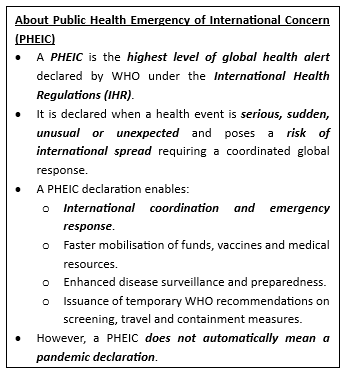
• WHO has declared the outbreak a Public Health Emergency of International Concern (PHEIC) to strengthen global coordination, surveillance and emergency response measures.
About Ebola Disease
• Ebola disease (EVD/EBOD) is a rare but severe zoonotic viral disease caused by viruses belonging to the Orthoebolavirus genus of the Filoviridae family.
• The disease was first identified in 1976 near the Ebola River in present-day DRC.
• Fruit bats are considered the natural hosts of the virus.
• The disease spreads to humans through contact with infected animals and later through direct contact with bodily fluids of infected persons.
• Human-to-human transmission occurs through contact with blood, vomit, saliva, urine, faeces, semen or contaminated surfaces/materials.
• A person infected with Ebola becomes contagious only after symptoms appear.
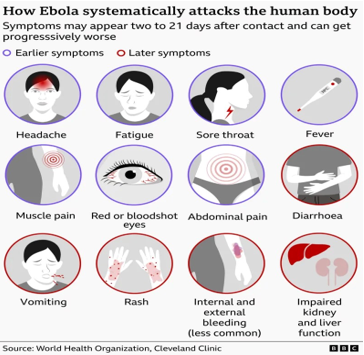
• The incubation period ranges from 2–21 days, with symptoms usually appearing within 8–10 days after exposure.
• The average fatality rate is around 50%, though it varies depending on the strain and quality of treatment.
• Types of Ebola Viruses Causing Human Disease
- Ebola virus (EBOV) → Ebola Virus Disease (EVD)
- Sudan virus (SUDV) → Sudan Virus Disease (SVD)
- Bundibugyo virus (BDBV) → Bundibugyo Virus Disease (BVD)
- Taï Forest virus
• Diagnosis: Diagnosis is confirmed through laboratory tests such as:
- RT-PCR (Reverse Transcriptase Polymerase Chain Reaction)
- ELISA tests
- Antigen-capture detection tests
- Virus isolation by cell culture
• Treatment and Vaccines: Early intensive supportive care, including rehydration and symptom management, significantly improves survival chances.
- WHO recommends monoclonal antibody treatments such as mAb114 (Ansuvimab) and REGN-EB3 (Inmazeb) for Ebola virus disease caused by the Zaire strain.
- Approved vaccines include: Ervebo (single-dose vaccine) and Zabdeno and Mvabea (two-dose regimen).
- However, no approved vaccine or treatment currently exists for the Bundibugyo strain involved in the present outbreak, though candidate vaccines are under development.
• Prevention and Control Measures: Prevention and control measures include rapid case isolation, contact tracing, safe burials, strict infection-control practices and community awareness campaigns.
- Health workers are advised to use Personal Protective Equipment (PPE), while people should avoid contact with infected persons, bodily fluids and infected wildlife.