
SYLLABUS
GS-3: Indian Economy and issues relating to planning, mobilisation of resources, growth, development and employment.
Context: The Union Cabinet has approved a Scheme for Promotion of Surface Coal/Lignite Gasification Projects with a financial outlay of ₹37,500 crore to accelerate coal gasification in India.
More on the News
• The Scheme marks a major step towards accelerating India’s coal/lignite gasification programme and advancing the national target of gasifying 100 Million Tonnes (MT) of coal by 2030.
• It seeks to strengthen India’s energy security and reduce dependence on imports of key products such as LNG (more than 50% imported), urea (~20% imported), ammonia (~100% imported), and methanol (~80–90% imported).
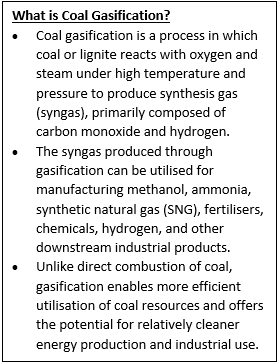
• The initiative also promotes cleaner and more efficient utilisation of coal by encouraging production of syngas and downstream products such as fertilisers, chemicals, and synthetic fuels.
• In a significant accompanying reform, the Government has also extended coal linkage tenure up to 30 years under the Non-Regulated Sector (NRS) linkage auction framework for coal gasification projects, thereby providing long-term policy certainty and improving investor confidence.
Need for the Scheme
• India possesses one of the world’s largest coal reserves (around 401 billion tonnes) and lignite reserves (around 47 billion tonnes), while coal continues to account for more than 55% of the country’s energy mix. This necessitates more efficient and value-added utilisation of domestic coal resources.
• Coal gasification enables conversion of coal/lignite into syngas, which can be used for domestic production of fuels, fertilisers, chemicals, methanol, ammonia, and other industrial products, thereby reducing dependence on high-value imports.
• India’s import bill for products such as LNG, urea, ammonia, ammonium nitrate, methanol, DME, and coking coal stood at approximately ₹2.77 lakh crore in FY2025, highlighting vulnerabilities arising from global price volatility and geopolitical disruptions, particularly in West Asia.
• The new scheme builds upon the National Coal Gasification Mission (2021) and the earlier ₹8,500 crore coal gasification scheme approved in January 2024, under which eight projects worth ₹6,233 crore are already under implementation.
Key Features of the Scheme
Financial and Institutional Framework
• The Scheme has a total financial outlay of ₹37,500 crore to incentivise new surface coal/lignite gasification projects for the production of syngas and downstream products, targeting gasification of nearly 75 Million Tonnes of coal/lignite.
• Financial incentives will be provided up to a maximum of 20% of the cost of plant and machinery for eligible projects.
• The scheme prescribes financial ceilings:
- Maximum ₹5,000 crore for a single project.
- Maximum ₹9,000 crore for a single product category (except Synthetic Natural Gas and Urea).
- Maximum ₹12,000 crore for a single entity group across all projects.
• Selection of projects will be undertaken through a transparent and competitive bidding process based on parameters such as project cost, coal input efficiency, and syngas output.
• Incentives under the scheme will be in addition to benefits available under the commercial coal mining regime and other Central or State Government schemes.
Technology and Industrial Development
• The scheme follows a technology-agnostic approach while encouraging the adoption and development of indigenous coal gasification technologies.
• It seeks to strengthen India’s domestic coal gasification ecosystem and reduce reliance on foreign Engineering, Procurement and Construction (EPC) contractors.
Significance of the Scheme
• Enhancing Energy Security and Import Substitution: The scheme promotes diversified utilisation of domestic coal resources and reduces dependence on high-value imports, thereby insulating India from global price volatility and geopolitical supply-chain disruptions.
• Supporting Atmanirbhar Bharat and Industrial Growth: Increased domestic production of syngas and downstream products will strengthen strategic industries and advance the objectives of Atmanirbhar Bharat and Make in India.
• Investment and Employment Generation: The scheme is expected to mobilise investments worth ₹2.5–3 lakh crore and generate nearly 50,000 direct and indirect jobs across around 25 projects in coal-bearing regions.
• Revenue Generation and Regional Development: Gasification of nearly 75 Million Tonnes of coal/lignite is expected to generate annual revenues of around ₹6,300 crore, along with additional downstream revenue through GST and related economic activities.
• Development of Indigenous Technology Ecosystem: By encouraging indigenous coal gasification technologies and reducing reliance on foreign EPC contractors, the scheme seeks to strengthen India’s domestic technological and industrial capabilities in the energy sector.