

SYLLABUS
GS-2: Effect of policies and politics of developed and developing countries on India’s interests, Indian diaspora.
Context: The International Organization for Migration released the World Migration Report 2026, highlighting global migration trends, major migration corridors, displacement patterns, and the growing role of migration in development and geopolitics.
About the Report
- The World Migration Report 2026 is the thirteenth edition of the flagship report published by the International Organization for Migration to improve understanding of migration and mobility worldwide.
- The report is divided into two parts:
- Part I presents key global and regional migration statistics,
- Part II provides evidence-based analysis of emerging migration issues such as climate mobility, internal displacement, migration pathways, migration and development, and disability-related migration challenges.
- It examines migration trends in the context of geopolitical tensions, environmental degradation, technological change, demographic shifts, and humanitarian crises, while also highlighting the developmental role of migrants and diasporas.
Key Findings of the Report
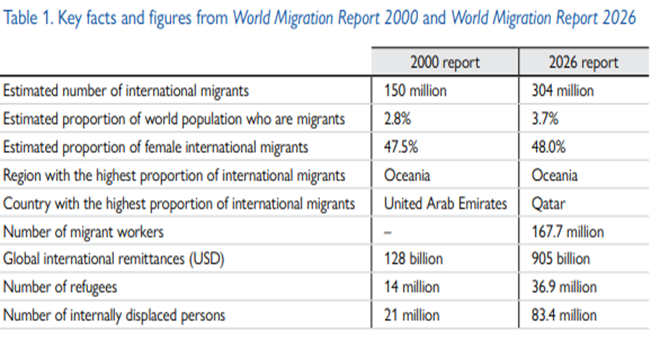
- Around 304 million people were living outside their country of birth by mid-2024, accounting for 3.7% of the global population, compared to 2.9% in 1990.
- The Mexico–United States corridor remained the world’s largest migration corridor with around 11 million migrants. Other major corridors included:
- Afghanistan–Iran
- Syria–Türkiye
- Russia–Ukraine
- India–United Arab Emirates
- India–United States.
- The India–United Arab Emirates corridor became the fifth-largest migration corridor globally, driven mainly by migrant workers.
- Indians constituted the largest nationality group in the UAE, with over three million Indians residing there.
- The India–United States corridor ranked as the sixth-largest migration corridor in the world and the second-largest involving North America after the Mexico–U.S. corridor.
- Around 3.2 million Indian migrants were living in the United States in 2024, making Indians the second-largest foreign-born group after Mexicans.
- Indian migration to the U.S. has been driven significantly by highly skilled workers and international students.
- The report highlighted the growing influence of the Indian diaspora in the United States in strengthening India–U.S. relations through organisations such as the United States–India Political Action Committee (USINPAC), particularly in areas like trade, defence cooperation, and visa policies.
- Other major Asian migration corridors included:
- Bangladesh–India (11th largest globally)
- India–Saudi Arabia (14th largest globally).
- Migration from South Asian countries such as India, Bangladesh, Pakistan, and Myanmar remained predominantly male-dominated, mainly due to labour migration towards Gulf and South-East Asian countries in sectors such as construction, manufacturing, and agriculture.
- Gulf countries such as the United Arab Emirates, Saudi Arabia, and Kuwait recorded a significantly higher proportion of male immigrants, while India had a relatively higher share of female immigrants.
- Global displacement continued to rise sharply:
- Over 120 million people were displaced worldwide by the end of 2024.
- Around 83 million people were internally displaced globally.
- Disaster-related internal displacements reached a record 45.8 million in 2024.
- International remittances reached approximately USD 905 billion in 2024, including USD 685 billion to low- and middle-income countries, highlighting migration’s contribution to development.
- Major conflicts contributing to displacement included Sudan, Ukraine, Gaza, Myanmar, Syria, Yemen, and the Democratic Republic of Congo.
- Climate change and environmental degradation increasingly contributed to migration through droughts, floods, storms, wildfires, and rising temperatures, particularly affecting vulnerable populations and poor countries.
- The report highlighted the growing use of Artificial Intelligence (AI) in migration governance, including border management, visa processing, and identity systems, while warning about risks related to bias, privacy, digital inequality, and labour displacement.
Report Recommendations
- Promote safe, regular, and legal migration pathways to reduce irregular migration and exploitation.
- Strengthen rights-based and evidence-driven migration governance.
- Reduce remittance transfer costs and improve financial inclusion for migrants.
- Promote skills partnerships, circular migration, and diaspora engagement for development.
- Integrate migration policies with climate adaptation, labour market planning, and social protection systems.
- Enhance international cooperation for refugee protection, displacement response, and migration data systems.
- Counter xenophobia, misinformation, and anti-migrant discrimination through inclusive policies and public awareness.