
SYLLABUS
GS-2: Functions and responsibilities of the Union and the States, issues and challenges pertaining to the federal structure, devolution of powers and finances up to local levels and challenges therein.
Context: Recently, the Ministry of Panchayati Raj released the Panchayat Advancement Index (PAI) 2.0 report on National Panchayati Raj Day (24 April 2026) to assess grassroots governance performance across rural India.
More on the News
- PAI 2.0 serves as a nationwide report card for over 2.5 lakh Gram Panchayats, with a high participation rate of 97.30% (2,59,867 Panchayats across 33 States/UTs), significantly improving from 80.79% in version 1.0.
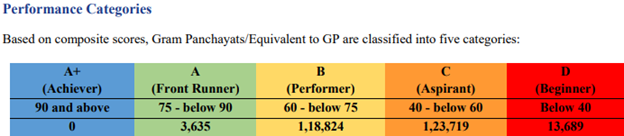
- Based on composite scores, 3,635 Panchayats are classified as Front Runners, while 1,18,824 (45.72%) fall under the Performer category.
- The report highlights strong outcomes in themes like Poverty-Free and Enhanced Livelihoods and Healthy Panchayats, reflecting progress in rural development indicators.
- The initiative strengthens transparency, accountability, and data-driven governance through mandatory Gram Sabha validation and real-time monitoring systems.
About Panchayat Advancement Index (PAI) 2.0
- Launched by the Ministry of Panchayati Raj, the PAI is the world’s first nationwide framework to measure the progress of Rural Local Government Institutions (Gram Panchayats (GPs)/Traditional Local Bodies (TLBs)) using objective and verifiable indicators.
- It is aligned with the Localization of Sustainable Development Goals (LSDGs), adapting global SDGs into locally relevant governance themes.
- PAI 2.0 evaluates Panchayats using 150 indicators and 230 data points, significantly reduced from 516 indicators and 794 data points in version 1.0, ensuring better usability and sharper focus.
- The framework is aligned with the National Indicator Framework (NIF) and uses a 0–100 scoring system based on multi-level data collection, validation by line departments, and mandatory Gram Sabha verification.
- PAI is widely used for evidence-based planning, Gram Panchayat Development Plans (GPDPs), resource allocation, and incentivisation, and is linked with initiatives like National Panchayat Awards and creation of Panchayat Learning Centres/Beacon Panchayats.
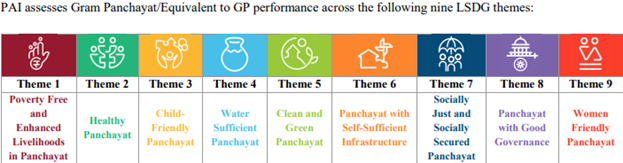
- Nine LSDG Themes Covered:
- Performance Categories:
Key Findings of the Report
- No Panchayat achieved the Achiever (A+) category overall, indicating scope for improvement in holistic development.
- 3,635 Panchayats are Front Runners, while the majority, 1,18,824 Panchayats (45.72%), fall in the Performer category, reflecting moderate but stable performance.
- A large number, 1,23,719 Panchayats, are in the Aspirant category, showing uneven development across regions.
- 13,689 Panchayats fall under the Beginner category, requiring targeted interventions.
- Theme-wise Highlights:
- Under Poverty-Free and Enhanced Livelihoods, 3,313 Panchayats achieved A+, indicating strong progress in poverty reduction and livelihood generation.
- Under Healthy Panchayat, 1,015 Panchayats secured A+, reflecting improvements in healthcare, sanitation, and nutrition awareness.
- Participation & Coverage:
- 97.30% participation (2,59,867 Panchayats) across 33 States/UTs.
- Significant improvement from PAI 1.0 participation levels.
- West Bengal did not participate in PAI 2.0.
- Delhi and Chandigarh are excluded as they do not have Gram Panchayats.
- Governance Impact:
- PAI scores are increasingly used for resource allocation, policy planning, and incentivisation.
- High-performing Panchayats are being developed as learning hubs and model governance units.
- The index promotes transparent, participatory, and outcome-based rural governance, aligned with India’s SDG 2030 commitments.
Sources :
PIB
Static PIB
PAI