
SYLLABUS
GS-3: Conservation, Environmental Pollution and Degradation, Environmental Impact Assessment.
Context: As per the latest updates from the United Nations Environment Programme (UNEP), the world has reached a major conservation milestone, with 10.01% of the global ocean now officially designated as protected and conserved areas.
More on the News
• This milestone marks a rise from 8.6% in 2024, meaning roughly 5 million sq km of ocean was added to the protection network in just two years.
• However, the milestone comes six years after the original target under the Aichi Biodiversity Targets, where countries agreed to protect 10% of the ocean by 2020.
• The milestone is closely linked to the broader global goal under the Kunming–Montreal Global Biodiversity Framework, which calls for protecting 30% of land and sea by 2030 (“30×30 target”).
Key Highlights of the Latest Update
• Global ocean protection has crossed the 10% threshold for the first time, marking a significant milestone in marine conservation efforts.
• The increase in protected areas over the past two years is substantial, covering an area larger than the European Union, indicating accelerated but still insufficient progress.
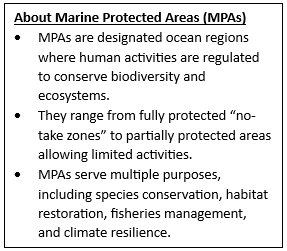
• However, effective protection remains limited, with only a small proportion of these areas being strictly or fully protected, raising concerns about the quality and enforcement of Marine Protected Areas (MPAs).
• Progress is highly uneven, with most gains concentrated within national jurisdictions, while protection in areas beyond national jurisdiction (high seas) remains minimal.
• To meet the 30×30 target by 2030, global ocean protection must expand significantly—by an area roughly equivalent to the Indian Ocean, highlighting the scale of effort still required.
Significance of Ocean Protection
• Ecological Importance: Oceans host immense biodiversity, including coral reefs, deep-sea ecosystems, and migratory species critical for ecological balance.
• Climate Regulation: Marine ecosystems act as major carbon sinks (blue carbon), helping mitigate climate change and regulate global temperatures.
• Economic Value: Oceans support fisheries, tourism, and livelihoods for millions, forming a key pillar of the global blue economy.
• Disaster Resilience: Healthy marine ecosystems such as mangroves and coral reefs provide natural protection against storms and coastal erosion.
Challenges and Concerns
• Gap to 30×30 Target: Despite reaching ~10% protection, the current pace is too slow, and achieving 30% by 2030 will require a rapid and large-scale expansion of well-managed MPAs.
• “Paper Parks” Problem: Many MPAs lack effective enforcement and monitoring, existing only on paper and failing to prevent harmful activities, thereby limiting real conservation impact.
• Limited High Seas Governance: Protection in areas beyond national jurisdiction remains minimal due to weak legal frameworks and coordination challenges, reducing overall global effectiveness.
• Funding and Capacity Constraints: Developing countries often face financial and technical limitations, hindering proper management, monitoring, and enforcement of protected areas.
• Conflict of Interests: Conservation efforts frequently clash with economic activities like fishing, shipping, and mining, creating policy trade-offs and slowing implementation.
Global Initiatives and Agreements
• Kunming-Montreal Global Biodiversity Framework (2022): It sets the “30×30 target”, committing countries to protect 30% of global land and oceans by 2030, forming the central guiding framework for biodiversity conservation.
• BBNJ Agreement (High Seas Treaty): It provides a legal framework for conserving biodiversity in areas beyond national jurisdiction, addressing gaps in governance of the high seas.
• Protected Planet Initiative: Led by the UNEP and International Union for Conservation of Nature (IUCN), it tracks global progress on protected areas and supports data-driven conservation planning.
• UN Sustainable Development Goal 14 (Life Below Water): It aims to ensure the conservation and sustainable use of oceans and marine resources, aligning global efforts with broader sustainable development objectives.
SOURCES
Down To Earth
Oceangraphi
IUCN