
SYLLABUS
GS-3: Indian Economy and issues relating to planning, mobilization of resources, growth, development and employment.
Context: The Reserve Bank of India Monetary Policy Committee (MPC) in its bimonthly meeting kept the repo rate unchanged at 5.25% with a neutral stance amid heightened global uncertainty driven by the West Asia (US–Iran) conflict.
Key Highlights of the Meeting
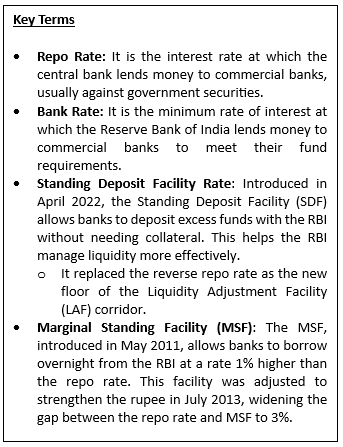
- The MPC kept the Repo Rate unchanged at 5.25%; consequently, the standing deposit facility (SDF) rate remains at 5%, and the marginal standing facility (MSF) rate and the Bank Rate remain at 5.50%.
- The committee continued with a neutral stance, signalling flexibility and data-dependence.
- Real GDP growth for FY27 is projected at 6.9%, supported by domestic demand despite global headwinds.
- CPI inflation for FY27 is projected at 4.6%, with moderate underlying core inflation pressures.
- The RBI introduced a core inflation estimate of 4.4%, enhancing transparency in inflation assessment.
- The RBI adopted a “wait and watch” calibrated strategy to balance inflation control with growth support.
Factors Influencing the Decision
- Global Geopolitical Conflict: The ongoing West Asia conflict involving the United States and Iran has disrupted global supply chains for weeks and created uncertainty due to risks of escalation, prolongation, and wider geographical spread.
- Energy and Commodity Prices: Disruptions in the Strait of Hormuz led to a sharp surge and volatility in crude oil and other commodity prices, increasing fuel costs, input costs across sectors, and acting as a drag on domestic production.
- External Sector and Financial Markets: Global financial market turmoil resulted in the US dollar strengthening, rupee depreciation, FPI volatility, equity market corrections, rising bond yields, higher freight and insurance costs, and potential widening of the current account deficit, though remittances are not expected to see a significant dent.
- Inflation Trends and Risks: Headline inflation increased due to base effects and food prices, while core inflation remained moderate, but volatility in global energy prices and risks such as possible El Niño conditions pose upside risks to inflation.
- Domestic Growth Conditions: Growth continues to be supported by robust private consumption, fixed investment, services sector momentum, manufacturing activity, rising capacity utilisation and healthy balance sheets, although supply disruptions and global volatility may constrain growth prospects.
About the Monetary Policy Committee (MPC)
- It was established in September 2016, under Section 45ZB (1) of the Reserve Bank of India Act, 1934 (RBI Act).
- The Urijit Patel Committee had recommended the setting up of the MPC
- The MPC’s primary role is to set the Policy Rate required to achieve the inflation target.
- According to Section 42B (2) of the RBI Act, the MPC consists of:
- The Governor of RBI, who serves as the Chairperson, ex officio.
- The Deputy Governor of RBI is responsible for Monetary Policy, as a member, ex officio.
- One RBI officer nominated by the Central Board, as a member, ex officio.
- (Three individuals appointed by the Central Government, as Members.
- Members appointed by the Central Government hold their positions for a term of four years or until further orders, whichever is earlier.
- According to Section 45ZA of the RBI Act, the inflation target is set at 4%, with an upper tolerance level of 6% and a lower tolerance level of 2%.
- If inflation exceeds 6% or drops below 2% for three consecutive quarters, it is deemed a failure to meet the target.