
SYLLABUS
GS-1: Distribution of key natural resources across the world (including South Asia and the Indian subcontinent).
GS-3: Conservation, Environmental Pollution and Degradation, Environmental Impact Assessment; Disaster and Disaster Management.
Context: The Ministry of Environment, Forest and Climate Change has released the Draft Tar‑Balls Management Rules, 2026, marking India’s first dedicated regulatory framework for managing tar-ball pollution.
More on the News
- The move responds to recurring episodes of tar‑ball deposition, especially along India’s western coastline, often intensifying during the monsoon due to ocean currents and winds.
- Existing mechanisms like the National Oil Spill Disaster Contingency Plan (NOSDCP) primarily focused on large oil spills, leaving smaller, dispersed pollution like tar-balls inadequately regulated.
- The draft is framed under the broader mandate of the Environment (Protection) Act, 1986, and aims to bring in a comprehensive and accountable regulatory approach for tackling tar-ball pollution.
What are Tar-Balls?
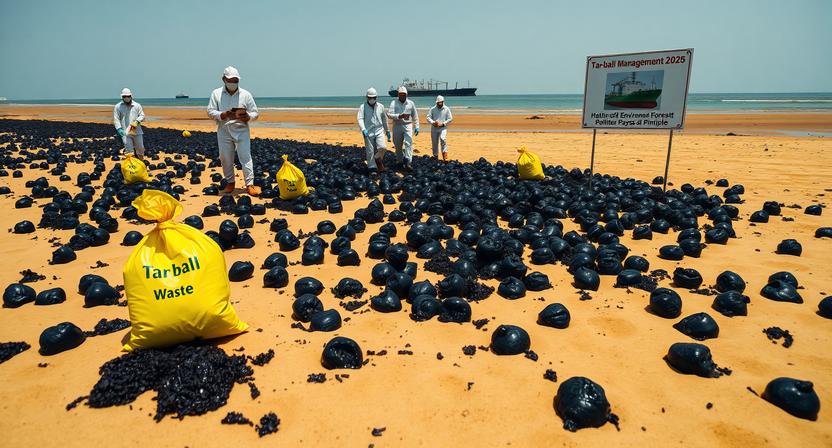
- Tar-balls are small, sticky, dark lumps of weathered crude oil formed after oil undergoes physical and chemical changes in marine environments.
- They originate from oil spills, tanker accidents, offshore drilling, pipeline leakages, natural seeps, and illegal discharge of oily waste.
- Their formation occurs through a process called weathering, which includes evaporation and dissolution of lighter components, emulsification into a thick residue, fragmentation by waves, and eventual solidification into dense masses.
- These tar-balls are transported over long distances by ocean currents and winds, often washing ashore far from their original source, making traceability difficult.
- Implication:
- Environmental Impacts: Tar-balls coat and suffocate marine organisms such as fish, seabirds, and turtles, affecting their mobility, feeding, and reproduction.
- Health Impacts: Tar-balls contain toxic substances like hydrocarbons, heavy metals, and persistent organic pollutants, posing risks through skin contact or exposure.
- Economic Impacts: They negatively affect tourism and fisheries, leading to loss of income and livelihoods for coastal communities.
Key Provisions of the Draft Rules
- Comprehensive Lifecycle Management: The rules establish a holistic framework covering the entire lifecycle of tar-balls, including their generation, collection, storage, transportation, treatment, and final disposal.
- Expanded Regulatory Scope: They introduce a broad definition of “oil facilities,” encompassing ships, offshore platforms, and pipeline operators, thereby bringing all potential sources of pollution under regulation.
- Polluter Pays Principle: The framework is anchored in the “Polluter Pays Principle,” mandating that responsible entities bear the cost of environmental damage, cleanup, and remediation.
- Institutional Mechanism: A multi-agency framework has been proposed, assigning responsibilities to key stakeholders such as the Ministries of Petroleum and Natural Gas, Ports, Shipping and Waterways, Defence, and Pollution Control Boards.
- Disaster Management Integration: Coastal state governments are required to classify tar-ball pollution as a “State Disaster” and respond through established disaster management systems.
- Decentralised Implementation: District administrations are entrusted with operational responsibilities, including the collection, transportation, and local management of tar-balls.
- Technology-Driven Monitoring: They emphasise the use of advanced technologies, such as aerial surveillance, satellite monitoring, and underwater systems, for the detection and tracking of oil spills.
- Resource Recovery and Disposal: Tar-balls with adequate calorific value may be utilised as fuel in cement industries, subject to environmental safeguards and regulatory approvals.
Significance of the Rules
- Bridging Regulatory Gaps: The rules provide India’s first dedicated framework for tar-ball management, addressing a long-standing gap in marine pollution regulation that was not fully covered under existing laws.
- Protection of Coastal and Marine Ecosystems: The rules contribute to safeguarding marine biodiversity, mangroves, coral ecosystems, and beaches from the harmful impacts of oil residues.
- Support for the Blue Economy: By reducing pollution risks, the framework helps protect tourism, fisheries, and coastal livelihoods, which are highly dependent on clean marine environments.
- Enhanced Disaster Preparedness: Integration with disaster management systems ensures faster and more coordinated response mechanisms to tar-ball incidents and oil-related pollution.
- Promotion of Technology-Driven Governance: The emphasis on satellite monitoring, aerial surveillance, and other advanced tools enhances early detection, tracking, and mitigation efficiency.
- Ensuring Accountability: The application of the “Polluter Pays Principle” strengthens environmental accountability and deters negligent practices by polluting entities.