
SYLLABUS
GS 3: Effects of liberalisation on the economy, changes in industrial policy and their effects on industrial growth; Indigenisation of technology and developing new technology.
Context: According to the Ministry of Defence, India’s defence exports touched an all-time high of ₹38,424 crore in the financial year 2025–26, marking a sharp increase of ₹14,802 crore (62.66%) over the previous fiscal year’s figure of ₹23,622 crore.
More on the News
• In FY26, India exported defence equipment to over 80 countries, including both complete systems and sub-systems.
• The milestone highlights significant contributions from both sectors, with Defence Public Sector Undertakings (DPSUs) accounting for 54.84% of exports and the private sector contributing 45.16%.
• DPSU’s exports grew by 151% year-on-year, while private sector exports increased by 14%.
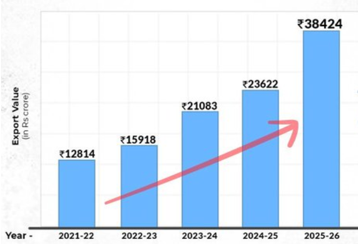
• In value terms, DPSUs exported ₹21,071 crore and the private sector ₹17,353 crore, up from ₹8,389 crore and ₹15,233 crore, respectively, in the previous year.
• The number of registered defence exporters increased from 128 to 145, a rise of 13.3% over the previous fiscal.
• This growth comes even as India continues to be the world’s second-largest arms importer, holding an 8.3% share of global sales during 2021–2025, according to the Stockholm International Peace Research Institute.
Significance of the Development
• Boost to Strategic Autonomy: Higher exports strengthen India’s defence industrial base, reducing dependence on imports and enhancing self-reliance under the Aatmanirbhar Bharat vision.
• Global Recognition of Indigenous Capability: Exports to over 80 countries reflect growing international trust in India’s defence manufacturing quality and technological capabilities.
• Economic Gains and Employment Generation: The surge in exports contributes to foreign exchange earnings, supports domestic industries, and generates employment across manufacturing and ancillary sectors.
• Strengthening Public–Private Partnership: Balanced contributions from DPSUs and the private sector indicate a maturing defence ecosystem with increasing private participation and competitiveness.
• Expansion of Defence Diplomacy: Defence exports act as a tool of strategic diplomacy, deepening bilateral ties and enhancing India’s geopolitical influence, especially in developing regions.
• Momentum for Industrial Growth and Innovation: Increased demand encourages R&D, innovation, and scale economies, helping India move up the global defence value chain.
• Diversification Despite Import Dependence: Even as India remains a major arms importer, rising exports signal a transition towards becoming a net contributor in the global defence market.
SOURCE
The Hindu