
SYLLABUS
GS-3: Awareness in the fields of Space.
Context: Recently, NASA has successfully launched the Artemis II mission, marking the first crewed journey to the vicinity of the Moon since Apollo 17 in 1972.
More on the News
• The mission was launched on April 1, 2026, from the Kennedy Space Center using the Space Launch System (SLS) rocket, carrying four astronauts aboard the Orion spacecraft.
- After liftoff, Orion enters Earth orbit, where multiple engine burns (perigee and apogee raising) place it in a high Earth orbit (~40,000+ miles).
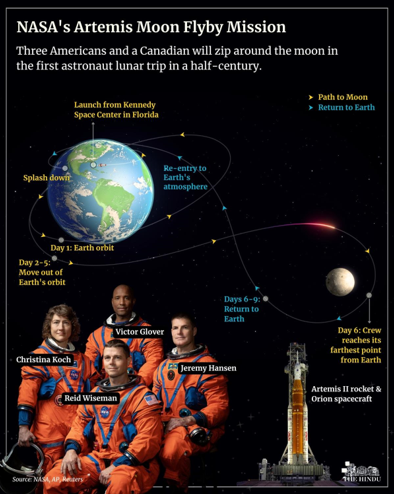
• The crew remains in Earth orbit for about a day to:
- Test life-support, navigation, and communication systems
- Perform manual piloting and proximity operations
• After system validation, the spacecraft performs the Trans-Lunar Injection (TLI) burn, sending it toward the Moon.
• The spacecraft follows a free-return trajectory, travelling around the Moon at a distance of about 7,500–10,000 km, including views of the far side, before returning to Earth.
• The mission duration is approximately 10 days, ending with re-entry at around 40,000 km/h and splashdown in the Pacific Ocean.
About the Artemis II Mission
• Artemis II is the first crewed mission of NASA’s Artemis programme, marking humanity’s return to deep space beyond low Earth orbit for the first time since Apollo 17.
• It is designed as a test flight without a lunar landing to validate systems required for future missions.
• The mission uses NASA’s powerful Space Launch System (SLS) rocket to launch the crew aboard the Orion spacecraft, which is specifically designed to support human life and operations during deep-space missions.
• Objectives: The primary objective of Artemis II is to test life-support systems with astronauts onboard, while also validating the spacecraft’s navigation, communication, and safety systems, thereby ensuring that all critical technologies and operations are ready for future crewed lunar landing missions.
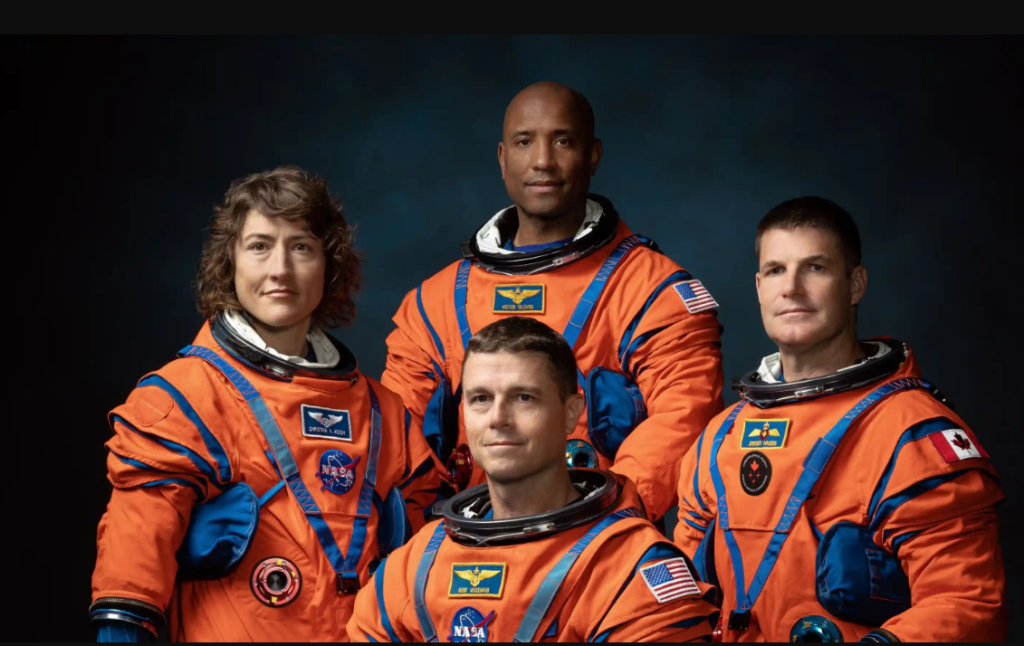
• Crew Composition: The mission carries a four-member crew consisting of commander Reid Wiseman, pilot Victor Glover, and mission specialists Christina Koch and Jeremy Hansen.
- It represents a historic milestone as it includes the first woman, first person of colour, and first non-U.S. astronaut to travel on a lunar trajectory.
• Scientific & Technical Aspects: The mission includes deployment of CubeSats and scientific observations.
- Key areas of study include Radiation exposure in deep space, Human physiological response, and Lunar surface imaging.
• Significance:
- Artemis II is the first human mission beyond low Earth orbit in over 50 years.
- It serves as a crucial stepping stone for future missions such as Artemis III, which aims to land humans on the Moon.
- It contributes to long-term goals of establishing a sustained human presence on the Moon and enabling future missions to Mars.
- Strategically, it assumes importance amid the evolving global space race, especially with China’s plans for a crewed Moon landing by 2030, focusing on the lunar south pole.
About the Artemis I Mission
• Launched in 2022, Artemis I was the first mission of NASA’s Artemis programme and marked the beginning of a series of increasingly complex missions aimed at enabling human exploration of the Moon and eventually Mars.
• It was an uncrewed lunar flight test conducted from November 16 to December 11, 2022, lasting 25 days, during which the Space Launch System (SLS) carried the Orion spacecraft on a 1.4-million-mile journey beyond the Moon and back.
• The mission was designed to test critical deep-space exploration systems and successfully demonstrated key capabilities of Orion, including lunar flybys, operation in a distant retrograde orbit, and safe atmospheric re-entry followed by splashdown in the Pacific Ocean.
• Artemis I also set a new benchmark in human-rated deep space exploration, as the spacecraft reached a maximum distance of 268,563 miles from Earth, surpassing the previous record set during Apollo 13, thereby paving the way for future crewed missions.