
SYLLABUS
GS-1: Population and associated issues, poverty and developmental issues, urbanization, their problems and their remedies.
GS-2: Government Policies and Interventions for Development in various sectors and Issues arising out of their Design and Implementation.
Context: The Government of India has commenced the first phase of Census 2027, the world’s largest population census exercise, with a first-ever digital approach.
More on the News
• The first phase of Census 2027 began on April 1, 2026, with the Houselisting and Housing Census (HLO).
• The exercise starts with a self-enumeration window of 15 days, followed by door-to-door houselisting operations by enumerators.
• Self-enumeration has been rolled out in select States and Union Territories, including Andaman and Nicobar Islands, Goa, Karnataka, Lakshadweep, Mizoram, Odisha, Sikkim, and areas under NDMC and Delhi Cantonment Board.
• President Droupadi Murmu became the first citizen to complete self-enumeration, continuing the tradition of initiating the Census with the Head of State.
About the Census of India 2027
• Census 2027 will be the 16th Census of India and the 8th after Independence.
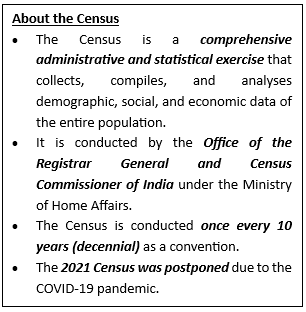
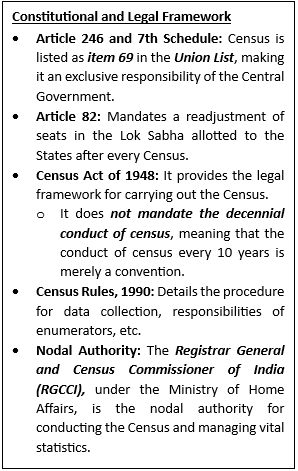
• Conducted under the Census Act, 1948, and Census Rules, 1990
• The Census will be conducted in two phases:
- Houselisting and Housing Census (April–September 2026): Involves listing all buildings and structures with geo-tagging and unique IDs, while collecting detailed data through a 33-question schedule on housing conditions, amenities, assets, and key household indicators such as headship, consumption patterns, and family composition.
- Population Enumeration (February 2027): The Phase will collect data on demographic, socio-cultural, and economic parameters, including migration and fertility.
- March 1, 2027, has been fixed as the reference date for most of the country.
- For snow-bound regions such as Ladakh and parts of Jammu and Kashmir, Himachal Pradesh and Uttarakhand, the reference date has been fixed as October 1, 2026.
• Digital and Technological Innovations: Census 2027 will be India’s first fully digital census, with the following initiatives:
- Mobile applications (Android & iOS) for real-time data collection.
- Census Management & Monitoring System (CMMS): A dedicated portal for end-to-end, real-time monitoring.
- Houselisting Block (HLB) Creator Web Map Application: For precise area demarcation by Charge Officers.
- Self-enumeration option for citizens.
- Robust data security features for digital operations.
- Census-as-a-Service (CaaS): Clean, machine-readable, and actionable data delivery to Ministries.
- Improved data dissemination with user-friendly dashboards and visualization tools, down to village/ward level.
• Inclusion of Caste Enumeration: As decided by the Cabinet Committee on Political Affairs (April 2025), caste enumeration will be included.
- Caste data will be collected digitally during the Population Enumeration phase, considering India’s social and demographic diversity.
• Implementation Strategy: Door-to-door household visits with separate questionnaires for HLHC and PE.
- Census functionaries appointed at the sub-district, district, and state levels by respective administrations.
- A nationwide publicity and awareness campaign focusing on inclusive participation, last-mile outreach, and dissemination of accurate information.
• Unlike 2019, the government statement does not mention a separate budgetary allocation for updating the National Population Register (NPR).
Historical Overview of Census in India
Pre-Independence:
• For the first time, a census was conducted in the towns of Allahabad (1824) and Banaras (1827-28) by James Prinsep.
• The first complete census of an Indian city was conducted in 1830 in Dacca by Henry Walter.
• The first nationwide census was undertaken in 1872 under Lord Mayo.
• The first modern synchronous census covering all of British India (except Kashmir) was undertaken in 1881 by W.C. Plowden, initiating the decennial census followed to the present day.
• The 1931 census was the last to record comprehensive caste data. This caste data was used by the Mandal Commission to recommend 27% reservations for Backward Classes.
Post-Independence:
• The 1951 census was the first to be conducted under the Census Act, 1948. It excluded caste enumeration for the general population except for SC and ST population. Now, the focus shifted to socio-economic parameters like education, literacy, and employment status.
• The National Population Register (NPR), launched in 2010 and updated in 2015, was designed to build a detailed identity database of all usual residents.
• The Socio-Economic and Caste Census (SECC) 2011 was a one-off exercise conducted separately from the main Census.
Sources:
Indian Express
PIB
Indian Express
The Hindu
Money Control