
SYLLABUS
GS-1: Role of women and women’s organization, population and associated issues, poverty and developmental issues, urbanization, their problems and their remedies.
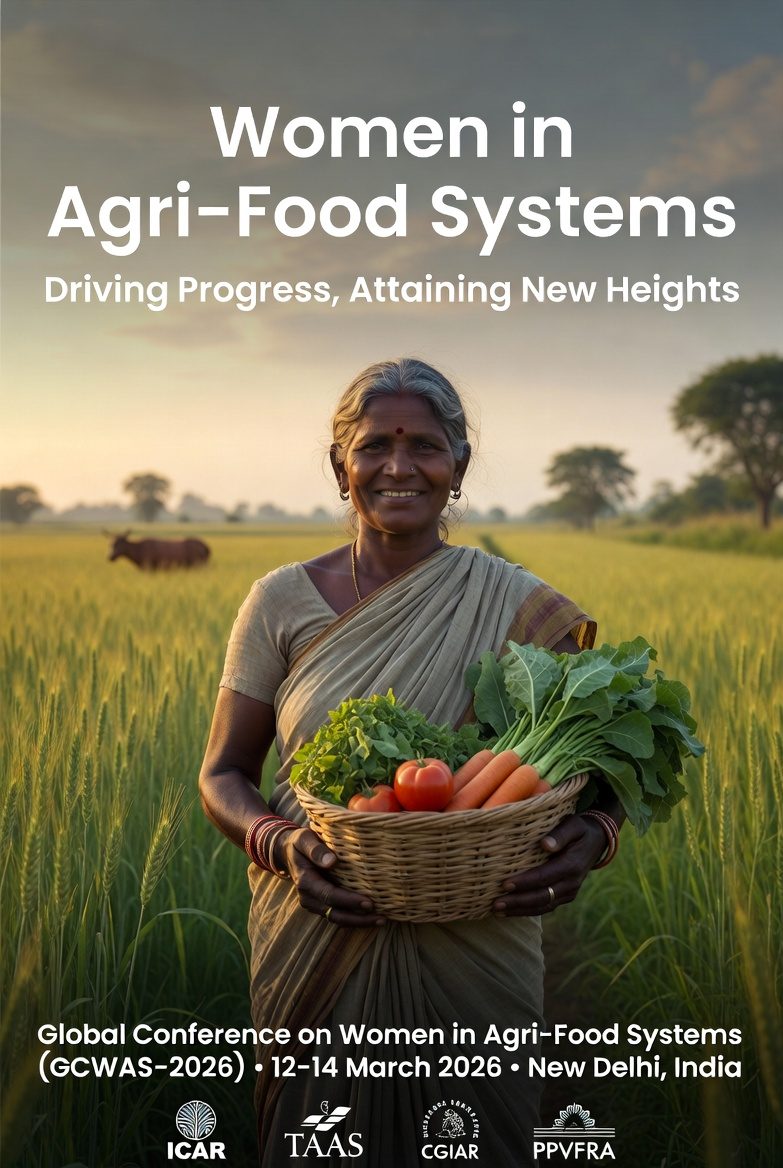
Context: The Global Conference on Women in Agri-Food Systems (GCWAS–2026), held in New Delhi, concluded by calling for stronger women’s leadership, participation, and innovation in agriculture and agri-food systems.
More on the News
- The conference brought together policymakers, scientists, development partners, and women leaders from 18 countries to discuss gender-responsive policies, inclusive innovations, and sustainable agricultural development.
- During the valedictory session, the Secretary of the Department of Agricultural Research and Education and Director General of the Indian Council of Agricultural Research (ICAR), emphasized that the conference should mark the beginning of renewed action for gender-responsive agri-food systems.
- The platform aims to strengthen research, extension services, and capacity-building initiatives focused on women in agriculture, supported by gender-disaggregated data for evidence-based policymaking.
- The conference adopted the Delhi Declaration, which calls for the creation of a Global Alliance on Women in Agri-Food Systemsto promote gender-responsive policies and strengthen women’s participation across agri-food value chains.
- The conference featured nine thematic technical sessions focusing on issues such as:
- Gender equality and social inclusion
- Women’s leadership in agriculture
- Emerging technologies for gender-transformative change
- Women’s economic inclusion
- Policy and market access
- Youth engagement in agri-food systems
About the Global Conference on Women in Agri-Food Systems (GCWAS–2026)
- It is an international platform for dialogue, knowledge sharing, and collaboration aimed at strengthening women’s participation and leadership across agri-food systems.
- It was organized from 12–14 March 2026 in New Delhi by the Indian Council of Agricultural Research (ICAR) in collaboration with the Trust for Advancement of Agricultural Sciences (TAAS), CGIAR, and the Protection of Plant Varieties and Farmers’ Rights Authority (PPV&FRA).
- The event brought together over 500 participants, including researchers, policymakers, women farmers, entrepreneurs, NGOs, farmer organizations, industry representatives, and students.
- The conference served as a global platform to share best practices, success stories, and innovative solutions for advancing gender equality in agriculture.
- It aimed to promote gender-responsive policies, technological innovations, and institutional collaboration to strengthen women’s role across the agri-food value chain.
Key Highlights
- Strengthening Women’s Role in Agriculture: Women contribute around 60–70% of the agricultural labour force, highlighting the need to expand their access to knowledge, credit, markets, and training.
- The Delhi Declaration, which calls for establishing a Global Alliance on Women in Agri-Food Systems. The declaration commits stakeholders to:
- Promote gender-responsive policies and institutional reforms
- Improve women’s access to land, finance, technology, markets, and digital innovation
- Strengthen leadership and entrepreneurship among women farmers and agri-business leaders
- Ensure gender-responsive budgeting
- Expand systematic collection of gender-disaggregated data
- Establish accountability mechanisms such as gender audits and progress reporting
- Promote global exchange of scalable innovations and women-led development models
- Recognition of Women as Biodiversity Custodians: Women play a vital role in conserving plant genetic resources and biodiversity, yet their contributions often remain unrecognized.
- The conference emphasized the need for institutional and financial support to empower such grassroots custodians.
- Strengthening Women’s Economic Empowerment: Participants recommended:
- Simplifying regulatory processes in seed value chains
- Supporting women to transition from custodians to agri-entrepreneurs
- Expanding credit access, growth finance, and market linkages
- Scaling women-led agri-business enterprises
- Integrating Agriculture with Health and Sustainability: Delegates stressed the importance of linking agriculture, nutrition, health, and environmental sustainability through frameworks such as One Health to support inclusive development.
- Promoting Gender-Responsive Innovation and Technology: Recommendations included:
- Promoting women-friendly agricultural technologies
- Bridging the digital divide through localized digital tools and advisory services
- Strengthening climate-resilient agriculture
- Enhancing digital literacy among women farmers
- Strengthening Institutional Convergence: The conference called for stronger collaboration among Government programmes, Research institutions, Universities and Private sector partners.
- Universities were identified as innovation and incubation hubs for women-led agricultural entrepreneurship.
- Key Policy and Governance Reforms suggested include:
- Mainstreaming gender equality in agricultural policies
- Ensuring women’s land rights and access to productive resources
- Strengthening gender-responsive extension systems
- Introducing gender-responsive impact metrics and monitoring systems
Source :
PIB
DD News
President of India
ICAR