

SYLLABUS
GS-3: Indian Economy and issues relating to planning, mobilisation of resources, growth, development and employment.
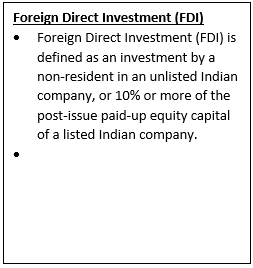
Context: The Union Cabinet recently approved amendments to foreign direct investment (FDI) guidelines for countries sharing land borders with India (LBCs) to ease investment restrictions while safeguarding strategic and ownership interests.
More on the News
• The decision modifies restrictions introduced under Press Note 3 (2020), which required government approval for investments from such countries.
- Press Note 3, issued in 2020, had specified that any entity of a country that shares a land border with India can invest in India only after securing Government approval. Earlier, this rule had applied only to entities in Bangladesh and Pakistan. The 2020 rule expanded this to the other countries that shared land borders with India, especially China.
• The amendment introduces a beneficial ownership framework and relaxes restrictions for certain non-controlling investments from neighbouring countries.
• The government also announced a faster approval mechanism for investments in selected manufacturing sectors.
• The reform aims to attract higher capital inflows while ensuring safeguards over ownership and control of Indian companies.
Key Changes in the Guidelines
• Definition of Beneficial Ownership: The amendment incorporates a formal definition and criteria for determining Beneficial Ownership based on provisions of the Prevention of Money Laundering Rules, 2005.
• Application of Beneficial Ownership Test: The beneficial ownership test will be applied at the level of the investor entity to identify the ultimate owner of the investment.
• Automatic Route for Limited Non-Controlling Investments: The government allows investors with non-controlling beneficial ownership of up to 10% from land bordering countries to invest through the automatic route.
• Compliance with Existing FDI Conditions: The investment must comply with existing sectoral caps, entry routes and other applicable conditions.
• Mandatory Reporting Requirement: The investee company will report all relevant investment details to the Department for Promotion of Industry and Internal Trade (DPIIT).
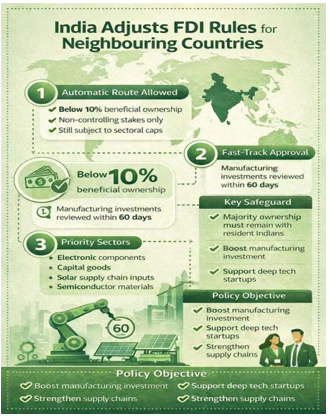
• Time-Bound Approval Mechanism: The government will process proposals for investments from land bordering countries in selected manufacturing sectors within a 60-day timeline.
• Coverage of Strategic Manufacturing Sectors: These sectors include manufacturing of capital goods, electronic components, polysilicon and ingot-wafer.
• Scope for Sectoral Revision: The Committee of Secretaries under the Cabinet Secretary may revise the list of specified sectors when required.
• Retention of Indian Ownership and Control: The guidelines mandate that majority shareholding and effective control of the investee company will remain with resident Indian citizens or Indian entities owned and controlled by them.
Significance of the Change
• The reform provides regulatory clarity for global investors, including private equity and venture capital funds that may have minor exposure to investors from neighbouring countries.
• The change is expected to improve ease of doing business by simplifying investment procedures and introducing a defined approval timeline.
• The policy can help unlock greater FDI inflows for startups, deep-tech and manufacturing sectors while maintaining safeguards for national security.
• The reform may facilitate technology transfer, joint ventures and deeper integration of Indian firms into global supply chains.
• The guidelines aim to strengthen domestic manufacturing capacity, particularly in electronics and advanced components.
• The policy balances economic openness with strategic safeguards by ensuring Indian ownership and control in critical sectors.