
SYLLABUS
GS-3: Awareness in the fields of IT, Space.
Context: Recently, NASA announced major structural changes to its Artemis Program following technical delays in the Space Launch System rocket.
More on the News
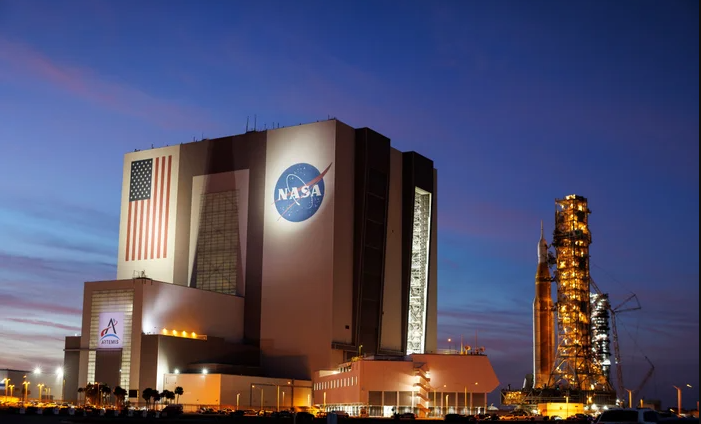
• The decision followed several technical problems encountered during preparations for the Artemis II mission at Kennedy Space Centre in Florida.
• Due to these technical concerns, the launch of Artemis II has been postponed, and it is now expected to take place no earlier than April 2026.
• The restructuring was also influenced by recommendations from the Aerospace Safety Advisory Panel, which warned that the original Artemis III Moon landing plan involved significant risks.
Key Changes in the Artemis Programme
• NASA has delayed the first crewed Moon landing of the Artemis Program to 2028, shifting the landing objective from Artemis III to Artemis IV.
• An additional test mission has been introduced in 2027, under which Artemis III will conduct technology demonstrations rather than attempt a lunar landing.
• Artemis III will now perform docking and system integration tests in low Earth orbit with commercial Human Landing System vehicles being developed by SpaceX and Blue Origin.
• The mission will validate critical technologies such as autonomous docking, life-support integration, propulsion interfaces and next-generation spacesuits before astronauts attempt a lunar landing.
• The restructuring aims to increase launch frequency, reducing the gap between Artemis missions from roughly three years to less than a year.
• The programme will adopt a step-by-step mission approach, similar to earlier human spaceflight programmes such as the Apollo program, to gradually test systems and reduce mission risks.
About the Artemis Programme
• NASA’s Artemis program is a multi-mission lunar exploration campaign designed to re-establish a human presence on the Moon for the first time since 1972.
• The programme uses the Space Launch System rocket and the Orion spacecraft to transport astronauts and cargo to deep space.
• It follows a phased mission approach, beginning with uncrewed testing missions, followed by crewed lunar flybys and eventually human landings on the Moon.
• The programme also aims to support long-term exploration through the development of the Lunar Gateway and to prepare for future human missions to Mars.
| Mission | Current Key Objective | Target Date |
| Artemis I | Completed uncrewed test flight of the Space Launch System rocket and Orion spacecraft around the Moon, validating key systems for deep-space missions. | November 2022 |
| Artemis II | First crewed mission of the Artemis programme; four astronauts will conduct a lunar flyby to test life-support systems and deep-space navigation. | April 2026 |
| Artemis III | Technology rehearsal mission in low Earth orbit to test rendezvous and docking with commercial lunar landers developed by SpaceX and Blue Origin, along with new spacesuits by Axiom Space. | Mid-2027 |
| Artemis IV | First human landing of the Artemis era, returning astronauts to the Moon’s surface for the first time since 1972. | Early 2028 |
| Artemis V and beyond | The expansion phase aimed at sustained human presence on the Moon, including a second crewed landing and development of Artemis Base Camp and lunar infrastructure. | Late 2028 and beyond |