

SYLLABUS
GS-1: Role of women and women’s organization, population and associated issues, poverty and developmental issues, urbanization, their problems and their remedies.
Context: A recent report by the World Bank Group highlights that laws designed to ensure equal economic opportunities for women are only half-enforced globally, exposing deep structural barriers that continue to limit women’s contribution to economic growth and prosperity.
About the Women, Business, and the Law (WBL) Report
• The WBL is a global benchmarking project of the World Bank that assesses women’s economic rights worldwide.
• It evaluates how laws, regulations, and policies affect women’s economic participation across 190 economies.
• For the first time, the latest edition examines not only legal equality but also enforcement and the availability of implementation systems.
• The report covers 10 domains such as safety from violence, employment protections, entrepreneurship, childcare access, asset ownership, and retirement security.
• It aims to help countries identify reforms that unlock women’s economic potential and promote inclusive growth and job creation.
Key Findings of the Report
• Major Gap Between Laws and Enforcement: Globally, laws promoting women’s economic participation are only about 50% enforced, revealing a large gap between legal provisions and actual outcomes.
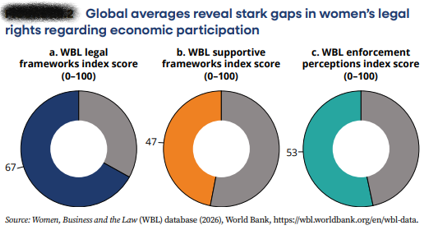
- Even with full enforcement, women would still have barely two-thirds of men’s legal rights, and only 4% of women live in near-equal legal systems (67 legal score vs 53 enforcement vs 47 implementation).
• Weak Implementation Ecosystems: Most economies lack even half of the institutional systems required to implement gender laws effectively.
- Weak enforcement mechanisms and institutions prevent legal reforms from translating into real economic empowerment, slowing growth and job creation.
• Safety from Violence – A Critical Barrier: Safety gaps remain one of the biggest barriers, with only one-third of required legal protections in place globally.
- Even where laws exist, enforcement fails nearly 80% of the time, restricting women’s mobility and workforce participation.
• Entrepreneurship Challenges: While women can legally start businesses in most countries, equal access to credit exists in only about half of economies.
- Persistent financing constraints continue to limit the scale and sustainability of women-led enterprises.
• Childcare as a Structural Constraint: Affordable childcare remains a decisive factor for women’s workforce participation, yet fewer than half of economies offer financial or tax support.
- Globally, only 30% of needed childcare policies exist, and in low-income countries, barely 1% of support systems are operational.
• Demographic Urgency: Over the next decade, 1.2 billion youth will enter the workforce, nearly half of them girls.
- With many coming from high gender-gap regions, ensuring equal opportunity is an economic imperative, not just a social goal.
• Progress Noted by the Report: Despite implementation gaps, 68 economies enacted 113 gender-related reforms in the last two years.
- Most reforms focused on entrepreneurship and violence protection, while seven countries introduced or expanded paternity leave to promote shared caregiving.
• Regional Highlights: Sub-Saharan Africa recorded the highest reform momentum with 33 legal changes.
- Countries such as Madagascar and Somalia removed restrictions on women working in sectors like construction and manufacturing.
• Country Example – Egypt: Egypt emerged as the top reformer by expanding maternity leave from 90 to 120 days and introducing paid paternity leave.
- It also mandated equal pay, enabled flexible work requests, and improved its legal gender equality score by nearly 10 points.