
SYLLABUS
GS-2: Bilateral, Regional and Global Groupings and Agreements involving India and/or affecting India’s interests.
GS-3: Indigenization of Technology and Developing New Technology; Awareness in the fields of IT, Space, Computers, Robotics, etc.
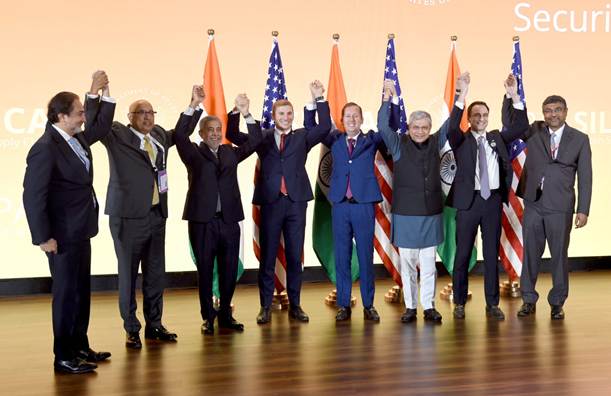
Context: During the India AI Impact Summit 2026, India has formally joined the US-led Pax Silica initiative, marking a significant milestone in building a common supply chain for electronics and critical minerals.
More on the News
- India’s entry follows an invitation extended in early 2026 and comes about two months after the inaugural Pax Silica Summit in Washington (December 2025).
- The move comes amid a broader India–US reset involving tariff rollbacks, a proposed trade framework, and deepening cooperation in AI, semiconductors and critical minerals.
- The signing also coincides with large AI‑infrastructure commitments in India, including multi-billion-dollar investments announced by Microsoft and Google in data centres, cloud and subsea connectivity, which complement the goals of Pax Silica.
About Pax Silica
- Pax Silica (from Latin Pax, meaning peace, and Silica, referring to the mineral base of semiconductors) is a U.S.-led strategic coalition of trusted nations.
- It is aimed at building trusted, resilient supply chains across the entire “silicon stack”, i.e. from critical minerals and energy to semiconductor fabrication, AI compute, data centres, connectivity and logistics.
- India joined as the tenth Pax Silica signatory. The earlier members include Australia, Israel, Japan, Qatar, the Republic of Korea, Singapore, the United Arab Emirates, and the United Kingdom.
- Its objectives include:
- Reducing “coercive dependencies” on concentrated suppliers (notably China) in critical minerals and advanced manufacturing.
- Co‑investment and joint ventures in minerals, fabs, AI infrastructure and secure connectivity.
- Protecting sensitive technologies and critical infrastructure from undue foreign control, and promoting aligned rules and governance for the AI economy.
- The initiative is widely viewed as a strategic response to China’s dominance in rare earth processing and critical technology supply chains, particularly in the semiconductor and AI ecosystems.
Significance of Pax Silica
- Supply Chain Resilience: Pax Silica is framed by Washington as a flagship economic‑security effort for the AI era, seeking to shape the 21st‑century technological order around a network of “trusted” democracies.
- Countering Overconcentration: The initiative aims to reduce dominance in areas where China has leveraged its position, particularly refined rare earths.
- Economic and Innovation Benefits: By pooling capital, technology and markets, Pax Silica aspires to sustain large‑scale AI deployment, support green and digital transitions, and create high‑value industrial jobs across member economies.
Significance for India
- Integration into Advanced Supply Chains: The initiative positions India within a trusted network covering minerals, semiconductors, and AI infrastructure.
- Access to Trusted AI and Semiconductor Ecosystems: Since India currently lacks global-scale AI and semiconductor infrastructure and relies heavily on imports for chips and refined critical minerals, Pax Silica offers an avenue to plug into advanced fabs, design ecosystems, and AI compute capacity.
- The participation also supports India’s Semiconductor Mission and National Critical Mineral Mission.
- Supporting “China+1”: As US and European firms pursue China+1 diversification, India’s presence in this coalition strengthens its bid to become a major hub of supply chains, from electronics assembly to data‑centre hubs.
- Domestic Industrial and Talent Gains: With a large STEM workforce and expanding startup base, India can position itself as a design, software and services powerhouse within the coalition.
Other Similar Initiatives
- Indo-Pacific Economic Framework (IPEF): It is led by the United States, of which India is also a member. It focuses on Resilient Supply Chain & Clean Economy.
- Minerals Security Partnership (MSP): India joined in 2023, and it focuses on Critical minerals like lithium, cobalt, and other rare earths.
- Quad’s Critical & Emerging Technologies Working Group: It focuses on Strategic tech coordination among trusted democracies.