
SYLLABUS
GS-1: Role of women and women’s organization, population and associated issues, poverty and developmental issues, urbanization, their problems and their remedies.
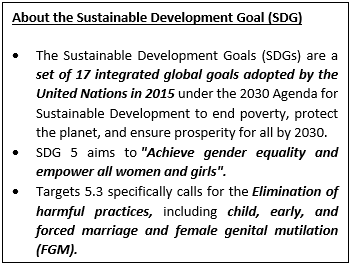
Context: Recently, the African Union released the Presidential Champion Report on Ending Child Marriage in Africa, warning that the continent is not on track to meet Sustainable Development Goal (SDG) 5.3, which targets elimination of child marriage by 2030.
More on the News
• The report was launched during the 39th Ordinary Session of the African Union Heads of State and Government and presented by Zambian President Hakainde Hichilema, the AU Champion on Ending Child Marriage.
Key Highlights of the Report
• Scale of the challenge: Africa accounts for one in three child brides globally.
- Around 130 million girls and women in Africa were married before the age of 18.
- If trends continue, Africa could account for nearly 50% of global child brides by 2050.
- Progress must be 20 times faster to achieve the SDG target by 2030.
• Regional Distribution: Sub-Saharan Africa bears the highest burden globally.
- West and Central Africa have the highest prevalence, including seven of the ten countries globally.
- In parts of the Sahel, more than half of girls marry before 18, and in some areas, exceeding 80% prevalence.
The Sahel is a vast semi-arid transitional zone separating the Sahara Desert in the north from the tropical savannas in the south.
- Eastern Africa has made progress, reducing prevalence from 48 percent to 31 percent over the past twenty-five years.
• Drivers of Child Marriage; The “Polycrisis” Effect: The report highlights overlapping crises worsening vulnerabilities:
- Climate shocks affecting livelihoods and schooling.
- Armed conflict and displacement increasing protection risks.
- Pandemics weaken social protection systems.
• Climate-Specific Findings: A 10% rainfall deviation is linked to a 1% rise in child marriage.
- During the drought in southern Africa, 70% of school dropouts were girls.
- Loss of livestock in pastoral regions has increased reliance on bridewealth-based early marriages.
- Desertification in the Sahel reinforces early marriage as a coping mechanism.
• Case Study-Zambia’s Progress: Zambia is highlighted as an example of strong political commitment and reform in tackling child marriage.
- The country reduced child marriage prevalence from 29% in 2018 to 23.9% in 2024 through legal bans, free education policies, and re-entry support for adolescent mothers.
- Community mobilisation and engagement with traditional leaders also played a key role in driving progress.
Strategic Pathways for AU Member States
• Governance and Legal Reforms: AU member states should set 18 years as the minimum marriage age without exceptions, harmonise statutory, customary, and religious laws, and strengthen enforcement and accountability systems.
• Social and Economic Measures: Governments should invest in girls’ education and empowerment while expanding cash transfers, scholarships, vocational training, and survivor-centred policies.
• Climate and Humanitarian Integration: Child marriage prevention should be integrated into climate adaptation strategies and humanitarian and disaster response frameworks.
• Technology and Data: Countries should deploy digital tools for awareness, reporting, and age verification while improving real-time data and predictive analytics.
• Regional Cooperation: The report calls for stronger collaboration through Regional Economic Communities (RECs), sharing best practices, and harmonising cross-border responses.