
SYLLABUS
GS-3: Indian Economy and issues relating to planning, mobilisation of resources, growth, development and employment.
Context: Recently, the Reserve Bank of India (RBI) notified the Foreign Exchange Management (Borrowing and Lending) (First Amendment) Regulations, 2026.
More on the News
• The amendment revises the External Commercial Borrowing (ECB) framework under FEMA to rationalise limits, strengthen monitoring, and align the rules with evolving global financing practices.
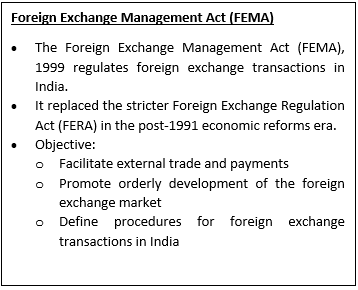
• The amendment introduces structural changes to the ECB regime under the Foreign Exchange Management Act (FEMA), 1999.
- External Commercial Borrowing (ECB) refers to commercial loans raised by eligible Indian entities from recognized non-resident lenders.
• The revised regulations were finalised after stakeholder consultations on the draft released in October 2025.
• Existing ECBs will continue under the earlier framework, but reporting must follow the new compliance norms.
Key Highlights of the Amendment
• Expanded Eligible Borrowers and Lenders: Any non-individual resident entity incorporated under Indian law can raise ECB from recognised overseas lenders, including IFSC-based institutions.
• Revised Borrowing Limits: ECB borrowing is capped at the higher of USD 1 billion or 300% of net worth, with exemptions for regulated financial entities.
• Minimum Average Maturity Period (MAMP): The standard MAMP is 3 years, while manufacturing entities can access shorter maturities (1–3 years) within prescribed limits.
• Cost of Borrowing Liberalised: Borrowing costs are largely market-determined, with ceilings only for very short-term loans and arm’s-length pricing for related-party ECBs.
• Currency Flexibility: ECBs can be raised in foreign currency or INR, with permitted currency conversion under safeguards.
• End-Use Restrictions Strengthened: ECB proceeds cannot be used for activities like real estate, chit funds, capital markets, certain agriculture uses, NPA-linked refinancing, or prohibited on-lending.
• Reporting and Compliance Reforms: Updated reporting mandates include ECB-1/ECB-2 filings, stricter timelines, late submission fees, and new compliance disclosures.
• Treatment of ECB Proceeds: ECB funds must flow through designated AD banks and can be temporarily parked in approved short-term instruments until use.
Significance of the Amendment
• Rationalisation of ECB Framework: The amendment simplifies borrowing limits and eligibility, making the framework more transparent and rules-based.
• Improved Access to Global Capital: A wide borrower and lender base enhances access to overseas funds and boosts capital inflows.
• Stronger Regulatory Oversight: Tighter end-use restrictions and improved reporting strengthen prudential supervision.
• Support to Manufacturing and Infrastructure: Relaxed maturity norms encourage long-term investment in the productive sector.
• Prevention of Financial Misuse: Curbs on NPA refinancing and speculative uses reduce regulatory arbitrage and evergreening.