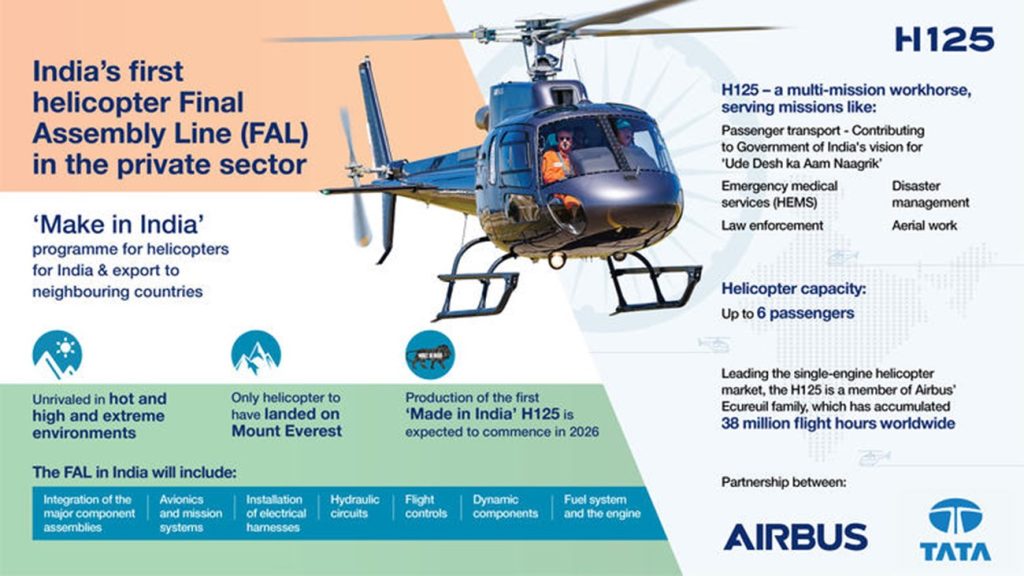
‘Bharat VISTAAR’ scheme
Context: Recently, the Union Minister for Agriculture and Farmers’ Welfare and Rural Development launched phase I of the ‘Bharat VISTAAR’ scheme in Jaipur, Rajasthan, as part of India’s push for AI-driven agricultural transformation.
About the Bharat VISTAAR
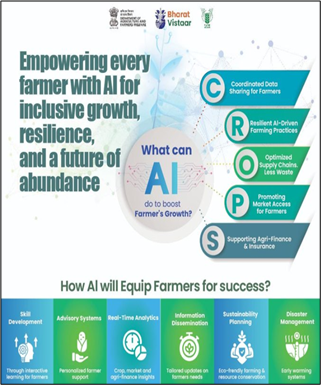
- Bharat-VISTAAR (Virtually Integrated System to Access Agricultural Resources) is an AI-powered digital public infrastructure (DPI) designed as a single digital gateway for farmers.
- It integrates data from sources such as AgriStack, ICAR advisories, IMD weather data, mandi prices (Agmarknet), and various government schemes to provide unified agricultural services.
- Objective:
- The scheme aims to provide farmers with real-time agriculture-related information and advisory services through technology.
- Key Features:
- Voice-first AI platform: Farmers can dial 155261 to ask queries, receive instant advisory, and check mandi prices, even using feature phones.
- Multilingual access: Initially available in Hindi and English, with plans to expand to 11 languages.
- Farmer Identity Card: A digital Farmer ID will store farmer profiles, scheme eligibility, and benefit tracking, initially linked with schemes like Pradhan Mantri Fasal Bima Yojana and Soil Health Card.
- Integrated services: Provides weather forecasts, pest alerts, crop advisory, soil and fertiliser guidance, scheme details, and complaint tracking.
- Multiple access modes: Available via helpline, chatbot, web interface, and upcoming mobile apps.
Project Vault
Context: The United States has launched Project Vault, a strategic initiative to create a domestic reserve of critical minerals aimed at safeguarding industries from geopolitical supply disruptions and economic coercion.
About Project Vault
- A public-private partnership designed as an independently governed and operated entity rather than a fully government-controlled reserve.
- Supported by up to $10 billion in financing from the Export-Import Bank of the United States (EXIM), along with additional private investment (~$2 billion).
- The project aims to stockpile 60 critical minerals identified in the U.S. Geological Survey (USGS) 2025 Critical Mineral List.
- EXIM will provide long-term loans to procure and store minerals domestically.
- The minerals will be procured and stored on behalf of participating companies based on upfront commitments.
- Withdrawal and replenishment will occur under predefined market disruption conditions, with participants paying storage premiums.
- Inspired by the model of the Strategic Petroleum Reserve (1975) as a buffer against supply shocks.
- The move follows growing concerns over supply chain vulnerabilities, especially due to China’s dominance in mining, processing, and rare earth magnet exports.
Significance of Project Vault
- The initiative treats critical minerals as strategic assets central to national power and economic security.
- The project reduces dependence on foreign-controlled supply chains vulnerable to coercion and disruption.
- The reserve provides an insurance mechanism for domestic manufacturers against volatile spot market prices.
- Strengthens resilience of U.S. industrial ecosystems and complements domestic mining and processing initiatives.
- May support alternative global supply chains by creating predictable demand beyond dominant suppliers.
‘Bee Corridors’ Along the National Highways
Context: Recently, the National Highways Authority of India (NHAI) announced a first-of-its-kind initiative to develop Pollinator or Bee Corridors along National Highways as part of sustainable infrastructure development.
Key Objectives
- To ensure year-round availability of nectar and pollen for pollinators.
- To reduce growing ecological stress on honeybees and wild pollinators.
- To address declining pollination services affecting agricultural, horticultural and ecological balance.
- To shift from ornamental roadside plantations to biodiversity-rich ecological plantations.
Ecological Design
- The corridor will include a mix of trees, shrubs, herbs, and grasses.
- Wild elements such as flowering weeds, dead wood, and hollow trunks will be retained.
- Plant species will ensure staggered flowering across seasons for a near-continuous blooming cycle.
- The initiative prioritises native and nectar-rich plant species.
Major Plant Species
- Native and nectar-rich species such as Neem, Karanj, Mahua, Palash, Bottle Brush, Jamun, and Siris will be planted along National Highways.
Implementation Strategy
- Corridors will be developed along National Highway stretches and vacant NHAI land parcels based on agro-climatic suitability.
- Plantation clusters will be created at intervals of 500 meters to 1 km.
- The spacing aligns with the average foraging range of honeybees and wild bees.
- NHAI field offices will identify suitable locations across the country.
Targets
- At least three pollinator corridors will be developed during 2026-27.
- Around 40 lakh trees will be planted along National Highways.
- Nearly 60% of plantations will be under the ‘Bee Corridor’ initiative.
- The initiative is expected to enhance habitat connectivity, improve pollination efficiency, and contribute to long-term ecological stability.
EXERCISE MILAN 2026
Context: The Indian Navy is conducting the 13th edition of MILAN under the aegis of the Eastern Naval Command t Visakhapatnam (Bay of Bengal) to strengthen maritime cooperation and enhance interoperability among friendly navies in the Indo-Pacific.
More on the News
- MILAN 2026 is one of the largest multilateral naval exercises in the Indo-Pacific, bringing together navies from across the globe
- The invitations have been extended to over 135, with around 70 nations confirming participation.
- The exercise will include both Harbour and Sea Phases, covering:
- Anti-submarine warfare
- Air defence operations
- Maritime domain awareness
- Search and rescue missions
- Cooperative security and HADR operations
- The theme of MILAN 26 is Camaraderie, Cooperation, Collaboration.
- The exercise reflects India’s commitment to maritime security, rules-based seas, regional stability and cooperative engagement in the Indo-Pacific.
- The exercise is being held alongside two major events in Visakhapatnam:
- International Fleet Review (IFR) 2026 and
- the IONS (Indian Ocean Naval Symposium) Conclave of Chiefs.
- MILAN 2026 aligns with the Prime Minister’s Mutual and Holistic Advancement for Security and Growth Across Regions (MAHASAGAR) vision, reinforcing India’s role as:
- Preferred security partner
- Bridge between Global South and major powers
- Stakeholder in global maritime commons.
Historical Background
- The MILAN exercise began in 1995 at the Andaman and Nicobar Islands with participation from Indonesia, Singapore, Sri Lanka and Thailand.
- It is a biennial multilateral naval exercise of the Indian Navy.
- Participation has steadily expanded:
- 2014: 17 nations
- 2022: 42 countries
- 2026: ~70 confirmed participants (largest edition so far).
India’s First Private Sector Helicopter Final Assembly Line (FAL)
Context: Recently, the Prime Minister of India and the President of France virtually inaugurated the Tata Advanced Systems Final Assembly Line for the Airbus H125 helicopter.
More on the News
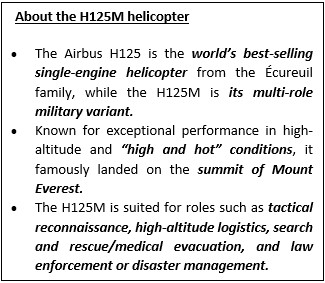
- The facility is located at Vemagal in Kolar district of Karnataka and is India’s first private sector helicopter Final Assembly Line.
- In aerospace manufacturing, a Final Assembly Line (FAL) is the concluding stage where all major pre-fabricated sections of an aircraft are integrated into a fully functional unit.
- The facility has been established by Tata Advanced Systems Limited (TASL) in partnership with Airbus.
- It marks a major step in India–France defence-industrial cooperation and supports the vision of Aatmanirbhar Bharat in aerospace.
Key highlights of the Development
- The facility will initially manufacture the civil variant of the Airbus H125 helicopter in India.
- It may also produce the military variant H125M in the future with high levels of localisation.
- The first Made in India H125 helicopter is expected to be delivered in early 2027.
- The helicopters produced here will serve domestic demand and export markets in South Asia.
- The project marks the first time the Indian private sector will undertake manufacturing, integration, testing and maintenance of a sophisticated rotary wing platform.
- The Karnataka government has allotted about 17 acres of land for the project.
- Around 500 helicopters may be produced over the next twenty years.
- The programme is expected to generate significant direct and indirect employment and strengthen India’s aerospace ecosystem.
- This is the second major Tata–Airbus collaboration, after the C295 transport aircraft assembly line.