

SYLLABUS
GS-2: Important Aspects of Governance, Transparency and Accountability.
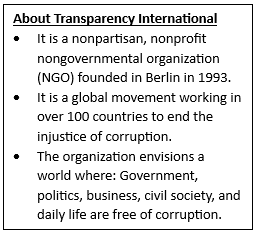
Context: Transparency International recently released the CPI 2025, which measures perceived levels of public-sector corruption across 182 countries and territories.
About the Corruption Perceptions Index (CPI)
• CPI is the most widely used global corruption ranking in the world, published annually by Transparency International since 1995.
• The index ranks 180-182 countries and territories by their perceived levels of public sector corruption.
• The index uses a scale from 0 to 100, where:
- 0 indicates highly corrupt,
- 100 indicates corruption-free.
• It aggregates 13 independent data sources (e.g., World Bank, WEF, risk consultancies) to provide a comparative global governance benchmark rather than a direct measure of corruption incidents.
• The CPI is widely used by governments, investors, researchers, and international organisations as a benchmark for governance quality, investment risk, and institutional transparency.
Key Findings of the Index
• Global Scores and Trends:
- The global average score has dropped to 42, its lowest level in more than a decade, signalling a worldwide backsliding in control of corruption.
- 122 out of 182 countries (more than two-thirds) score below 50, indicating that most governments are failing to keep public-sector corruption in check.
- The number of countries scoring above 80 has sharply declined from 12 a decade ago to just five this year, reflecting weakening integrity even among historically high-performing governance systems.
• Top and Bottom Performers:
- Denmark tops the index for the eighth consecutive year with a score of 89, followed by Finland (88) and Singapore (84); New Zealand and Norway complete the list of just five countries scoring above 80.
- At the bottom, Somalia (9) and South Sudan (9) are joint last, with Venezuela (10) just above them. These countries are marked by conflict, repression, and severely restricted civic space.
• Long-Term Trends:
- Since 2012, 31 countries have significantly improved their CPI scores, including Estonia (76), Bhutan (71), South Korea (63) and Seychelles (68), where sustained reforms, oversight and digital governance have strengthened integrity.
- 50 countries have significantly declined, such as Türkiye (31), Hungary (40) and Nicaragua (14), reflecting entrenched patronage, democratic backsliding and weakened institutions.
India-Specific Findings
• India has been ranked 91st out of 182 countries, with a score of 39/100 in CPI 2025 (a one-point improvement over 38 in the previous year)
o In the 2024 Index, India was ranked 96 with a score of 38/100.
• Despite the slight uptick, India’s score remains below the global average (42), indicating that corruption is still perceived as a systemic challenge.
• In its neighbourhood, India lags behind Bhutan (score 71, rank 18) and China (43, 76) but outperforms others, namely, Sri Lanka (35, 107), Nepal (34, 109), Pakistan (28, 136), Bangladesh (24, 150), with Afghanistan and Myanmar (16, 169).
Concerns Raised
• Transparency International warns of a “decline in leadership” on anti-corruption, even in established democracies like the US (64), Canada (75), New Zealand (81), UK (70), France (66) and Sweden (80), all of which have seen score slippage in recent years.
• In 36 of the 50 countries with the biggest CPI declines since 2012, civic space has also shrunk, with governments restricting NGOs, media and protests through legal and informal pressures.
• Between 2012 and 2025, 150 journalists investigating corruption were murdered outside conflict zones, over 90% in countries scoring below 50, including India (39), Brazil (35), Mexico (27), Pakistan (28) and Iraq (28).
Key Recommendations
• Strengthening Institutions: Strengthen independent justice systems and oversight institutions to ensure impartial investigation and prosecution of corruption cases.
• Ensuring Transparency: Enhance transparency in political finance, lobbying, and public procurement, reducing undue influence over policymaking.
• Protecting Civic Space: Protect civic space, including safeguarding journalists, whistle-blowers, and civil society organisations from intimidation or legal harassment.
• Tackling Transnational and Illicit Financial Flows: Combat transnational corruption by increasing beneficial-ownership transparency, regulating professional intermediaries, and facilitating asset recovery.
• Empowering Citizens: Give citizens and communities accessible complaint mechanisms and legal remedies against corruption, ensuring that those harmed can seek justice.