
SYLLABUS
GS-3: Conservation, environmental pollution and degradation, environmental impact assessment .
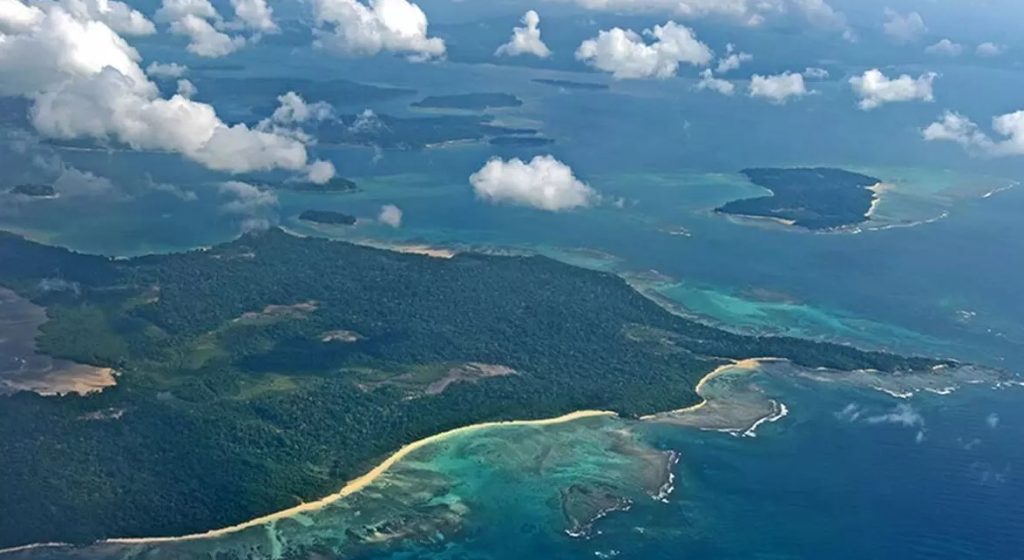
Context: A six-member special bench of the National Green Tribunal (NGT) upheld the Environmental Clearance (EC) granted to the Great Nicobar Island mega infrastructure project, stating it found “no good ground to interfere” with the approval.
NGT Ruling and Litigation Background
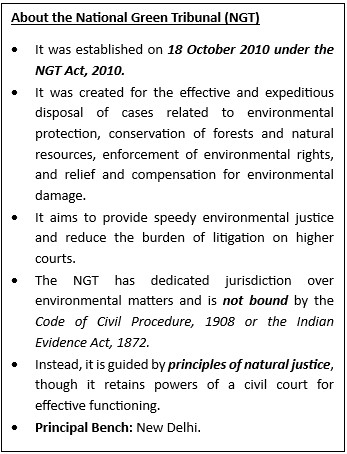
- The tribunal emphasised a balanced approach between ecological protection and strategic development, noting that safeguards were built into the EC.
- It found no conclusive violation of the Island Coastal Regulation Zone (ICRZ) Notification, 2019, and relied on findings of a High-Powered Committee (HPC) constituted earlier.
- The NGT directed protection of shorelines, conservation of sandy nesting beaches, and scientific coral regeneration, with compliance responsibility placed on the Union Environment Ministry.
- Environmental clearance was originally granted in November 2022, along with in-principle forest clearance, triggering multiple petitions citing coastal regulation violations, weak EIA data, and tribal rights concerns.
- In 2023, the NGT largely upheld the clearance but formed an HPC to examine issues related to coral reefs and coastal zones; the report was not made public, citing strategic and security concerns.
- The 2026 ruling represents the second round of litigation, reaffirming the EC; however, forest clearance issues remain under challenge before the Calcutta High Court.
About the Great Nicobar Island Mega Project
- Launched in March 2021 by NITI Aayog under the “Holistic Development of Great Nicobar Island” initiative aimed at transforming the southernmost Andaman and Nicobar Island into a strategic and economic hub.
- Implemented by the Andaman and Nicobar Islands Integrated Development Corporation (ANIIDCO).
- Estimated cost ranges between ₹72,000–₹92,000 crore across phases.
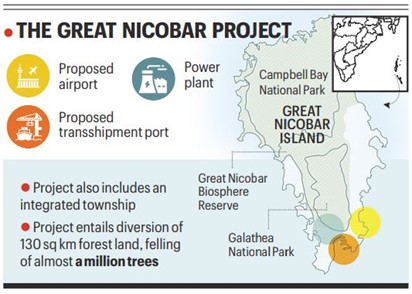
- Covers ~166 sq. km (~18% of the island), including ~130.75 sq. km of forest land and parts of tribal areas.
- Key components include:
- International Container Transshipment Terminal at Galathea Bay to reduce dependence on foreign ports.
- Dual-use greenfield international airport (civilian + military) for connectivity and strategic operations.
- Large integrated township with projected population growth from ~8,000 to over 3.5 lakh.
- 450 MVA gas- and solar-based power plant to support infrastructure.
Significance
- Strategic Importance:
- The island lies near the western entrance of the Strait of Malacca, through which nearly 40% of global trade passes, enhancing India’s maritime surveillance and Indo-Pacific presence.
- It provides a forward operating base in the Indian Ocean Region, strengthening India’s position amid growing Chinese strategic activity.
- The project aligns with Maritime India Vision 2030, Amrit Kaal Vision 2047, and India’s broader Indo-Pacific strategy.
- Economic Importance:
- Nearly 75% of India’s transshipment cargo is currently handled by foreign ports, reflecting high external dependence. The project aims to reduce reliance on hubs like Colombo and Singapore.
- It seeks to capture global transshipment revenue and build long-term maritime infrastructure to boost trade competitiveness.
- Legal Significance: Environmental clearance granted in 2022 and upheld by the NGT (2026) may serve as a precedent for balancing strategic infrastructure development with environmental safeguards in ecologically sensitive regions.
Challenges and Concerns
- Ecological Fragility: Great Nicobar is a biodiversity hotspot with rainforests, mangroves, coral reefs, and endemic species, raising risks of deforestation, habitat loss, and threats to species like the leatherback turtle, Nicobar megapode, and robber crab.
- Marine and Environmental Risks: Potential damage to over 20,000 coral colonies and reliance on single-season EIA data have raised concerns about underestimated ecological impacts and contested mitigation measures like coral translocation.
- Tribal and Social Impacts: Indigenous communities such as the Shompen (PVTG) and Nicobarese face risks of displacement, shrinking habitats, disease exposure, and disruption of traditional lifestyles amid projected demographic expansion.
- Rights and Consent Issues: Allegations include inadequate consent under the Forest Rights Act, 2006, and claims of coercion in land surrender.
- Continuing Legal Contestation: Despite the NGT ruling, forest clearance remains under judicial scrutiny, and environmental groups continue to question long-term ecological safeguards.