
SYLLABUS
GS-3: Indian Economy and issues relating to planning, mobilisation of resources, growth, development and employment.
Context: The Ministry of Statistics and Programme Implementation (MoSPI) has released the October–December 2025 Quarterly Bulletin of the Periodic Labour Force Survey.
More on the News
• The Ministry of Statistics and Programme Implementation released the October–December 2025 Quarterly Bulletin of the Periodic Labour Force Survey through the National Statistics Office (NSO).
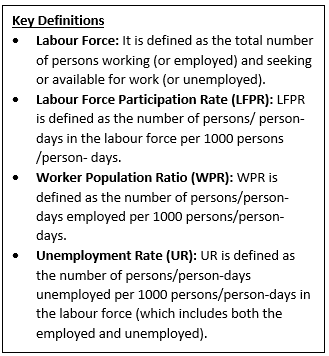
• It serves as the key data source on labour market activity and employment-unemployment trends throughout India.
• The PLFS survey methodology has been modified from January, 2025 to provide monthly and quarterly estimates of labour force indicators for both rural and urban India under the Current Weekly Status framework.
• The report is the third quarterly bulletin under the revamped methodology covering both rural and urban areas.
Key Highlights of the Periodic Labour Force Survey
Labour Force Participation Rate (LFPR)
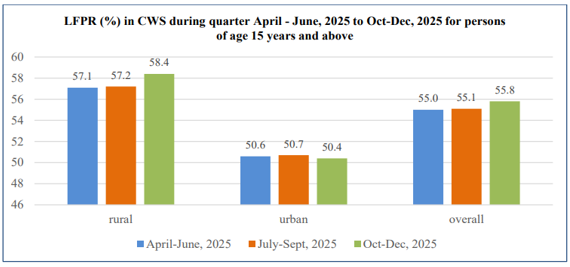
• The overall LFPR for persons aged 15 years and above increased to 55.8% during October–December 2025, compared to 55.1% in the previous quarter (July-September, 2025).
• The rural LFPR increased to 58.4% from 57.2% in the previous quarter.
• The urban LFPR remained broadly stable during the period.
• The overall LFPR of females aged 15 years and above showed an upward trend, increased to 34.9% in October-December, 2025 from 33.7% in the previous quarter.
- It was driven by an increase in female LFPR in rural areas from 37.5% in the quarter July-September, 2025, to 39.4% in October-December, 2025. However, female LFPR in urban areas remained stable.
Worker Population Ratio
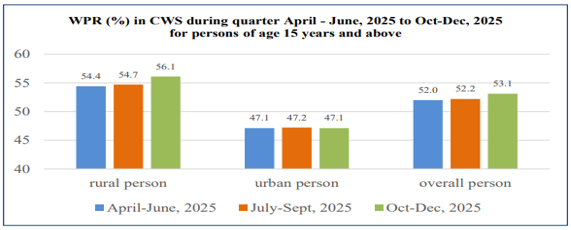
• The overall Worker Population Ratio of age 15 years and above increased to 53.1% from 52.2% in the previous quarter.
• The rural Worker Population Ratio showed a steady upward trend for both males and females.
• The improvement indicates higher absorption of labour, especially in rural areas.
Unemployment Rate
• The overall Unemployment Rate among persons aged 15 years and above declined to 4.8% during October–December 2025.
• The rural Unemployment Rate declined to 4.0%, driven by improvements for both rural males and females.
• The urban Unemployment Rate declined to 6.7%, supported by a reduction in male unemployment.
Distribution of Workers by Employment Status and Industry
• The share of self-employed persons increased particularly in rural areas, where it rose to 63.2%.
• The share of salaried employment declined across rural and urban segments.
• The agriculture sector accounted for 58.5% of rural employment and remained the dominant employer.
• The secondary and tertiary sectors recorded a decline in employment share during the quarter.
• The tertiary sector remained the largest employer in urban areas, engaging 61.9% of workers.
Significance of the Report
• Evidence of Improving Labour-Market Conditions: Rising Labour Force Participation Rate (LFPR) and Worker Population Ratio (WPR) alongside declining Unemployment Rate (UR) indicate better employment absorption, particularly in rural areas and among women.
• Insight into Employment Quality and Structure: The increase in self-employment and continued dominance of agriculture in rural jobs highlight concerns about informality and productivity, underscoring the need for quality job creation beyond subsistence sectors.
• High-Frequency Policy Guidance: The revamped PLFS methodology, providing monthly and quarterly estimates for both rural and urban India, enables timely, evidence-based policymaking in areas such as skilling, rural livelihoods, and labour formalisation.