
SYLLABUS
GS-3: Conservation, environmental pollution and degradation, environmental impact assessment.
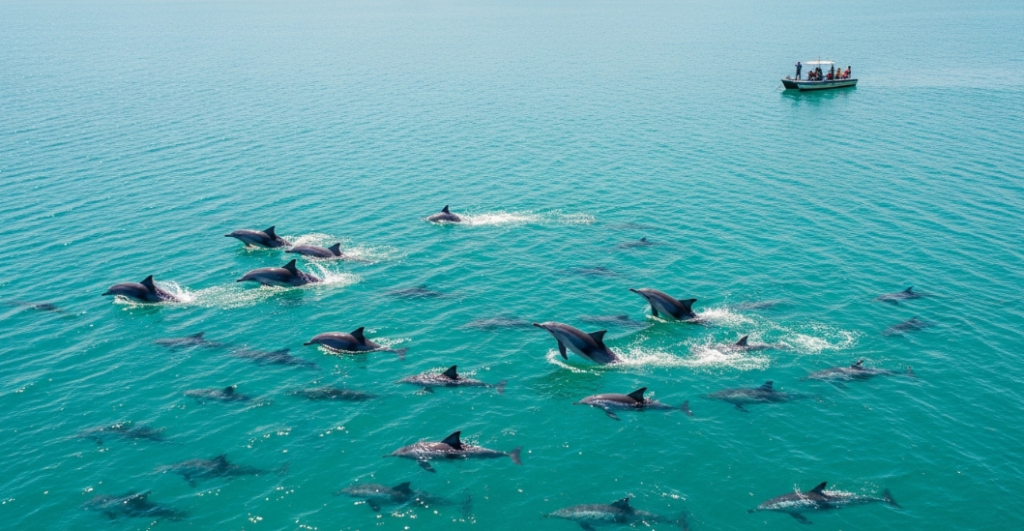
Context: Odisha’s latest marine dolphin census reports 765 dolphins, marking the highest count in five years and reflecting improved conservation outcomes along the state’s coastline.
More on the News
- The Wildlife Wing of the Forest Environment and Climate Change Department conducted the annual state-wide census of dolphin and cetacean estimation on 20 January 2026.
- The census covered Chilika Lake, Rajnagar Mangrove Division, Puri, Bhadrak, Balasore and Berhampur divisions.
- The dolphin estimation exercise was initiated in Chilika in 2008 and expanded to all coastal divisions in 2015, evolving into a coordinated, science‑based monitoring programme.
Key Findings of the Census
- Population Size and Species Composition: The total dolphin population was estimated at 765, showing a broadly stable to improving trend compared with recent years.
- Species-wise distribution: Humpback dolphins – 497 (largest share), Irrawaddy dolphins – 208, Bottlenose dolphins – 55, Spinner dolphins – 3, Finless porpoise – 2.
- Population Trend: The population of dolphins in Odisha was estimated at 544 in 2020-21. Since then, it has shown a generally upward or stable trend.
- There were 726 dolphins in 2021-22, 733 in 2022-23, 743 in 2023-24 and 710 in 2024-25.
- Spatial Distribution:
- Chilika Lake, Asia’s largest brackish-water lagoon and a Ramsar wetland, recorded 159 Irrawaddy dolphins, the highest concentration in a single location globally.
- Gahirmatha Marine Sanctuary in Kendrapara district has emerged as a major stronghold for humpback dolphins with 474 individuals.
- Irrawaddy dolphins are also recorded along the broader coast: Balasore (15), Berhampur (13), Puri (12), Rajnagar/Bhitarkanika mangroves (9), indicating range use beyond Chilika.
Conservation Significance
- Conservation Success: The steady growth trend highlights Odisha’s integrated approach combining scientific monitoring, habitat management and community engagement.
- Policy Value: The findings provide baseline scientific data for marine biodiversity conservation, wetland and coastal management, and policy formulation.
- Biodiversity Indicators: Dolphins act as a flagship and indicator species for marine ecosystem health. Stable or rising populations suggest relative ecological resilience in Odisha’s coastal and lagoon systems.
- Replicable Governance Model: Odisha’s annual, standardised census methodology, including training, inter-divisional coordination, and expert participation, serves as a model for marine wildlife monitoring in India and globally.
About Dolphin
- Dolphins are aquatic marine mammals known for high intelligence, echolocation ability, and complex social behaviour.
- They inhabit oceans, estuaries, and some freshwater systems, with species such as Irrawaddy dolphins adapted to brackish and riverine environments.
- Globally, there are over 90 species of cetaceans, of which around 40 species are dolphins.
- Cetaceans (order Cetacea) are an entirely aquatic order of mammals comprising whales, dolphins, and porpoises.
- Approximately 30 species of coastal and marine dolphins inhabit Indian waters, with 29 being marine and the Irrawaddy dolphin (found in estuaries/lakes).
- Dolphins are protected under Schedule I of the Wildlife (Protection) Act, 1972.
- To conserve the South Asian River dolphin in India, a Conservation Action Plan (CAP) was prepared for a duration of 10 years from 2010 to 2020.
- The Plan was criticized for focusing solely on the Gangetic species. To overcome this, Project Dolphin was launched on August 15, 2020, which expanded the scope to include both riverine and marine dolphins.