
SYLLABUS
GS-1: Modern Indian history from about the middle of the eighteenth century until the present- significant events, personalities, issues.
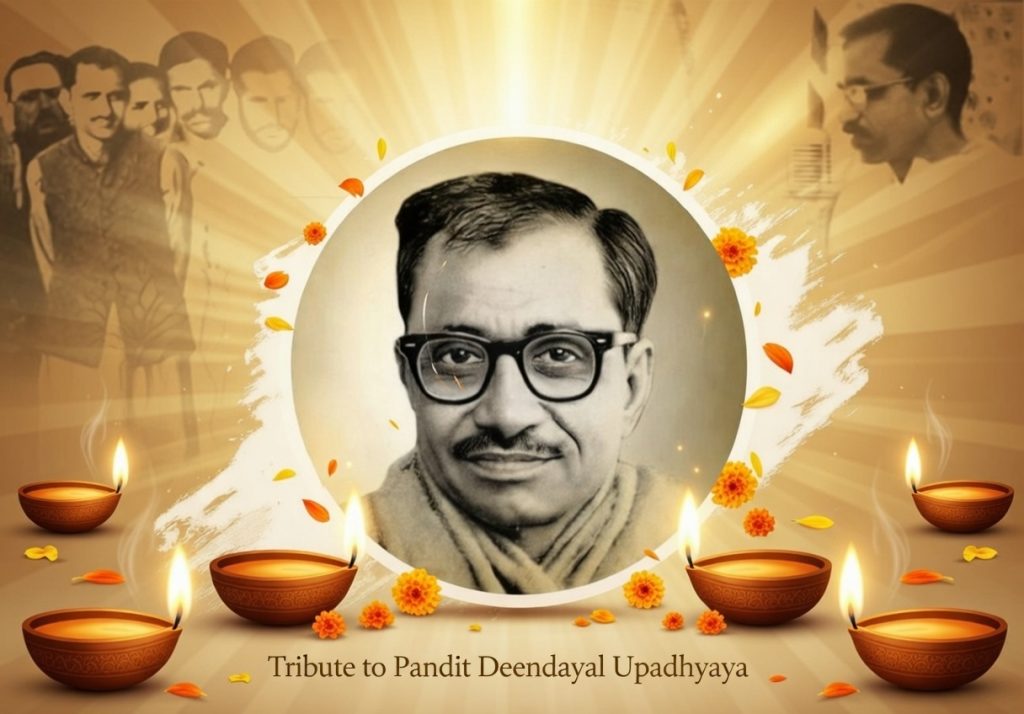
Context: On 11 February 2026, the Prime Minister of India paid tributes to Pandit Deendayal Upadhyay on his death anniversary.
More on the News
- The tribute highlighted his ideological contribution to public life, especially his philosophy of Integral Humanism (Ekatma Manav Darshan) and his emphasis on Antyodaya, upliftment of the last person in society.
About Pandit Deendayal Upadhyay
Birth and Early Life:
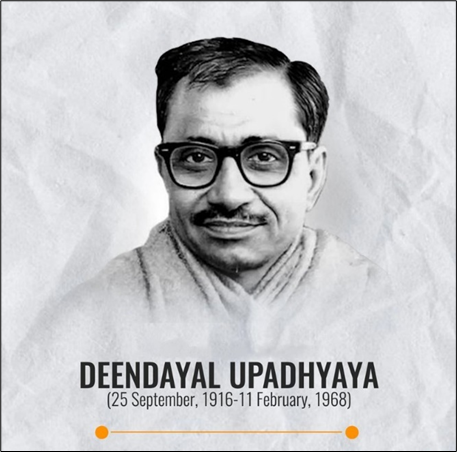
- Born on September 25, 1916, in Nagla Chandrabhan village, Mathura, Uttar Pradesh.
- He lost both his parents at a young age and was brought up by his maternal uncle.
- He excelled academically and received scholarships during his studies.
Association with RSS:
- During his student life at Sanatan Dharma College, Kanpur, he came into contact with the Rashtriya Swayamsevak Sangh (RSS).
- In 1942, he chose to dedicate himself as a full-time pracharak (organiser) of the RSS instead of pursuing a conventional professional career.
Political Career:
- In 1951, when Dr. Syama Prasad Mookerjee founded the Bharatiya Jana Sangh, Deendayal Upadhyaya became the first General Secretary of its Uttar Pradesh unit.
- He later served as the All-India General Secretary, playing a crucial role in building the organisational structure of the party.
- After the death of Dr. Mookerjee in 1953, he led the party’s expansion for nearly fifteen years.
- In December 1967, he was elected President of the Bharatiya Jana Sangh.
- He died under mysterious circumstances on 11 February 1968, near Mughalsarai railway station (now renamed Deendayal Upadhyaya Nagar).
Major Works and Intellectual Contributions
Integral Humanism:
- His core philosophical doctrine, presented in a series of lectures in 1965.
- Proposed an indigenous socio-economic model rooted in Indian culture.
- Rejected both Western capitalism and Marxist socialism.
- Based on the four Purusharthas — Dharma, Artha, Kama, and Moksha — emphasising holistic human development.
Other Writings:
- Political Diary – reflections on contemporary politics.
- The Two Plans – critique of India’s Five-Year Plans.
- Writings on historical personalities such as Samrat Chandragupta and Adi Shankaracharya.
- Associated with publications such as Rashtra Dharma, Panchjanya, and Swadesh for dissemination of nationalist thought.
Philosophical Vision:
- Advocated Antyodaya — welfare of the last person as the measure of governance.
- Emphasised a balance between material progress and spiritual values.
- Supported a decentralised polity, with the village as the basic unit of governance.
- Promoted self-reliance and economic policies aligned with Indian conditions.
Legacy and Contemporary Relevance
- Pandit Deendayal Upadhyaya is regarded as one of the principal ideologues of modern Indian political thought associated with cultural nationalism.
- His philosophy of Integral Humanism continues to influence policy discussions, particularly in debates on inclusive development, decentralisation, and ethical governance.
- His life symbolises dedication to organisational work, ideological clarity, and nation-first politics.
Sources.
E Gyankosh
PM India