
SYLLABUS
GS-2: Bilateral, regional, and global groupings and agreements involving India and/or affecting India’s interests.
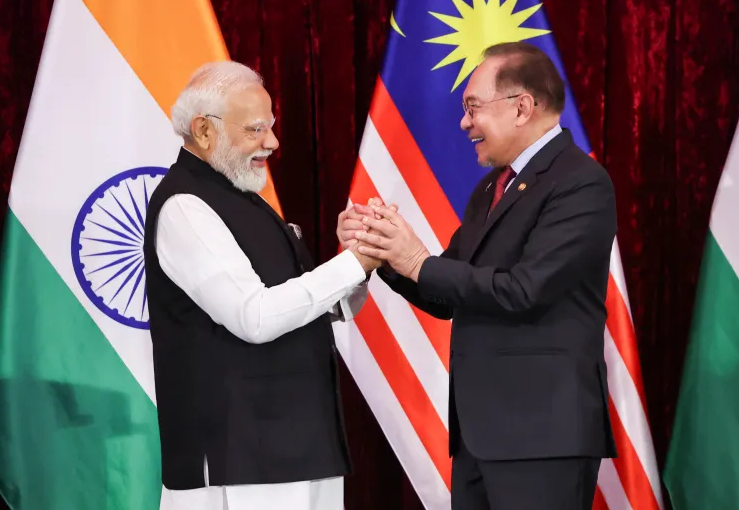
Context: At the invitation of Malaysian Prime Minister Anwar Ibrahim, Prime Minister Narendra Modi undertook an official visit to Malaysia.
More on the News
• The visit reaffirmed the shared commitment of both leaders to consolidate and expand the India–Malaysia Comprehensive Strategic Partnership (CSP), which was elevated in August 2024.
• The leaders witnessed the exchange of 11 agreements/MoUs, aimed at strengthening institutional cooperation across multiple sectors.
• The visit helped reinforce momentum in bilateral ties after some diplomatic unease in 2025 and reaffirmed India’s strong commitment to ASEAN centrality and the Indo-Pacific.
Key Highlights of Visit
• 11 agreements/MoUs signed, covering semiconductors, disaster management, UN peacekeeping, healthcare, national security, vocational education (TVET), social security for Indian workers, counter-corruption, and audio-visual co-production.
• Strong and explicit condemnation of terrorism, including cross-border terrorism, with both leaders stressing “no double standards, no compromise” and pledging cooperation at the UN and FATF.
• Agreement to deepen semiconductor cooperation, building on collaboration between IIT-Madras Global and Malaysia’s Advanced Semiconductor Academy, and industry bodies from both sides.
• Renewed push for local-currency settlement in trade using the Indian Rupee and Malaysian Ringgit, alongside payment linkages between NPCI International Limited and PayNet Malaysia.
• Commitment to expand bilateral trade beyond $18.6 billion, enhance investments, and strengthen supply chains in food, energy, and critical technologies.
• Emphasis on Indo-Pacific peace and stability, freedom of navigation, and dispute resolution in accordance with UNCLOS 1982.
• Support for ASEAN centrality, early completion of the ASEAN–India Trade in Goods Agreement (AITIGA) review, and closer coordination in multilateral forums.
India–Malaysia Bilateral Relations
| Historical Background: | · India established diplomatic relations with the Federation of Malaya (predecessor of Malaysia) in 1957.· Bilateral ties were elevated to a Strategic Partnership in 2010.· Relations were further upgraded to an Enhanced Strategic Partnership during the visit of PM Narendra Modi in 2015.· Under India’s Act East Policy (2014), Malaysia has emerged as a key partner for India’s engagement with ASEAN and the Asia-Pacific. |
| Economic and Commercial Relations: | · Malaysia is India’s third-largest trading partner in ASEAN.· The ASEAN–India Agreements on Trade in Services and Investment came into force in 2015.· A bilateral Comprehensive Economic Cooperation Agreement (CECA) has been in effect since July 2011.· India’s major exports to Malaysia include petroleum products, machinery, chemicals, cereals, electrical equipment, and spices.· India’s major imports from Malaysia include palm oil, petroleum products, machinery, electronics, rubber, and aluminium.· Bilateral trade stood at around USD 19.9 billion in 2024–25. |
| Defence and Security Cooperation: | · Defence cooperation is anchored in the 1993 MoU on Defence Cooperation, amended in 2023.· India and Malaysia conduct regular army, navy, and air force exercises, including Harimau Shakti, Samudra Laksamana, and Udara Shakti.· The Indian Navy and Coast Guard regularly undertake port calls and maritime cooperation with Malaysia.· India inaugurated HAL’s first regional office in Kuala Lumpur in 2023.· Both Leaders appreciated India’s steadfast engagement in the ASEAN Defence Ministers’ Meeting Plus framework and welcomed the co-chairmanship with Malaysia of the Counter-Terrorism Working Group for the 2024-2027 term. |
| Education & Skill Development: | · Both Leaders noted the large number of students in each other’s countries and ongoing cooperation under the Malaysia Technical Cooperation Programme (MTCP) and Indian Technical and Economic Cooperation Programme (ITEC).· Prime Minister Narendra Modi invited Malaysian students to avail opportunities under the ‘Study in India’ Programme. |
| Cooperation in Sustainable Development: | · Both Leaders underscored shared commitment to biodiversity conservation, noting Malaysia’s role as a founding member of the International Big Cat Alliance (IBCA).· Cooperation will continue under the MoU between the National Disaster Management Authorities of both countries.· Leaders acknowledged regional and international initiatives, including the Coalition for Disaster Resilient Infrastructure (CDRI). |
| Indian Diaspora: | · Malaysia hosts approximately 2.75 million PIOs, which is the second-largest PIO community in the world after the US.· Malaysia has the third-largest Indian diaspora in the world (2.9 mn). |
Significance of Malaysia for India
• Strategic Counterweight to China in Southeast Asia: Malaysia occupies a critical geopolitical space amid China’s expanding economic and maritime footprint.
- Stronger ties with Malaysia allow India to balance China’s influence in ASEAN and reinforce a multipolar Indo-Pacific order.
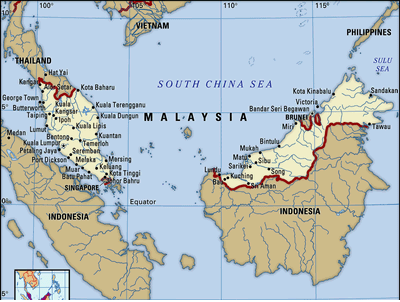
• Maritime & Indo-Pacific Security Anchor: Located astride the Strait of Malacca, Malaysia is vital to freedom of navigation and regional sea-lane security.
- Cooperation with Malaysia advances India’s SAGAR/MAHASAGAR vision, supports UNCLOS, and counters coercive maritime behavior without escalation.
• Pillar of Act East Policy & ASEAN Centrality: As a key ASEAN member, Malaysia strengthens India’s Act East engagement and helps preserve ASEAN Centrality against unilateral, China-centric regional architectures—keeping the Indo-Pacific inclusive and rules-based.
• China-Plus-One Supply Chain Diversification: Malaysia’s strength in electronics and semiconductor back-end manufacturing complements India’s design and fabrication ambitions, enabling resilient, non-China supply chains and reducing exposure to economic coercion.