

SYLLABUS
GS-2: Functions and responsibilities of the Union and the States, issues and challenges pertaining to the federal structure, devolution of powers and finances up to local levels and challenges therein.
Context: Recently, the government of India, the government of Nagaland and the Eastern Nagaland Peoples’ Organisation (ENPO) signed an agreement for the formation of the Frontier Nagaland Territorial Authority (FNTA).
About Agreement
- This arrangement aims to develop Eastern Nagaland by providing financial autonomy and stronger decision-making, leading to faster infrastructure growth, economic empowerment, and better use of resources.
- It provides a “middle path” that addresses the long-standing political, economic, and developmental grievances of Eastern Nagaland without altering the state’s territorial integrity.
About Frontier Nagaland Territorial Authority (FNTA)
• The agreement will pave the way for the creation of the Frontier Nagaland Territorial Authority (FNTA) for six districts of Nagaland, including Tuensang, Mon, Kiphire, Longleng, Noklak and Shamator.
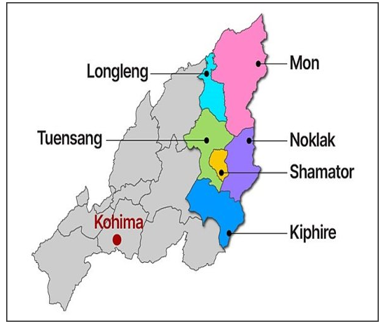
• The authority will have administrative, legislative, and financial autonomy over 46 subjects from the Seventh Schedule’s Concurrent List.
• The agreement provides a mini-Secretariat headed by a senior official (Additional/Principal Secretary) and a proportional share of the state’s development outlay..
• The arrangement does not affect Article 371(A) of the Indian Constitution, which provides special provisions for Nagaland.
- Article 371A of the Constitution, inserted by the 13th Amendment Act, 1962, grants special provisions to Nagaland by protecting Naga customs, religious practices, customary law, administration of justice, and land ownership, with Parliamentary laws applying only after approval by the Nagaland Legislative Assembly.
• The initial expenditure for the establishment of the FNTA will be provided by the Indian Government through the Home Ministry, besides a yearly fund allotment.
• The Memorandum is subject to a formal review after 10 years to assess the authority’s effectiveness and address any remaining contentious matters through democratic processes.
About Eastern Nagaland Peoples’ Organisation (ENPO)
- ENPO is an apex body representing eight recognised Naga tribes of the six eastern districts of Nagaland.
- The 8 Naga tribes are Konyak, Sangtam, Chang, Khiamniungan, Yimkhiung, Tikhir, Phom and Sumi.
- The main focus of the ENPO is to protect and secure its people and ensure statehood for the people of Eastern Nagaland.
- Its central headquarters is in Tuensang, a town in the eastern part of Nagaland.
Significance of FNTA:
- Inclusive federalism: Reflects constitutional flexibility by enabling tailored autonomy within India’s federal framework.
- Peace-building: Helps address long-standing regional concerns, reducing the risk of political radicalisation and separatist pressures.
- Development boost: Facilitates faster infrastructure development, efficient resource use, and focused delivery of welfare schemes.