

Supreme Court’s Declining Confirmation of the Death Penalty in India
Context: An annual report by The Square Circle Clinic at NALSAR University of Law, Hyderabad, shows that the Supreme Court of India has not confirmed any death sentence in the last three years, indicating heightened judicial scrutiny of capital punishment.
More on the News
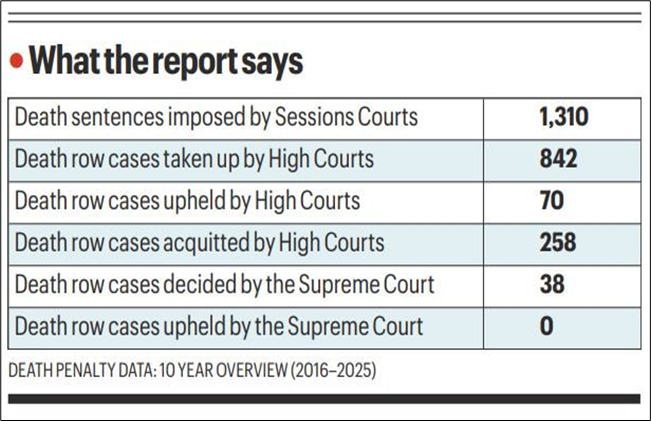
- The report analyses nationwide death penalty data between 2016 and 2025.
- It highlights a widening divergence between trial courts’ sentencing and appellate court review.
Key Findings
- The Supreme Court has not confirmed a single death sentence for the third year in a row (2023-2025).
- In 2025, the Supreme Court acquitted 10 death row prisoners, the highest number in a decade.
- Sessions Courts awarded 1,310 death sentences across India between 2016 and 2025.
- Despite increased caution at higher judicial levels, 128 death sentences were imposed by the sessions Court in 2025 alone.
- High Courts confirmed only 8.31% of death sentences, while acquittals and commutations far outnumbered confirmations.
- Not a single High Court–confirmed death sentence has been upheld by the Supreme Court in recent years.
Capital Punishment
- Capital Punishment is the highest legal penalty in India, reserved for the “rarest of rare” cases.
- Rarest of Rare Doctrine: Established in Bachan Singh v. State of Punjab (1980), requiring the death penalty only when life imprisonment is unquestionably inadequate.
- Legal Framework: The Bharatiya Nyaya Sanhita (BNS), 2024, which replaced the IPC, retains the death penalty and extends it to certain new offences such as mob lynching and organised crime resulting in death.
- Method of Execution: Hanging by the neck; under military laws, shooting is also permitted.
- Current Status: As of 31 December 2025, India had 574 death row prisoners (550 men, 24 women), the highest since 2016.
Motion of Thanks Passed in Lok Sabha
Context: The Lok Sabha adopted the Motion of Thanks to the President’s Address by voice vote amid continued Opposition protests.
More on the News
- President Droupadi Murmu addressed the joint sitting of parliament on 28thJanuary 2026.
- The Motion was passed on 5 February without the Prime Minister’s customary reply due to persistent disruptions.
- The Prime Minister was not present in the House at the time of passage.
- The last such instance of the Motion being passed without a Prime Minister’s reply occurred in June 2004.
- The episode underscores concerns over legislative decorum and parliamentary functioning.
About Motion of Thanks
- The Motion of Thanks is a formal resolution moved in the Indian Parliament to express gratitude to the President for their Special Address.
- The Motion of Thanks is governed by a combination of constitutional mandates and internal parliamentary rules:
- Constitutional Basis: Under Article 87, the President must address a joint sitting of both Houses at the start of the first session after each general election and the first session of every year.
- Article 87(2) mandates that each House of Parliament provide for the discussion of matters referred to in the President’s Address, which is carried out through the Motion of Thanks.
- Rules of Procedure:
- Lok Sabha: Governed by Rules 16 to 24 of the Rules of Procedure and Conduct of Business in Lok Sabha. Rule 17 specifically mandates that the motion be moved and seconded by members selected by the Prime Minister.
- Rajya Sabha: Governed by Rules 14 to 21 of the Rules of Procedure and Conduct of Business in Rajya Sabha.
16th Finance Commission: Revised Forest Criterion in Tax Devolution
Context: Recently, the 16th Finance Commission has revised the forests criterion in horizontal tax devolution by including open forest and assigning differential weights based on forest density.
More in the News
- The change aims to incentivise states to expand and conserve forest cover by linking fiscal rewards to increases in forest area.
- It also addresses the cost disabilities of hilly and ecologically fragile regions, thereby strengthening ecological management and enhancing disaster risk mitigation.
- Another change introduced by the Commission is the explicit inclusion of forest fires as one of the 10 hazards used to determine the updated Disaster Risk Index (DRI).
- DRI is a tool that assesses, measures, and maps the probability of loss of life, injury, or economic destruction from natural hazards like earthquakes, floods, and tropical cyclones.
- The Commission’s considers forest area share and growth between 2015-2023.
- Minimum area floor reduced from 2% to 1.5% per state.
Changes made in Forest Area Calculation
- The 16th FC has also considered open forests in arriving at the total forest area. In contrast, the 15th FC had considered only dense and moderately dense forests, and defined the parameter only in terms of the share in the overall forest area.
- Very Dense Forests (VDF) are identified as areas with a canopy cover of 70 per cent and above.
- Moderately Dense Forests (MDF) are classified as having a canopy density of 40-70 per cent.
- Open forests (OF) are defined as having a canopy density of 10-40 per cent.
- The central government has defined a weighted forest area by assigning a weight of 0.30 to OF, 0.65 to MDF, and 1.0 to VDF.
Significance
- Aligns fiscal transfers with climate action and biodiversity goals.
- Encourages results-based environmental governance.
- Strengthens disaster risk mitigation
Jiyo Parsi scheme
Context: Recently, the Jiyo Parsi scheme has facilitated the birth of over 490 Parsi children and provided ₹35.05 crore in financial assistance.
About Jiyo Parsi Scheme
- It is a Central Sector Scheme launched in 2013–14 by the Ministry of Minority Affairs to arrest the declining population of the Parsi community in India.
- It is a first-of-its-kind demographic intervention that adopts scientific, medical, and social measures to stabilise and gradually increase the Parsi population.
- Objectives
- To address fertility-related challenges within the Parsi community
- To reduce financial burdens associated with childbirth, childcare, and elderly care
- To promote awareness, counselling, and behavioural change related to reproductive health
- To ensure transparent, targeted delivery of benefits through DBT
- Nature of the Scheme
- 100% Central Sector Scheme
- Implemented with the support of State Governments and Parsi institutions.
- Benefits are transferred through Direct Benefit Transfer (DBT) after biometric and official verification.
- Implemented during the 15th Finance Commission cycle (2021–22 to 2025–26).
- The scheme has three components:
- Medical Assistance: Provides financial support to couples facing fertility issues through Assisted Reproductive Technologies (ART).
- Health of Community: Aims to remove economic disincentives associated with raising children and caring for elderly dependents.
- Advocacy & Outreach: Focuses on social and behavioural interventions to support fertility and community health.
About the Parsi Community
- Parsis are followers of Zoroastrianism, which is based on the teachings of the ancient Iranian prophet Zoroaster (also known as Zarathustra).
- The Parsis trace their ancestry to Persian Zoroastrians who migrated to India to escape religious persecution following the Islamic conquest of Persia, with the migration traditionally dated to the 8th century, though some scholars place it as late as the 10th century or in multiple waves.
- Parsis commonly speak Gujarati and English in daily life; Avestan is not a native or spoken language but a liturgical language used exclusively for religious rituals.
- The Avesta is the primary collection of sacred texts of Zoroastrianism, comprising hymns, rituals, and doctrinal teachings.
- Zoroastrians (Parsis), along with Muslims, Christians, Sikhs, Buddhists, and Jains, are notified as minority communities under Section 2(c) of the National Commission for Minorities Act, 1992.
- As per the Census of India 2011, Muslims constitute 14.2%, Christians 2.3%, Sikhs 1.7%, Buddhists 0.7%, Jains 0.4%, and Zoroastrians (Parsis) about 0.006% of India’s population
India-UK MoU on Criminal Records Sharing
Context: Recently, India and the United Kingdom signed an MoU on Criminal Records Sharing (CRS), under the aegis of the Ministry of Home Affairs, to strengthen bilateral cooperation in criminal justice and internal security.
Key Features of the MoU
- Enables real-time exchange of criminal records, fingerprints and law-enforcement intelligence.
- Allows central agencies in India to access verified data on known offenders, serious criminals and sex offenders.
- Aims to improve the speed, accuracy, and effectiveness of cross-border investigations.
Related Developments
- In July 2024, the Central Bureau of Investigation (CBI) signed an MoU with the National Crime Agency (UK) to cooperate on corruption, serious fraud, and organised crime.
- Separately, the Union Cabinet approved the signing of a Mutual Legal Assistance Treaty (MLAT) in criminal matters between India and Nepal, which was signed on 24 December 2025.
Significance
- Strengthens India’s ability to tackle transnational crime, including organised crime and sexual offences.
- Enhances institutionalised law-enforcement cooperation through formal legal frameworks.
- Improves evidence sharing, investigations, and prosecutions across jurisdictions.
- Reflects India’s broader strategy of building robust international security partnerships.
About the Mutual Legal Assistance Treaties (MLATs)
- MLA is a formal mechanism that enables countries to cooperate in criminal investigations and prosecutions, especially when evidence or proceeds of crime are located abroad.
- Such cooperation is generally governed by bilateral treaties or agreements between countries.
- MLATs are increasingly used in cases involving heritage crimes, financial offences, and transnational investigations.
United Nations Commission for Social Development (CSocD)
Context: Recently, India reaffirmed its commitment to inclusive and rights-based social development at the 64th Session of the Commission for Social Development, attended by over 100UN Member States.
About the United Nations Commission for Social Development (CSocD)
- It is a Commission within the United Nations Economic and Social Council (ECOSOC).
- Its main responsibility is to provide advice to the UN on social development issues.
- The Commission plays a vital role in promoting social policies that support the overall development goals of the UN.
- This is particularly in relation to eradicating poverty, advancing social integration, and ensuring full employment and decent work for everyone.
- Development of CsocD
- Since the 1995 World Summit for Social Development in Copenhagen, the Commission for Social Development has been the key UN body responsible for follow-up and implementation of the Copenhagen Declaration and Programme of Action.
- Established by ECOSOC resolution 10 (II) in 1946 and originally known as the Social Commission renamed in 1966.
- It advises ECOSOC on general social policies and on social issues not addressed by specialised intergovernmental agencies.
- Membership: Originally 18, membership has been increased several times, most recently in 1996, and now stands at 46.
- Headquarters: The Commission meets every year at the United Nations Headquarters in New York, usually in February.