
SYLLABUS
GS-3: Conservation, environmental pollution and degradation, environmental impact assessment.
Context: The Union Minister of Environment informed the Parliament that Delhi has utilised only 14% of National Clean Air Programme (NCAP) funds released since 2019.
More on the News
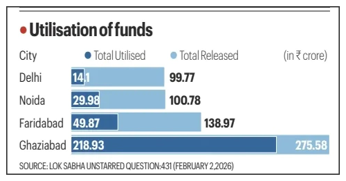
• While Delhi has utilized only Rs 14.1 crore of Rs 99.77 crore (14%), neighbouring cities in the National Capital Region (NCR), such as Ghaziabad and Meerut, have spent more than 80% of their funds.
• The disclosure came a day after the Union Budget 2026–27 allocated Rs 1,091 crore under the “Control of Pollution” scheme of the Ministry of Environment, Forest and Climate Change.
- The budget allocation under this scheme does not represent the entire pollution-related funding in the Delhi National Capital Region.
About the National Clean Air Programme (NCAP)
• The National Clean Air Programme (NCAP) is India’s first long-term, time-bound national framework for air quality management, launched in January 2019.
• It aims to systematically reduce particulate matter (PM) concentrations across targeted cities through coordinated actions between central and state agencies.
• Core Objectives & Targets:
- Initial Target (2019): To achieve a 20–30% reduction in PM10 and PM2.5 concentrations by 2024, using 2017 as the base year.
- Revised Target (2022): The goal was updated to a 40% reduction in PM10 levels by 2025-26 or reaching the national standard of 60 µg/m³.
- Monitoring Network: NCAP emphasises expansion of air-quality monitoring infrastructure, including manual monitoring stations and Continuous Ambient Air Quality Monitoring Stations (CAAQMS) across cities.
- Non-Attainment Cities: Focuses on 131 cities (originally 102) that did not meet the National Ambient Air Quality Standards (NAAQS) for five consecutive years.
About the “Control of Pollution” Scheme
- The “Control of Pollution” scheme, active since 2018 under the Ministry of Environment, Forest & Climate Change, is a central sector initiative aimed at monitoring and mitigating air, water, and noise pollution across India.
- It supports the NCAP and funds State Pollution Control Boards (SPCBs) for technical, monitoring, and research activities.
- For 2025–26, the Budget Estimate for the scheme was Rs 853.9 crore.
- A Parliamentary Standing Committee noted that actual expenditure till January 2025 was only Rs 7.22 crore against a revised estimate of Rs 858 crore for 2024-25.
Other Funding Channels for Air Pollution Control in Delhi NCR
- Pollution control funding also flows through the Commission for Air Quality Management.
- The Commission has been allocated Rs 35.26 crore for 2026–27, mainly for administrative and coordination purposes.
- Additional funds are generated through environmental compensation imposed by courts and tribunals under the polluter pays principle.
- Another distinct funding stream is the Environment Protection Charge (EPC), which applies to diesel cars and sports utility vehicles with an engine capacity of 2000cc and above sold or registered in Delhi NCR.
- Additionally, the Central Pollution Control Board (CPCB) maintains the EPC fund and also utilises it for air quality management in the region.