
SYLLABUS
GS-3: Achievements of Indians in science & technology; indigenisation of technology and developing new technology.
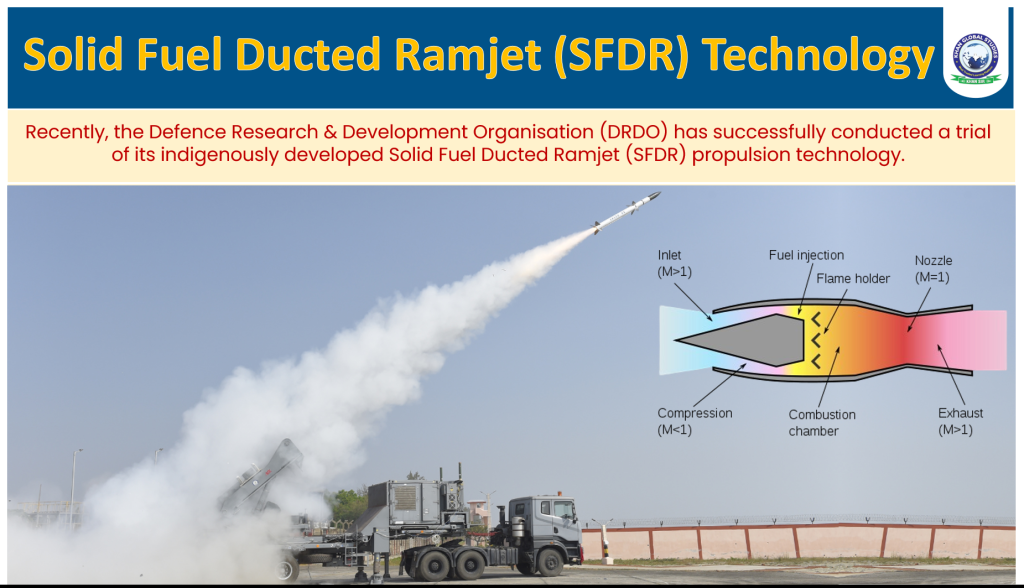
Context: Recently, the Defence Research & Development Organisation (DRDO) has successfully conducted a trial of its indigenously developed Solid Fuel Ducted Ramjet (SFDR) propulsion technology.
More on the News
- This marks a major milestone in India’s effort to develop long-range air-to-air missiles with superior performance.
- The demonstration was conducted at the Integrated Test Range (ITR), Chandipur, nearly four years after the previous test, with earlier trials beginning in 2018.
- The SFDR has been developed by Defence Research and Development Laboratory (DRDL),Hyderabad, in collaboration with other DRDO laboratories.
About Solid Fuel Ducted Ramjet (SFDR) Technology
- It is a next-generation propulsion technology developed for long-range air-to-air missiles.
- It enables fighter aircraft to engage enemy targets beyond visual range (BVR), significantly increasing air combat reach.
- Unlike conventional rocket motors that carry both fuel and oxidiser, SFDR uses solid fuel while drawing oxygen from the atmosphere for combustion.
- This fundamental difference allows the missile to sustain supersonic speeds for a much longer duration during its flight.
- It can also be adapted for surface-to-air missile systems, thereby strengthening India’s overall air defence architecture.
- SFDR-powered missiles offer exceptional operational parameters:
- Engagement range: between 50 km to 340 km
- Speed: Mach 2 to Mach 3.8
- Operational altitude: Sea level up to 20 km
- Vertical manoeuvre capability: Up to 10 km
- This combination of range, speed, and agility makes enemy aircraft significantly harder to evade, providing Indian fighter jets with a decisive aerial combat advantage.
Working of the SFDR Propulsion System
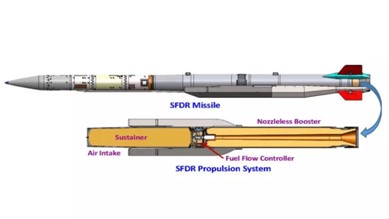
- Nozzle-less booster: The missile is rapidly accelerated to supersonic speeds within about three seconds using a nozzle-less booster, ensuring safe and efficient air-launched ignition.
- Solid fuel ducted ramjet sustainer: After boost, a boron-based solid fuel ramjet ignites, burning onboard fuel with atmospheric oxygen to enable sustained powered flight for 50–200 seconds depending on altitude.
- Hot gas valve: An indigenously developed hot gas valve precisely regulates combustion gases according to speed and altitude using advanced high-temperature materials.
- Air intakes: Cheek-mounted air intakes compress incoming air efficiently to maintain continuous combustion throughout the flight envelope.
- Advanced onboard systems: Integrated guidance, navigation, seekers, secure data links, and high-torque actuators ensure accurate targeting, complemented by a proximity-fused fragmentation warhead for enhanced lethality.
Significance for India
- Indigenous Technological Capability: The successful SFDR demonstration marks a major milestone in India’s indigenous missile development by demonstrating mastery over complex long-range propulsion technologies previously possessed by only a few countries, such as the US, Russia, and France.
- Expansion of the No-Escape Zone (NEZ): By providing sustained thrust instead of losing speed after burnout like conventional missiles, SFDR significantly enlarges the No-Escape Zone, making it nearly impossible for enemy aircraft to evade through speed or manoeuvrability.
- Higher Average Speed: Using atmospheric oxygen for continuous combustion, SFDR-powered missiles maintain high average speeds of Mach 2 to 3.8 throughout flight, ensuring maximum kinetic energy during the terminal phase even at extreme ranges.
- Strategic Autonomy: Indigenous development of SFDR reduces India’s dependence on foreign propulsion systems such as those used in the Meteor missile, reinforcing strategic autonomy under the Aatmanirbhar Bharat initiative in critical air-defence technologies.
- Force Enhancement: As the propulsion core of the Astra Mk-III (Gandiva), SFDR is expected to deliver a range of 190–340 km, providing the Indian Air Force with a decisive “First Look, First Kill” advantage against regional adversaries.
About the Ramjet
- A ramjet is an air-breathing jet engine that produces thrust through subsonic combustion of fuel in air that is compressed naturally by the vehicle’s high forward speed, without using compressors or turbines.
- Since a ramjet cannot generate thrust at low speeds, a ramjet-powered vehicle requires assisted take-off, usually through rocket boost or another propulsion system, to reach the minimum speed needed for operation.
- The engine functions solely on the principle of ram pressure, where incoming air is compressed due to the vehicle’s rapid forward motion.
- Ramjets become effective only at very high velocities, typically in the range of Mach 2.5 to Mach 3.0 and above.