
SYLLABUS
GS-3 Disaster and disaster management.
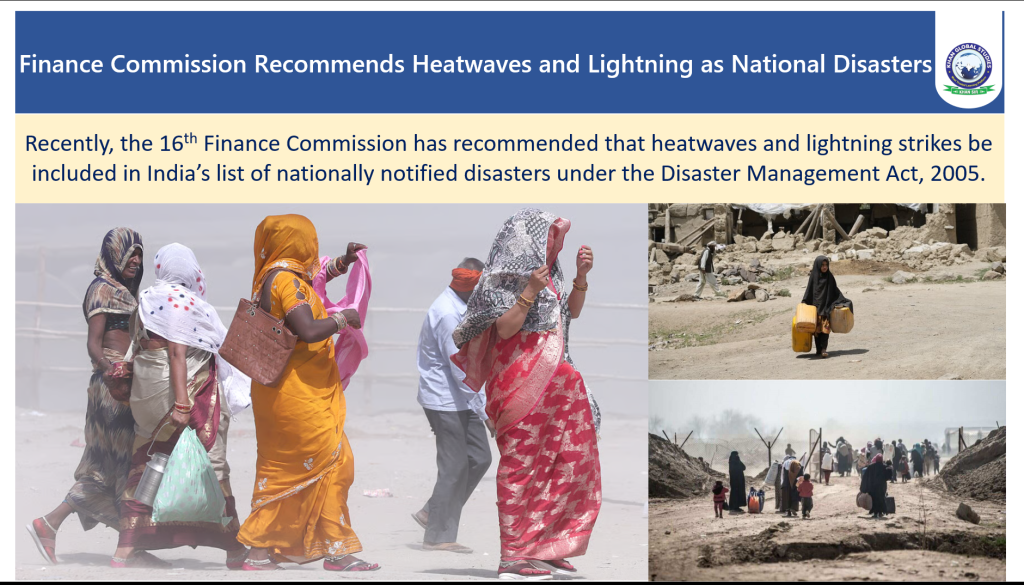
Context: Recently,the 16th Finance Commission has recommended that heatwaves and lightning strikes be included in India’s list of nationally notified disasters under the Disaster Management Act, 2005.
More on the News
- The move will enable the states to use their State Disaster Response Fund (SDRF) to the full extent for providing relief and assistance to people affected by heatwaves and lightning.
- SDRF, constituted under Section 48 (1)(a) DMA 2005, is the primary fund available to State Governments for immediate relief during notified disasters (cyclone, flood, earthquake, etc.).
- Apart from SDRF, the State Disaster Mitigation Fund (SDMF) has also been established exclusively for mitigation projects, following the 15th Finance Commission (FC) recommendations.
- The recommendation comes after a long-pending demand of the state governments, considering that both heatwaves and lightning have become frequent events with large-scale impacts.
- Earlier, the 15th Finance Commission had also considered this issue, but it was rejected by concluding that the existing list of notified disasters covers the needs of the States to a large extent.
Notified Disasters & Use of SDRF
- Presently, 12 disasters have been notified by the Union government. These include – cyclone, drought, earthquake, fire, flood, tsunami, hailstorm, landslides, avalanches, cloudburst, pest attack, and frost and cold waves.
- For these notified disasters, States have the freedom to use the money in the SDRF to the full extent.
- In addition, they have the flexibility of utilising up to 10% of the fund for some other ‘state-specific’ disasters, if notified by them.
- Presently, 11 states have notified heatwave and 16 states have notified lightning as “state-specific disaster”.
Need for Inclusion
- Heatwaves:
- A heatwave is an extreme air temperature harmful to humans, defined by thresholds, heat index, or temperature deviations.
- According to the IMD, a heatwave is declared when the maximum temperature reaches ≥40 °C in plains or ≥30 °C in hilly regions, along with specified departure-from-normal or absolute temperature thresholds.
- If the above criteria are met in at least two stations of a meteorological subdivision for two consecutive days, then a heatwave is formally declared on the second day.
- States are increasingly pushing to recognise heatwaves as national disasters. Between 2018 and 2022, 3,798 deaths due to heat or heatwaves were recorded in India (NCRB and Union Home Ministry data).
- Lightning:
- Lightning is a high-voltage atmospheric discharge between clouds or cloud and ground, that heats air to 50,000°F, causing rapid expansion and thunder.
- Lightning strikes have surged, with a 34% increase in 2020-21, totalling 18.5 million strikes, 4.7 million more than the previous year (Annual Lightning Report 2020-21).
16th Finance Commission Recommendation
- The 16th FC, chaired by Arvind Panagariya, is responsible for recommending the tax-sharing formula and disaster management grants for the period starting April 2026.
- A total of Rs 2.04 lakh crore (up from 1.6 lakh crore allocated by the 15th FC) has been allocated to states for the State Disaster Response Fund (SDRF) and the State Disaster Mitigation Fund (SDMF) for the five-year period from 2026-27 to 2030-31.
- The allocation will be divided with 80 per cent assigned to the State Disaster Response Fund (SDRF) and 20 per cent to the State Disaster Mitigation Fund (SDMF).
- The 16th FC has retained the 75:25 financing formula (90:10 for North-East/Hill states) for funding both SDRF and SDMF.
About the Finance Commission
- Article 280 of the Constitution of India provides for a Finance Commission as a constitutional body.
- It is constituted by the president of India every fifth year or at such earlier time as he considers necessary.
- The First Finance Commission was constituted vide Presidential Order under the chairmanship of Shri K.C. Neogy on 6th April 1952.
- It consists of a chairman and four other members to be appointed by the president.
- The Chairman of the Commission shall be selected from among persons who have had experience in public affairs.
- The four other members shall be selected from among persons who have experience as a High Court Judge, knowledge of government finances, extensive financial or administrative experience, or expertise in economics.
- Members serve for a term specified by the President and can be reappointed. They can resign by writing to the President.