
SYLLABUS
GS-2: Issues relating to development and management of Social Sector/Services relating to Health.
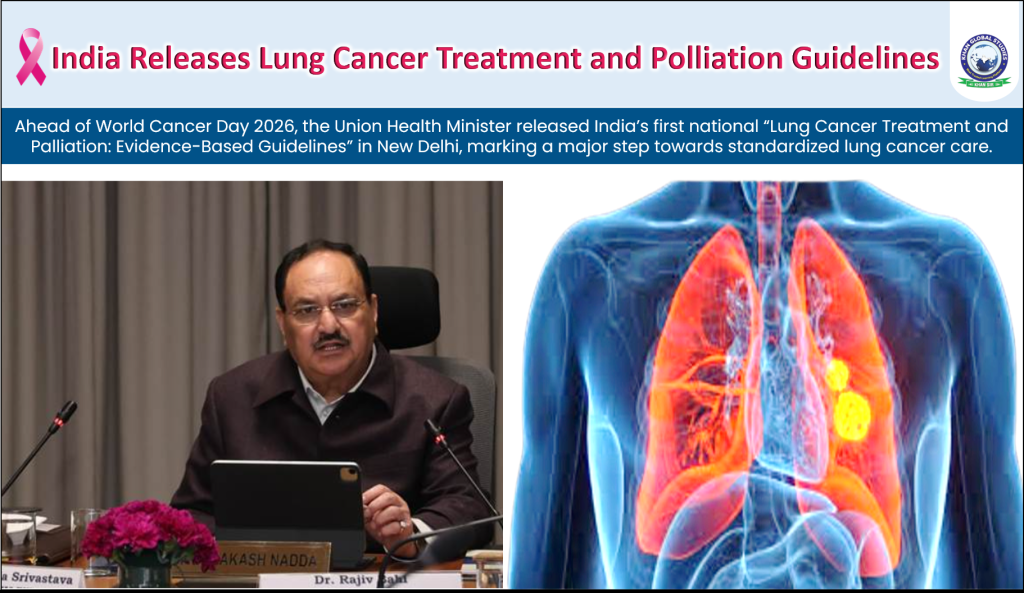
Context: Ahead of World Cancer Day 2026, the Union Health Minister released India’s first national “Lung Cancer Treatment and Palliation: Evidence-Based Guidelines” in New Delhi, marking a major step towards standardized lung cancer care.
About the Guidelines
- Developed by national oncology experts under the Department of Health Research (DHR) and the Directorate General of Health Services (DGHS).
- The guidelines aim to provide a standardized, evidence-based framework for the diagnosis, treatment, and palliative care.
- Designed to ensure high-quality, accessible, and patient-centric care.
Key Features of the Guidelines
- The Guidelines comprise 15 evidence-based recommendations addressing both treatment and palliative care for lung cancer.
- The recommendations are based on systematic evidence synthesis and adapted to Indian healthcare realities.
- The guidelines aim to reduce variations in clinical practices across public and private healthcare systems.
- The guidelines have been made publicly accessible through the Department of Health Research website, enhancing transparency and adoption.
Summary of 15 Evidence-Based Recommendations
- Prehabilitation is recommended for patients planned to undergo lung cancer surgery.
- Mediastinal lymph node dissection is recommended over mediastinal lymph node sampling in operable lung cancer.
- Radical local treatment of both primary and metastatic sites is recommended over systemic therapy alone in patients with oligometastatic disease.
- Prophylactic Cranial Irradiation (PCI) is recommended over no PCI for patients with small-cell lung cancer.
- Either early or late integration of thoracic radiotherapy with chemotherapy is recommended for patients with limited-stage small cell lung cancer.
- Routine use of postoperative radiotherapy is not recommended following complete surgical resection.
- Stereotactic Body Radiation Therapy (SBRT) is not recommended over lobectomy or segmentectomy, except in selected patients who are medically unfit or unwilling to undergo surgery.
- Adjuvant tyrosine kinase inhibitor (TKI) therapy is recommended over chemotherapy alone in eligible patients.
- Second- and third-generation tyrosine kinase inhibitors are recommended over first-generation TKIs in appropriate clinical settings.
- Immunotherapy, either alone or in combination with other agents, is recommended over chemotherapy alone in suitable patients.
- Either neoadjuvant therapy followed by surgery or upfront surgery followed by adjuvant therapy is recommended, based on clinical judgment and patient factors.
- Lower-dose pembrolizumab (100 mg) may be considered on an individualized basis when standard dosing is not feasible.
- Early integration of palliative care with standard oncological care is recommended as compared to standard oncological care alone for patients with lung cancer.
- Multi-modal treatment is recommended as compared to drug therapy alone for the treatment of dyspnoea in patients with advanced lung cancer.
- A multimodal approach of treatment is recommended over Psychotherapeutic Care alone for patients with lung cancer.
Significance for India’s Healthcare System
- The guidelines strengthen early diagnosis and promote uniform treatment pathways for lung cancer patients.
- The emphasis on palliative care supports holistic and patient-centric management, especially for advanced-stage cases.
- The framework enhances credibility, consistency, and evidence-based clinical decision-making.
- The initiative reflects India’s shift towards indigenous, context-specific healthcare solutions rather than blind replication of global models.