

SYLLABUS
GS-3: Indian Economy and issues relating to planning, mobilization, of resources, growth, development and employment.
Context: The Union Finance Minister, in the Union Budget 2026-27, proposed the establishment of dedicated rare earth corridors in Odisha, Kerala, Andhra Pradesh, and Tamil Nadu.
More on the News
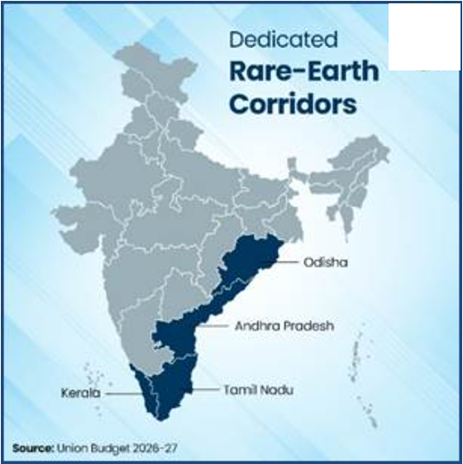
- The corridors aim to promote mining, processing, research and manufacturing of Rare Earth Permanent Magnets (REPMs) in mineral-rich coastal states.
- The announcement builds on the recently launched Rare Earth Permanent Magnet Manufacturing Scheme.
- These initiatives align with the national priorities of Atmanirbhar Bharat, Net Zero 2070, and Viksit Bharat @2047, while positioning India as a key player in global advanced-materials value chains.
Key Highlights of the Initiative
- About: Rare Earth Corridors are integrated industrial and logistics ecosystems designed to connect the entire rare earth value chain from mining to the manufacturing of high-value finished products within a specific geographic region.
- Target States: The corridors will be developed in four mineral-rich coastal states: Odisha, Kerala, Andhra Pradesh, and Tamil Nadu.
- Beach Sand Minerals are the primary source of rare earths in India and contain monazite with uranium and thorium.
- India holds 13.15 million tonnes of monazite, containing an estimated 7.23 million tonnes of rare-earth oxides (REO).
- Integrated Ecosystem: Unlike traditional transport routes, these corridors function as coordinated industrial zones integrating mining, processing, research, and manufacturing.
- Strategic Objective: The primary goal is to reduce strategic dependence on imports of rare-earth permanent magnets (REPMs), particularly from China, which dominates global rare earth processing and to secure supply chains for the electric vehicle (EV), semiconductor, defence, and renewable energy sectors.
Rare Earth Permanent Magnet (REPM) Scheme
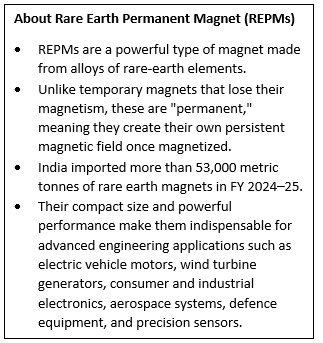
- The Government of India approved the “Scheme to Promote Manufacturing of Sintered Rare Earth Permanent Magnets (REPM)” in November 2025 to establish a domestic integrated ecosystem for high-performance magnets.
- It aims to support 6,000 metric tonnes per annum of integrated magnet manufacturing capacity.
- Five beneficiaries will be selected through competitive bidding with up to 1,200 Metric Tonnes Per Annum (MTPA) each.
- Sales-linked incentives of Rs 6,450 crore and capital subsidy of Rs 750 crore will be provided.
Significance of the Initiatives
- Import Substitution (Atmanirbhar Bharat): By reducing dependence on imports, where 60–80% of the value and 85–90% of the quantity of permanent magnets were sourced from China between 2022–25, India aims to strengthen its domestic capability and secure critical supply chains.
- Clean Energy Transition: Rare earth magnets are essential for electric vehicle motors and wind turbine generators, both central to India’s renewable energy expansion and its Net Zero 2070 vision. The corridors announced in the Union Budget will ensure that mineral-rich states directly contribute to this transition.
- National Security and Defence: Rare earth magnets are vital for aerospace systems, defence equipment, and precision sensors. Domestic corridors and manufacturing capacity ensure secure access for strategic applications, reducing vulnerability to global supply chain disruptions.
- Policy and Institutional Reforms: These initiatives complement reforms under the Mines and Minerals (Development and Regulation) Act (MMDR Act, amended in 2023), which introduced a dedicated list of critical minerals and opened exploration and mining to private participation.
Source:
PIB
Indian Express
First Post