
SYLLABUS
GS-3: Conservation, environmental pollution and degradation, environmental impact assessment.
Context: In the Union Budget 2026-27, the Union Finance Minister announced a ₹20,000 crore outlay over the next five years through a dedicated scheme for Carbon Capture, Storage and Utilisation (CCUS).
More on the News
- The scheme aims to scale CCUS technologies from pilot/demonstration projects to commercial deployment.
- It will support decarbonisation efforts in five emission-intensive “hard-to-abate” sectors, namely power, steel, cement, refineries and chemicals.
- Earlier, an expert committee of the Department of Science and Technology (DST) had submitted a report in December 2025 outlining the strategic, technological, and regulatory roadmap for CCUS in India to help achieve the goal of net-zero by 2070.
About Carbon Capture, Utilisation and Storage (CCUS)
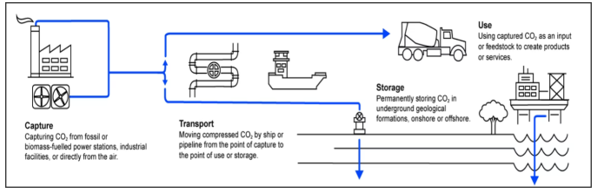
- CCUS involves the capture of CO2, generally from large point sources like power generation or industrial facilities that use either fossil fuels or biomass as fuel.
- If not being used on-site, the captured CO2 is compressed and transported by pipeline, ship, rail or truck to be used in a range of applications, or injected into deep geological formations such as depleted oil and gas reservoirs or saline aquifers.
- The objective is to prevent carbon dioxide from entering the atmosphere and contributing to global warming.
Role of CCUS in Climate Strategy
- CCUS is viewed as a supplementary tool for decarbonisation rather than a replacement for renewables.
- CCUS plays a critical role in abating residual emissions from hard-to-abate sectors and supports the production of low-carbon hydrogen (blue hydrogen) and other synthetic fuels.
- Recent global climate conferences like COP26 and COP28 have recognised the potential role of CCUS, while simultaneously warning against fossil-fuel lock-in, emphasising that CCUS must not delay the transition to clean energy.
Significance of CCUS for India
- Enabling Net-Zero and Industrial Decarbonisation: CCUS is crucial for decarbonising hard-to-abate sectors such as steel, cement, power, refineries and chemicals, where emissions are process-linked. It directly supports India’s commitment to achieve net-zero emissions by 2070, especially where renewables alone are insufficient.
- When combined with biomass (BECCS) or direct air capture (DAC), it can actively remove CO2 from the atmosphere, creating negative emissions.
- Strategic Autonomy and Indigenous Capability: By encouraging domestic R&D and deployment, CCUS reduces reliance on imported low-carbon technologies, strengthens India’s clean-tech ecosystem, and aligns with Atmanirbhar Bharat in advanced climate technologies.
- Circular Carbon Economy: CCUS enables reuse of captured CO₂ into synthetic fuels, fertilisers, construction materials and industrial gases, converting emissions into economic value.
- Trade Competitiveness: CCUS also becomes significant in light of measures by the European Union to impose indirect tariffs on imports (CBAM) from countries that use higher carbon than its domestic manufacturers to forge iron and steel products.
CCUS Pilot Projects in India
- NTPC began carbon capture at Vindhyachal Thermal Power Station, capturing about 20 tonnes of CO₂ per day.
- The captured carbon dioxide is used with green hydrogen to produce methanol.
- NTPC also started India’s first geological CO₂ storage borewell in Jharkhand in 2025.
- ONGC launched its first CCS pilot at the Gandhar oilfield in Gujarat, injecting CO₂ into depleted wells.
- Tata Steel and JSW Steel have commissioned CCUS pilot plants in Jamshedpur and Dolvi, respectively.