
SYLLABUS
GS-1: Distribution of key natural resources across the world (including South Asia and the Indian sub-continent); factors responsible for the location of primary, secondary, and tertiary sector industries in various parts of the world (including India).
Context: Recently, the Government of India has notified Coking Coal as a Critical and Strategic Mineral under the Mines and Minerals (Development and Regulation) Act, 1957 (MMDR Act), with the objective of reducing import dependence and strengthening the domestic steel supply chain.
More on the News
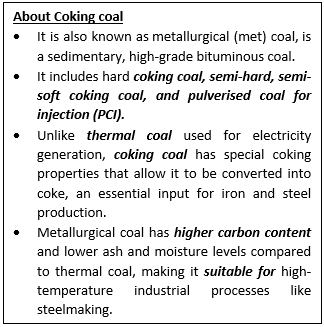
• The decision was taken based on the recommendations of the High-Level Committee on the implementation of Viksit Bharat goals and policy inputs from NITI Aayog, recognising the strategic importance of coking coal for mineral security and the steel sector.
• The First Schedule of the MMDR Act has been amended:
- In Part A, the term “Coal” now reads “Coal, including Coking Coal”.
- Coking Coal has been included in Part D, which lists Critical and Strategic Minerals.
Significance of the Move
- India possesses around 37.37 billion tonnes of coking coal resources, yet nearly 95% of steel sector requirement is met through imports.
- Imports increased from 51.20 million tonnes in 2020–21 to 57.58 million tonnes in 2024–25, resulting in substantial foreign exchange outgo.
- The new classification is expected to enable faster approvals and improve ease of doing business in exploration and mining, including deep-seated deposits.
- Mining of critical minerals is exempt from public consultation requirements and permits the use of degraded forest land for compensatory afforestation, encouraging private participation.
- The reform is expected to attract private investment in exploration, beneficiation, and advanced mining technologies, while strengthen supply chain resilience for the steel sector and support the objectives of the National Steel Policy.
- As per Section 11D(3) of the MMDR Act, royalty, auction premium, and other statutory payments from mining leases will continue to accrue to the respective State Governments.
About Critical Minerals
- Critical minerals are minerals that are essential for a nation’s economic development, technological advancement, and national security, but whose supply chains are vulnerable to disruption.
- The term “Criticality” refers to a combination of high economic importance and high risk of supply disruption, due to factors such as import dependence, geopolitical concentration, or limited domestic availability.
- India’s Critical Minerals List (2023): In 2023, the Ministry of Mines released India’s first official list of 30 critical minerals, identified based on strategic relevance and supply risk.
India’s Notified Critical Minerals (2023)
- Antimony, Beryllium, Bismuth, Cadmium, Cobalt, Copper, Gallium, Germanium, Graphite, Hafnium, Indium, Lithium, Molybdenum, Niobium, Nickel, Phosphorous, Potash, Rhenium, Selenium, Silicon, Strontium, Tantalum, Tellurium, Tin, Titanium, Tungsten, Vanadium, Zirconium, Platinum Group Elements (PGE) and Rare Earth Elements (REE).
- Platinum Group Elements (PGE): Platinum (Pt), Palladium (Pd), Rhodium (Rh), Ruthenium (Ru), Osmium (Os) and Iridium (Ir).
- Rare Earth Elements (REE): A group of 17 elements—Lanthanum, Cerium, Praseodymium, Neodymium, Promethium, Samarium, Europium, Gadolinium, Terbium, Dysprosium, Holmium, Erbium, Thulium, Ytterbium, Lutetium, Scandium and Yttrium.
- Applications: Critical minerals are indispensable for advanced and emerging technologies, including electric vehicles, renewable energy systems (solar panels and wind turbines), electronics (mobile phones, semiconductors, fibre-optic cables), as well as defence, aerospace, and medical technologies.
Strategic Minerals
- Strategic minerals are raw materials essential for a country’s national security, economic stability, and technological sovereignty, particularly where supply disruptions could have serious strategic consequences.
- Legal Recognition (2023): The Mines and Minerals (Development and Regulation) Amendment Act, 2023 formally introduced Part D of the First Schedule, titled “Critical and Strategic Minerals”, providing a statutory basis for prioritised exploration, regulation, and policy support.
- Relationship with Critical Minerals: While often used interchangeably, strategic minerals emphasise defence and security importance, whereas critical minerals focus more broadly on economic and technological vulnerability, with significant overlap between the two.
Source
PIB
Economictimes